The American Alliance of Museums is launching new affinity communities in 2026! Organized around shared museum professional roles and identities, these new groups will help busy museum workers find their people, share their expertise, and level up their leadership skills.
Watch the AAM Communities Team for a Town Hall to learn about this new initiative, ways to get involved, and how to engage with these communities both at Annual Meeting and year-round.
Transcript
Grace Stewart:
Hello. Welcome. We’ll give everyone a few minutes to get into the room, and then we will get started with this town hall.
I see folks are already doing but if you are here, please go ahead and say hello in the chat. Share your name, where you’re from, anything else you want folks to know. We’re so excited that you’re here with us today.
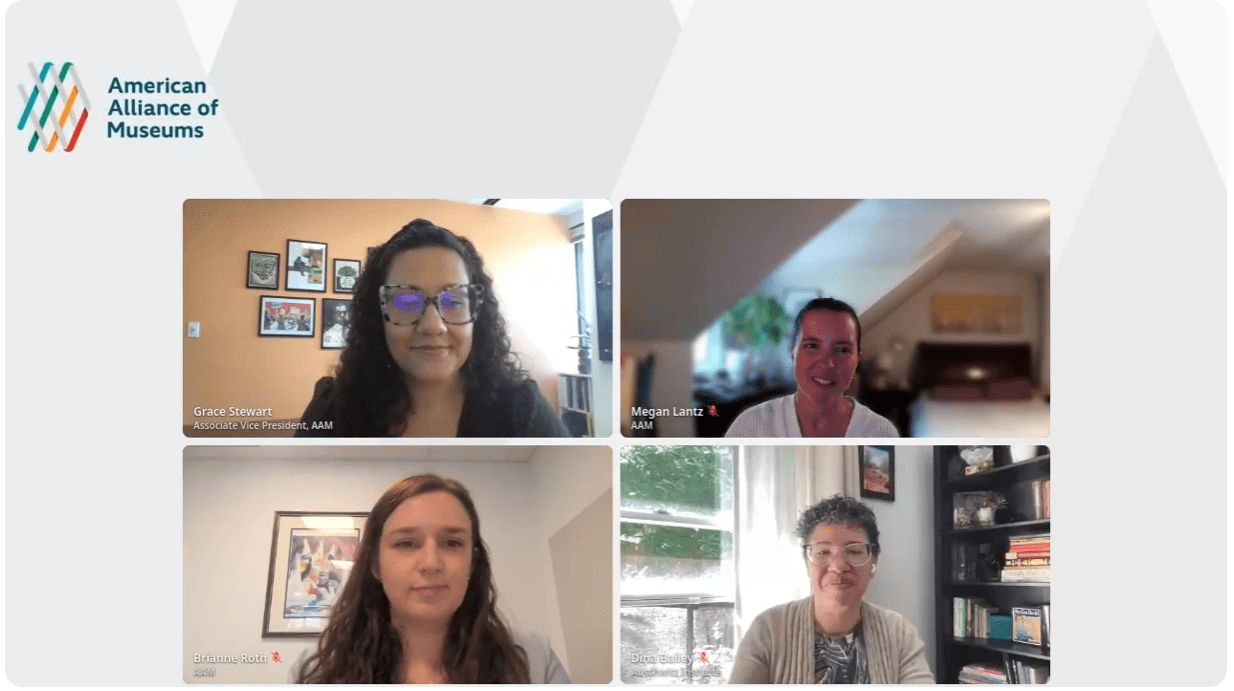
And we’ll get started here in just a moment. Alright. So I see a lot of people have joined us, so we’re gonna go ahead and get started and welcome folks as they continue to join. So welcome, everyone. My name is Grace Stewart. I am the AVP of Museum Practice Management and Coalition Building here at the American Alliance of Museums, and it’s so great to welcome you to this affinity community town hall where we are very excited to be launching our new Affinity Communities initiative and to be answering questions and sharing feedback, and telling you all about this new So I will I will go ahead and have, Brianne’s gonna share slides.
Lovely. Thank you, Brianne.
And
marketing started; I wanted to first introduce our communities team. So we have a new team that is managing our communities, and this is our connection and belonging team. This team has been in place at AAM for just about nine months, so it’s a new team. All members have been part of AAM for a while, but this is a new configuration. Because we knew it was important to make sure that we had staff that were prepared to manage this part of our initiative.
And so, as I said, my name is Grace Stewart. I’m the AVP of coalition building and practice management here at AM. I’ve been here for
almost seven years now. So I’m very excited to be joining you today. And I am joined by my fabulous colleagues, Megan and Brianne, who I’m going to invite to come off mute and introduce themselves.
Megan Lantz:
Hi, everyone. Thanks so much, Grace.
Wonderful to be with you all, and it’s really exciting to see some familiar names and friends in the chat.
I’m Megan Lance, and I am the director of belonging and connection at the Alliance. And I’ve been here for about almost eleven years, in different roles at AAM.
I’m just so excited to get to be with you all to talk about our community’s work today.
And I’ll pass to Brienne.
Grace Stewart
Yes.
Dina Bailey:
Thank you so much, Grace. I love it. As Grace said, my name is Dina Bailey. I am the founder and CEO of Mountain Top Vision. And for those of you who are already in the chat, I am based out of Atlanta, Georgia. I am the community and culture board committee chair, and this is my second term of being on AAM’s board. So I am very excited to make this part of my intensive work that I do with AAM, and I am joined by, as you see up on the screen, Allison, Patsy, and Jessica. So Allison is at the Science Museum of Minnesota. Patsy is at IAAIA Museum of Contemporary Native Arts. And Jessica is at the Griffin Museum of Science and Industry. So very excited to have them as part of the committee. Hopefully, y’all can reach out to them. I am also pretty aware, I think, that some of those committee members are also here. So if you’d like to make a shout-out in the chat, please do. And then, if there are other board members, we would love you to name yourselves in the chat as well, just so everyone can see you here and being supportive.
So excited, and really happy to be a part of this conversation. I’m going to pass it back to the team. Thanks so much.
Grace Stewart:
Thank you, Dina.
So before we get into the details and logistics of how we’ve gotten to this point, I wanted to just share some high-level thinking about how AM got here. One of the things that has been so important as been listening to the field and to our members and reenvisioning what the structure could look like. We wanted to make sure that we were leading with our values and really making sure that it was something that we were building a structure that supporting a healthy ecosystem. And so AAM has, in the past, really been positioned as a default leader. And as we’re growing, we’re really trying to shift the way that we think about ourselves and be really equitable partners inside a healthy ecosystem, and recognizing that that means that we need success from all corners of our communities. And so, as we’re really thinking about this new stance for AM, we wanted to be building this new initiative with that in mind.
So we’re really thinking about how do we connect across the field, whether that’s through AAM or whether that’s through our allies and partners in other organizations, with that goal really being we want a deep relational connection, and we wanted to move away from a transactional relationship that we know has sometimes happened in the past. So we’ve really spent a lot of time thinking about what went well from our previous professional network system, where the pain points were, and what we could shift to better meet the needs of our field and how that system how the systems and structures could really support that and really support a relational goal. So a lot of that was taken into consideration. And as I said, we’ve had the support of our CEO, of our board, of our full staff. And so it’s been a really exciting time for those of us at AAM who are deeply invested in this work to have that deep support. And so I wanna now turn it over to Megan and Brianne, who are going to get into some of the details about this new structure that we have put together for this pilot. I also want to iterate that this is a pilot program.
We know that this is complex and difficult work. We are starting, small-ish, knowing that there’s lots more communities that are needed, but we wanted to take this initial step so that we could try some things out, evaluate, iterate, and make changes. We know we’re not gonna get everything right the first time. We know that needs evolve and shift, and so we wanted to make sure we were committed co-creating together. And so while we have an initial structure to test out in this pilot year, we will still be making changes in iterating so that we are serving the field as best we can.
And with that, I’m gonna turn it over to Megan.
Megan Lantz:
Thank you, Grace. And hi, everyone. I’m just so excited to see some of the folks that are showing up in chat.
Some of the people who are on this journey with us as co-leads and other friends from the broader museum world.
It’s just great to be together.
So, yes, as Grace mentioned, we did extensive research onto into best practices for speaking with peer organizations and other folks who have affinity communities and groups. Like the ones that we are launching. And during the listening session, and data gathering, we have the opportunity to conduct something like 60 plus one-on-one interviews with folks from the field, both within AAM’s membership and not in AAM’s membership. Folks who had been previously engaged with our network, board members, folks, at peer organizations and other museum associations, Just a broad sampling of people from different institutions across the country from a to z or a to z as we like to say at AM, art museum folks to zoo folks, and from all of those conversations, the listening sessions, a national survey, and the interviews, some themes really emerged. And Brianne, I’ll, yes. Perfect.
So the question that we had at top of mind as we were speaking with folks and gathering data was how can we best meet your community needs as museum people? We know that there is a vast universe of individuals working in the field, and we also know that there are some folks who might be in institutions who are very geographically isolated, or they’re in smaller museums where they really are having a hard time finding people with similar challenges, that they can connect with.
And so unsurprisingly, there were three main themes that we identified in the data and that we seek to advance as we move forward with our new model. First and foremost, far and away, the loudest need that we heard from the field is that people are really in need of spaces to find belonging and care. And this could include things like networking for professional purposes, but also just finding spaces where AAM can do a better job helping to facilitate new relationships. So, that is one of the biggest priorities we have as we look to this new affinity communities model. Really helping museum professionals find their community and expand their network. The number two need that emerged that folks are looking for opportunities to share their expertise. And this also would include opportunities to learn from one another. So in our previous model under the professional networks, it was really fantastic and valuable for the broader field. To have spaces and places where folks could go to receive information from subject matter experts who are really at the forefront of the field, whether it be in museum education, collections, folks who share a different share a particular identity, etcetera. And so we’re really excited to be launching affinity communities as once again a space where folks will have the opportunity to share what they know with the support of AAM. Our learning team and our communications team to really promote those events and programming, which we’ll talk about a little more in detail later in this presentation.
And then finally, folks really want to find opportunities where they can impact the field and give back through mentoring others, contributing to commute communities and leading groups, and even leading, serving as co-leads. So one of the wonderful benefits of our previous communities model is that it really offered people the opportunity to cultivate and level up their leadership skills. And we recognize that that is a gap that has been sorely missed. And so, as we move forward with our new model, we really look for ways that we can advance folks career and their visibility through giving back to the field by helping us launch and lead these groups.
Next slide, please.
And so as we were having conversations and analyzing data, we really sought to identify groups of museum professionals that were most in need of community right now. As Grace mentioned, this is a pilot, so we wanted to intentionally start small, and we wanted to originally have a slate of about five to eight groups just to start this year. With the intention and anticipation that we would expand possibly to more groups in 2027 and beyond.
But the groups that emerged as, most popular and most requested were the ones that you see on this slide.
An affinity community for BIPOC museum professionals, museum educators, for those who work in ethnically and culturally specific museums, for exhibitions museum professionals, folks who identify as LGBTQ plus folks who are in the mid-career, middle, and really wanting to have support at that particular career stage.
Individuals who work in small museums, and finally, those who work in visitor services and visitor experience.
And so with that in mind, we got down to work thinking about a structure that would best put pull forward our goals as identified by the data that we gathered. And what we landed on is a structure that really helps to reinforce relationships with two co leads for each community, and then an advisory team comprised of about eight to 10 folks also for each community that would really be the group of people who would be charged with leading the identification of emerging issues, future programming for the group, whether it be a particular topic that might be featured in a webinar or the creation of a new resource with AAM’s learning team, etcetera.
And then wanting to ensure that we really resource these groups at the level that they deserve and the care that they need. In this model, we seek to have at least one AAM staff liaison, assigned to each community, which would look like having an AAM staff or available not to facilitate the monthly or quarterly meetings the groups might have to identify programming, But just to be sort of a supportive presence and voice in the virtual room to ensure that folks get quick information on what’s needed from AAM to support programming moving forward.
And I should mention, we also view that as a really wonderful opportunity for our staff to have the chance to get to know the field more personally and build those relationships. So that’s a great benefit that we realize as we think about what this model will look like in practice. And so, yes, we are so thrilled. I see many of the names in the chat. To introduce you to the individuals who have raised their hand and rolled up their sleeves to volunteer to help us launch and learn together. So on this slide and the next, you will see the titles, names, and pictures of our affiliate affinity communities co-leads.
And I won’t go through each person and their name and title, but I’m sure that you all will get to know them very well as we move into launch in the summer and early fall with new programming.
Really excited and grateful to have these folks on board.
And then finally, I’ll say one more quick word about structure, which is we really view this as an opportunity for us to also invest in these folks are coming alongside as volunteer leaders to launch these groups with us.
So it is our intention that our co-leads will meet together as a cohort with our staff and other outside experts. So they’ll have the chance to benefit from personal and professional development really tailored to setting them up for success. As community engagement folks in this capacity. And I just wanna point that out because some of you on the call may not be engaged yet as a pilot co-lead, but might be interested in thinking down the road for the future.
What might be the sort of benefits, and what might the opportunity look like? To come alongside us and really volunteer to lead these groups. So we’re really excited to invest in our new co-leads as a leadership cohort And we’re really, we have great anticipation around the ripple effects that might results we look to implement that learning in real time with the bigger advisory teams and with the field.
And with that,
Brianne Roth:
Thank you, Megan. Yes. So I’m here to sort of round out the sort of presentation part of today, and then we’ll get into the Q and A and then open up open things up for the town hall format. So just to give you a high-level look at what the Affinity community programming will include, so we plan to include virtual events and networking opportunities, online discussions, opportunities to develop and access new resources, and in person gather gatherings at the annual meeting and museum expo. Some of these things will be rolling out sort of over the next few months. Those online discussions will come later. But we’ll be sort of slowly rolling that out over the next summer and fall, or this summer and fall, and going beyond that. So stay tuned to our website and our calendar for more announcements on those future opportunities.
So, to access AAM affinity community events and resources, Affinity community events and resources will be available to all individual professional AAM members. There’s no need to quote unquote opt in. So, those of you that may have been familiar with the professional networks model, you may remember having to click to opt into those communities. When you renewed your membership or updated your profile, we have gotten rid of that. Instead, any individual professional member can attend any affinity community activity online that they would like to participate in. And the goal and idea is that you can participate in all of the community offerings unless otherwise indicated or maybe, like, a very, like, rare instance or something like that, or maybe something in person that is happening in a meeting that you might not be able to attend. If you’re not attending that year’s conference.
And speaking of conferences, at AAM twenty-six in Philadelphia, we will have at least three opportunities for folks to meet with our affinity community colleagues and to connect with each other. And sort of begin this new iteration of community engagement and networking here at AAM. So the first thing that we’ll be offering is the find your folks and first-timers coffee. This will be happening on Thursday, May 21, at first thing in the morning, before all the sessions begin. And this is where you’ll be able to get an overview of the conference, grab a coffee, meet leaders of the new affinity communities, as well as meeting other museum professionals that may come from similar museums as yours, or from similar functional roles or positions.
We’ll also be hosting what we’re calling museum people meetups in the expo hall during the expo breaks on Thursday, May twenty first, and Friday, May 22. At these museum people meetups, AM partners and other museum groups, including some of our communities, will program activities to help attendees share about their work, and find their people, and make connections.
And then finally, at the connect event on Friday, May 22, at the Philadelphia Museum of Art, we will be having our affinity community co leads present, to sort of help celebrate with new friends and create connections and we’ll also be there to kind of talk about ways to get involved and some of those activities that will be coming later in the summer and fall with the affinity communities.
I also wanna just highlight for those of you that might be interested, the LGBTQ plus museum professionals affinity community is hosting their kickoff virtual happy hour this Thursday, and that is open to all. I will in a minute, once I’m done sharing my screen, I will drop the link into the chat for those of you that are interested in signing up for that. But that is the first of all of our affinity community events for the year.
And then finally, stay tuned, as I’ve mentioned, for more affinity community events coming later this summer and fall. If at any point you have questions, feel free to email us aamcommunities@aam-us.org. That’s a mouthful. I’ll drop it into the chat. And then we also have a beautiful new webpage kind of outlining all of the kind of high-level information you need to learn more about affinity communities, which I will drop in the chat as well.
On that note, I’m going to stop sharing my screen.
And sort of,
Megan Lantz:
That’s a great question, Brianne, and thank you for bringing it forward. Yes. So I think, generally, we’ve been thinking about a mid-career professional as somebody with, like, six to nineteen, twenty-six years of experience. But really, truly, that’s up for self-definition. So it might be that you find yourself managing folks and sort of helping to inform strategy upwards, and you might only have a couple years of experience or conversely, you’ve been in the field for decades. We aren’t terribly prescriptive about that. It’s really how you choose to self-identify. In terms of your career tenure and development.
Brianne Roth:
Thanks, Megan. Let me check here.
Alright. The session is being recorded. Not sure about it being shared out afterwards, but I think that was answered. Yes. Okay. Thanks, Grace.
Awesome. Alright.
Checking for more questions.
Maybe, maybe
Grace Stewart:
So that is a great question. And I’ll actually I’ll have Megan jump in and share because I know she’s been also working on the advisory committee. So while we currently have our co-leads in place, we are looking to add advisory committee members to each of these communities, and so that is something that will be open and we’ll be recruiting this summer. So if that is something that people interested in, they can email us directly, and we are happy to talk with them and see what different communities they are interested in and what might work out. So been really having those one-on-one conversations. We wanna make sure that we’re doing that deep relational work again and engaging with each person. And then, Meaghan, you share a little bit about, like, the terms and, like, what someone could expect if they join that advisory? Committee.
Megan Lantz:
Yeah. I’ve absolutely. Thanks, Grace. I’ll share about the terms and expectations. And, also, briefly, I’ll just add, you know, we really, it’s really important to us that the composition of these advisory team groups is reflective of sort of the breadth and diversity of the field. So you might be an emerging museum professional. You might be really more established. We need your voice and your lens on these advisory teams. So please don’t feel like just because you’re new to the field or conversely, you feel like you might feel like a Littlemore established, that this opportunity is not for you. It’s really our design and hope that these advisory teams reflect folks from different career stages, from museums of different sizes, from museums that are geographically across the nation. So I just wanna really underscore that. And if you ever have sort of questions or concerns about whether or not an advisory team opportunity might be a good fit for you. Again, reach out to us at AAMcommunities@aam-us.org. I know Brianne just dropped our email in the chat. Too.
In terms of terms, to start, we anticipate terms for advisory team members of two years.
And it’s our hope that we would ultimately reach a rhythm where we’re staggering those terms for knowledge transfer and continuity of work. In recognition of sort of the service and leadership that comes with serving on those teams, you’ll receive a complimentary AAM individual professional member for advisory team members.
And the sort of we’re not terribly prescriptive, but our anticipation is that the advisory teams for each group will likely meet at a regular rhythm of once a month or every other month, about an hour just to sort of share how things are going, identify emerging issues for potential new resources or webinars, and just support one another.
So that’s the vision right now, but we are piloting, so that is up for adjustments and learning as we grow together.
Brianne Roth:
Thanks, Megan. And there’s a question in the chat here. I may have missed this, but there are online forums for these groups? So, not yet. That is something as part of our pilot rollout that will come later in the year. Can I say this publicly? Great. We’re we have signed a contract. We will AM will be unveiling a new LMS platform, that will learning management system. A new learning management system that will allow for more professional development opportunities through our website. And it also has a community feature. So that will be the sort of online forum integration. We still have Museum Junction. It will sort of be a transition of Museum Junction into a new space. But that is sort of our trajectory with that. Grace, I’m not sure if you wanna expand on that at all, or, Dina, if you have any thoughts on that as well with our new learning management system.
Grace Stewart:
I’m personally very excited about this learning management system. It’s been a long time coming. And one of the things we’re most excited about is that we’re really trying to position our new professional development as learning in community because we recognize that our field in particular one of the things we love about our field I know I love about our field, speak for myself, is that we are such a collaborative, generous, connected field that we are often learning from one another both for formally and informally. And so we wanted to make sure our platform would house both learning and community, together. And so instead of having those be separate, So, we are in the process. We are currently in the implementation phase, so we are deep in the weeds of getting the system to work, but we are looking forward to rolling that out in the fall. So we will have a new online platform that is more integrated and will give a smoother membership experience for all of our members. So, yes, there will be an online forum, and it is coming soon.
Dina Bailey:
And I would just quickly add as plus for our board and our staff that we have been hearing for a long time that all of these different ways that we’ve been managing have been complicated and not exactly user-friendly. And so I myself, as a board member, I’m just really excited that once this gets kicked off, there’s going to be a smoother way, a more direct way, like, a more user-friendly way to do many of those connecting things that I know a lot of us have been
Brianne Roth:
And we do have a question in the chat on the q and a feature, but I am gonna just raise here, what’s a coalition group? When we’re talking about coalition building and our coalition partners, what do we mean by that? And I’ll turn that over to Grace.
Grace Stewart:
Sure. I’m happy to hop in. So when we talk about coalitions, we’re we are using that term very broadly. Usually at AM, when we’re talking about all of our friends and partners and allies in the larger museum ecosystem. So that could be other museum associations, so of which we have many, many friends, other museum organizations, other groups. I know that we have some joining us here today, which is so exciting. So we’re really talking about that larger group that is all working towards the benefit of the field. And so for us, though, that coalition effort generally has been around advocacy, which we are deepening that work But we are also expanding that kind of coalition work to really think about what are the other areas where we can replicate the successes from our advocacy work, where we know when we work together, we can actually accomplish more things, bigger things, things that we can’t do alone.
And thinking about outside of advocacy, where else can we replicate that success? And so thinking about that in terms of professional development, other large issues that are impacting our field, and where are the places that AAM alone cannot make change, no individual can make change, but together and in united way, we can actually move things forward. So when we talk about coalitions and our coalition groups, we’re thinking about it in those very big terms. We have several advocacy coalitions, that are broader than even the museum field. So we’re partnering with other cultural associations, and other nonprofit organizations as we’re campaigning and lobbying for federal funding or, you know, other support of other agencies. So we’re using it in a very broad term as the way that we’re thinking about all the different ways we are pulling groups together, with an action-oriented goal.
So I hope that answers that question, but if there was something more specific, I’m happy to dig in a little deeper.
I saw Brianne, there was also a question, I think, in the chat about how we’ve gone about restructuring and, like, how we’ve gotten to this point, like, what that background has been like. And so I wanna address that, head-on. So many people in the audience have participated or were familiar with AAM’s previous professional networks model, and that was in place for seventy years for a very long time. And that was sunset in 2023, and we have been reworking on rebuilding a new structure. And so some of the things that went into that process, a lot. We wanted to make sure, first of all, we knew that there were there were sis there were things in place in our previous systems structures that were not serving either AAM or any of you. And our members. And we were hearing consistently that there were challenges, that there were barriers to participation, And so we went through and we’re evaluating what were all of the pain points, where were the barriers, and what were the ways that our system and our structures were created that was making it more difficult for us to pivot and to actually respond in the ways that we wanted to. And so that has led to, in many ways, a large we’re completely redoing our entire digital footprint, so we will be rolling out a new website. We’re rolling out new accreditation systems. We’re rolling out our new LMS, this new platform, because we also recognized that our technology was working against us. And so we have been reinvesting in that infrastructure, that internal infrastructure, so that we can actually live into our values, operationalize the things we want to do. And be able to accomplish them better. Sowe started there with all of that infrastructure work. And then from there, we also looked at where were the places that we could do better, and there were several things that showed up, but one that I think was probably the most important was we heard a lot of feedback that people wanted less of a transactional relationship with AAM, and they wanted to really feel like they had deep relationships, that they were seen as full people, that they able to participate as full people.
And I would say on our end, as AAMers, we want the same thing. I know many of us, I think, most of us this call, have been part of were part of the professional networks, have been in the museum field, like, you all are friends, and we wanna make sure that we’re staying connected too and that we having those relationships that are meaningful and based in care, and mutual. Respect. And so we’d really wanted to create a structure that could center those values. So that was one of the first things that we tried to tackle was how do we create a system and a structure that doesn’t put up barriers to those things but actually allows those things to thrive? So that was one of the first things we looked at. And then we also recognized that, as with any good playground, having a fence around it makes it more comfortable to play in that playground. So what are the actual reasonable boundaries so that we can all be on the same page? What are the things that AIM is actually capable of supporting? We don’t wanna bite off more than we can chew. I know that’s also one of the reasons, starting with only eight communities to start with, even though we know that there were over 20 professional networks and there are many, many more communities, and some didn’t even exist before that will be needed.
But we wanted to make sure that we were being we’re taking our time, that we’re being careful and intentional, and able to actually commit those resources and be able to grow in a way that was allow the system to continue to thrive. The previous system was around for over seventy years, and we hope that we are building something that will be around for another century. So we want to be very thoughtful about that.
We terms of those boundaries, we also went back and looked at our entire volunteer structure, and how everyone engages with AAM, and how can we make sure that that experience is consistent, that people have consistent forms and ethics and codes of conduct. And so we looked through all of those documents as well to streamline that system and create something that was easier to understand, that cover covers all of all of our volunteers and also keeps that relationship at the center. And so looking at a code of ethics that serves and both protects both those that are involved in the communities and AAM, and also is able to support growth in both directions. And so we wanted to create a system that had enough flexibility to be adaptive, but enough structure that people had something to work within. So, it’s I will keep saying it’s a pilot, and so we are we’ve put together a system in place that we are going to test out. We do have evaluators that will be evaluating this new initiative throughout the year and the coming years so that we can see what is working, what is not working, and make changes as needed. We didn’t wanna lock too hard into a system without testing it first, knowing that needs are continuously evolving. I know we’re in a time right now where it seems like new things are happening every day, so we wanna make sure that we’re able to be responsive.
We wanted to make sure there was enough structure that people felt like they had something to dig into. So that’s some of that background. We really wanted to pull those great things forward and also try and prevent some of the pain points that we knew were troublesome for our members in the past.
Dina Bailey:
I’m just gonna jump in again to really plus one what Grace has said about all of the work that was done behind the scenes, and I think it was Megan’s slide talking about all of the folks, both members and not, who were talked to one-on-one and in small groups. Just really recognizing again and supporting from the board perspective the work that the staff has done. And acknowledging that there have been many, many conversations on the board about what our values are and how we’ve lived those values out. And so leaning into really being human-centered, being people-centered, and creating, recreating communities that focus more in that way. And, if you all didn’t quite connect, but to go back to it, the idea of the co leads and also the sort of professional development or learning and growth that will come with that, I think, is one of the important sort of differentiations from some of the previous communities as well that AAM is really giving resources, giving staff time, and really leaning into this idea of the co leads not just being the folks who are, quote, unquote, in charge. Right? That’s not what we want. We want everybody to be growing and learning together. We want everyone to feel like they’re benefiting. And so, as Grace was saying with the pilot, figuring out the ways that we have created these new communities to really lean into that. And if there’s something that’s not working, then figuring out that during the pilot as well. So
Megan Lantz:
Thanks, Dina. I just wanna add to the really thoughtful and wonderful comments Grace and Dina have made.
Just personally, I have to confess, it was new territory for me.
Learning to move at a relational pace. It’s part of the reason why we’ve been joking. We’ve been sort of spending, goodness, like nine months in conversation, engaging in repair and healing with our friends in the broader ecosystem, getting feedback from our peer organizations and learning from them, so that we can really work in sort of tighter partnership and alliance with other museum associations and groups serving the field. And our mantra has been progress moves at the speed of trust, and trust happens in relationship.
So it’s sort of with that ethos that we seek to move this work forward. And I’m personally just so excited to have the opportunity to sort of, in my own role, be at the front lines of a project that centers care.
Sorry, Brianne. I think you’re about to say something.
Brianne Roth:
No. That’s okay. I was just gonna say, like, in addition to everything that Dina, Grace, and Megan have said, you know, because this is a pilot, we are working on parallel tracks and at times, like, crisscrossing tracks and things like that. And so we talk about, like, more communities to come, things like that. If you have ideas for communities, if you have ideas for us, please email us and let us know. Because just because we’re in this process of launching and rolling out these affinity communities and their activities and resources and things like that, we still have ongoing conversations with our partners in the field and our members and nonmembers about how best to serve folks through this affinity communities model. And so just because we’re in this sort of launch phase doesn’t mean that, like, we can’t continue to have conversations as we have been with some groups out there, to kind of talk more about ways that we might be able to either partner with other associations to highlight the affinity communities that they might have, that we don’t need to duplicate, or if there’s ways for us to partner, and create an affinity community or create, like, a standalone AAM affinity community. So just wanted to highlight that as well. And then do also wanna tackle this one question here in the q and a.
And the question says, since this will be launched in the summer and fall, could you identify when and or how we can keep up and get involved with the first affinity or first opportunities how we receive that information. So we will be pushing this out on every AM communication platform that you could probably think of. You can also email us at our community’s inbox, and we can make sure that you get signed up for updates and get the AAM emails and notifications. But we will be kind of broadcast broadcasting this loud and clear on every AAM channel. So, just keep your eyes out for that. And we’ll continue to keep everybody updated. We will be including all of the affinity community events. So anytime that there’s, like, a virtual happy hour or a webinar or, you know, something like that. It will be added to AEM’s calendar of events on our own website. Will also be featured in our newsletter, like Aviso and other platforms that you might engage with AAM on.
And I think there was another one on here about digital things. One second. I’m scrolling. Okay. The other question was, does AAM have a replace for what used to be Museum Twitter as a more informal way to connect with like-minded folks or get topical questions and answers by peers in the field. So we don’t have, like, a complete replication of, like, museum Twitter where you can, like, log in a social media account and see that. But that’s an idea that we can kind of share with our communications team, and I think some of our colleagues are here in this call. But we also see the community platform, that will be unveiled as part of our new LMS system, as a way to also provide kind of more of those in informal ways to connect, whether it be, like, one-on-one messaging, or things like that. So you if you’re used to Museum Junction, it will look and function a bit differently. It won’t be the exact same thing. So stay tuned. So we’ll have ways to kind of engage on our own platforms as well.
I’m just catching up in the chat to make sure I haven’t missed any questions in here.
Alright.
Megan Lantz:
Freon, something while you’re catching up that I’d love to mention that I’m not sure if we hit upon yet, but because there’s no opt-in requirement for this new model, we’ve already said, you know, anybody who’s an AAM member can engage with any of the communities, whether that be participating in an event or accessing resources. I also want to mention that part of the sort of philosophy behind that is that we want to sort of break down unnecessary walls between the different groups. And that goes for not only the internal AAM affinity communities, but also the groups that exist as communities with other museum associations and organizations. So with that in mind, we’re really energized and excited for our new communities to work together on programming. So it could be our new museum educators group and our LGBT plus group get together, create a resource, or host a happy hour.
There could be the opportunity to sort of co-present on a panel at the annual meeting. We just wanna make sure that we’re not creating unnecessary silos around groups because we recognize that one museum professional at any point in their career could identify with so many different groups. And I would say too, while I know we’re on this call talking specifically about the AAM model,
also understand that many of you are engaged with other associations, groups, and you know, interest groups or networking with other groups. We’re always really excited to hear from, from you, the field, and our members. About other groups that exist in the broader museum sort of space. That we might reach out to or partner with, for resource resources or programming here at AAM. So feel free to keep those ideas coming to us. We’re really thrilled to find ways to reach out, partner, and make new friends.
Brianne Roth:
And I do wanna just, sort of piggyback off of Megan’s comment here to say that in those listening sessions and sort of deep research that we were doing, we had some pretty intensive conversations with groups like AASLH, folks that served in some of the regional associations, and some of the other affiliate organizations like ARCs and things like that to really help inform our model. We even spoke to AAA m, and just sort of the broader museum association world out there and took some of their lessons learned and feedback about what works and what didn’t work with regards to online community discussions as well as, these affinity community models, and sort of taking a page out of some of the things that worked for them, and borrowing the things that worked well, and then taking our own feedback to make sure we’re implementing everything based on our previous model as well. So, we really could not have done this without having those conversations with the other associations in this field. And we’ll continue to have those conversations with the other associations in this field because we’re all doing the same work, which is supporting museum professionals. And so that’s kind of going back to Chris’s comments about making sure that we’re a really equitable partner in the museum field and the museum ecosystem, and that we’re not we’re not the lone people out there doing all of the work. So
Grace Stewart:
And I’ll I will just name, I think it’s important for me, to be fully transparent. You know, some of this is a shift in how we’ve worked in the past. And so as we’re figuring out how to be really good partners, how to really rethink this in addition to it being a pilot, as I said I would keep repeating. We also are approaching this with humility. Like, this is complex work. Our field is very diverse. There’s so many different people, so many different organizations, so many intersections. And we’re not gonna get this perfect. Right? Like, there’s no universe on which we’re not gonna make any mistakes. And so we wanna step into this a, like, knowing that and acknowledging that upfront. We know it’s not gonna be perfect. That’s why we wanna be iterative. And we’re looking to co-create something together. And so we know that we don’t have all the answers, even though we would love to, and we do our best to find as many as we can. The you know, we know that it’s not gonna be perfect and that there are gonna be missteps, and we are looking for your feedback. And for you know, that kind of helpful criticism because those are things that we take and can actually make things better. So as thing as this is rolling out or as things are coming up, if there are things that you’re like, I don’t think this quite met the mark or actually this would be better, like, please reach out. We really do wanna hear those things.
You know, and we won’t be in our feelings about it, or at least not too long. And we will make sure that we’re addressing those things in and seeing what we can do to improve. So wanna say that upfront, like, we know that everything is not gonna be perfect, but what we are excited about is trying something together and being able to be vulnerable enough to try something new. Do something a little bit different. So thank you for being, you know, patient with us and giving us some grace as we do that, and we are hope hoping that we can meet as many of your needs as possible. But we hope that you’ll keep us accountable also.
Dina Bailey:
I would just say really quickly, in addition to that accountability and that critique, which, again, plus one, like, bring those. We really want to hear them, and we want to do something if we can. Right? But in addition to that, I also just wanna lean into all of the opportunities. So you all are in the field. You are seeing things, hearing things, experiencing things, and I think, part of what AAM as an organization also wants to lean into is being more adaptable, is being flexible, is being brave, right? And so as things are coming up, sometimes you all may find them, see them, hear them, experience them, more quickly or to a different extent than the AAM staff or even those of us who are board members. And so, just really, finding a way in this AAM community’s email can be part of that. Right? But the community committee is being another part, or the affinity groups being another part, is, like, this is the space that we can really be adaptable. This is the space where we can really help to figure things out or amplify things. And so being a part of these communities is really important, but using them, right, in ways that make your lives feel more fulfilled and whole is something that I know the team is really genuinely focused. So, finding ways to do that, I would encourage as well.
Grace Stewart:
I see some folks are starting to drop in their recommendations for future affinity communities. If you have other ones that you’re like, ” Oh, I really want this one, drop in the chat too. We’re keeping a long list and making sure that we’re following up on all of those.
As folks are thinking about that, and or other things that they may want to say. Also, just want to name Aam’s updated new strategic plan. And so thinking about how that plan also connects into the work that we’re doing. So if you have not been able to check that out, if you haven’t seen the announcement, that would be a wonderful way to, again, make a connection between AAM’s vision and mission and goals and what we’re doing in this moment. Right? I think living our values is really important. And so making that connection would be
Brianne Roth:
Was just running to grab that link. So, yes, thank you, Aileen, for that in the chat.
Alright. I see a comment here about being excited to see visitor service. And frontline workers included as a group. Yes. That’s to Megan’s point earlier, that was another group that we heard very loud and clear, about a distinct need for a group that addresses visitor services and visitor experience.
Staff members. I mean, I have someone that got their start in visitor services and visitor experience, I know how hard those frontline roles can be. And how exhausting at times they can be, but also rewarding. So we wanted to make sure we gave a space for that. And, I’ll just say, like, my kind of, like, parting comment, and then I’ll turn it over to everyone else, is I just wanna thank you all for joining us today.
Grace Stewart:
I love that. I agree. It’s been a real honor and a privilege to be in communication with everyone.
And like, the deep trust that people have given us, and it again, it takes a lot of vulnerability to share critiques or to share concerns or things that you really need that you’re not getting. And so I really appreciate the honesty and the candor that people have shared with us, and it’s given us the tools to be able to create something new that really centers what you need. So really, really appreciative of that. And I know I’m looking forward to these new communities and being able to be in deeper relationship with everyone. I know those of us on this call, like, we’ve missed being in that deeper relationship with you and are looking forward to being back in that in that space as well.
So, I also just wanna give a shout out, like, we are so excited about the communities that we’re launching. And, also, so many of our partners and allies and other associations have wonderful ways to connect, and we hope that you’re connecting with them as well. So whether that’s your state association, your regional association, specialty associations, they are doing amazing work. These are our friends. Want to make sure that you’re supporting them as well. Like, we all do better when we’re all doing better. So please know that if you don’t see a community that we have, we will be sharing out other people’s communities as well, but please make sure that you are joining these other associations all in this together, and the more that we can do in all the different ways, I think the stronger field will be. So we are trying to think of this not as competition. These are collaborators, and we wanna make sure that everyone is doing well.
So shout out to all our association friends that are on the call too.
Megan Lantz:
Thank you
Thanks, Grace Abrianne. I’ll plus one your comments of gratitude.
And just as sort of a closing comment for me. Just wanna highlight again, don’t forget we’re having an LGBTQ plus museum professionals affinity community, virtual happy hour.
Gonna be Thursday, April 23, this week from three to 4 PM eastern. So that’s open to everyone. We hope that you’ll join and thank you everybody, for taking the time to join us on this call and your generosity in helping to just inform and inspire this new model.
I’m grateful.
Dina Bailey:
And I would wrap us up by just again, thanking everyone who is here, who was maybe curious or skeptical or totally on board. All of this spectrum. So excited to have you all here. So glad that we have board members on the call as well, recognizing the support that is truly coming from the board that we feel very strongly about. All of our members and also our nonmembers, we care about the field And then I would just say, finally, in addition to everything that the staff has said, just a very, generous, heartfelt, super excited thank you to this team in particular, Megan, Brianne, and Grace for all of the work that you all have done, all of the work that we know you are going to continue doing, and all of the relationships that you have built and will continue building for AAM. I think it’s so important. So wanted to make sure to give a shout-out to you. And other staff members who are behind the scenes and in the chat as well. Thank you. We value you all so much.
Megan Lantz:
Thank you.
Grace Stewart:
Thank you, Tina, for all your support at the board level. And it’s yeah. Knowing that we have you in our corner has made this work even more fun. So thank you. You.
Alright. So I think with that, we have just a few minutes left, but there aren’t any other questions, I think we can wrap up. We’ll stand for a few more minutes. In case anyone has anything they wanna drop in. But if you have a question that you don’t wanna share out loud in the chat, feel to email us so we can get back to you that way. But thank you, everyone, for joining us today, for being curious, and for being on this journey with us. And we look forward to the next steps and all the ways that we will be connecting and community with you. So thank you, everyone.
Upcoming Events
-
-
-
Industry Showcase: Innovative Digital Solutions
Event Date: -
Creative Museums Summit
Event Date:Presented by: MuseumNext