This article first appeared in the journal Exhibition (Spring 2026) Vol. 45 No. 1 and is reproduced with permission.
Mystic Seaport Museum is the largest maritime museum in the United States. Located in Mystic, Connecticut, a coastal village with rich maritime and industrial history, our museum has told stories of “America and the sea” since 1929 through living history demonstrations and our collection of historic vessels, buildings, and exhibitions. The museum’s 1941 acquisition of the Charles W. Morgan, the last wooden whaling ship in the world, grounds the museum’s open-air 19th-century historic village and expansive whaling industry collection and narratives. In recent years, we have expanded the scope of our interpretative approach to include diverse and complex stories that paint a more well-rounded and diverse picture of our nation’s maritime history and culture. Now, we urge visitors to “find your sea story” and aim to share stories that resonate with as many people as possible by connecting to current events.
Interpretive staff and volunteers are vital to the visitor experience at Mystic Seaport Museum. Composed of skilled tradesfolk—including shipsmiths, letterpress printers, woodcarvers, coopers, and historic hearth cooks—experienced sailors, academics, and those interested in maritime and local history, this dynamic team teaches visitors history and culture by demonstrating trades and skills, telling stories, and interpreting historic content. They work on historic vessels, in historic buildings and trade shops, and in the museum’s formal galleries and family activity spaces to engage visitors with the historic resources we preserve and restore.
The museum once relied heavily on first-person interpretation—in which interpreters dressed in 1870s New England garb and interacted with visitors as intensely researched and historically accurate roleplaying characters. While roleplaying still plays a part in our interpretive work, it is on a smaller scale, as special demonstrations or programs. Today, we instead mostly rely on third-person interpretation: interpreters do not play a character; they talk to visitors as themselves and engage in topics from a contemporary point of view. The lean toward third-person interpretation enables us to broaden our scope to tell many stories from multiple perspectives and to guide visitors toward modern resources.
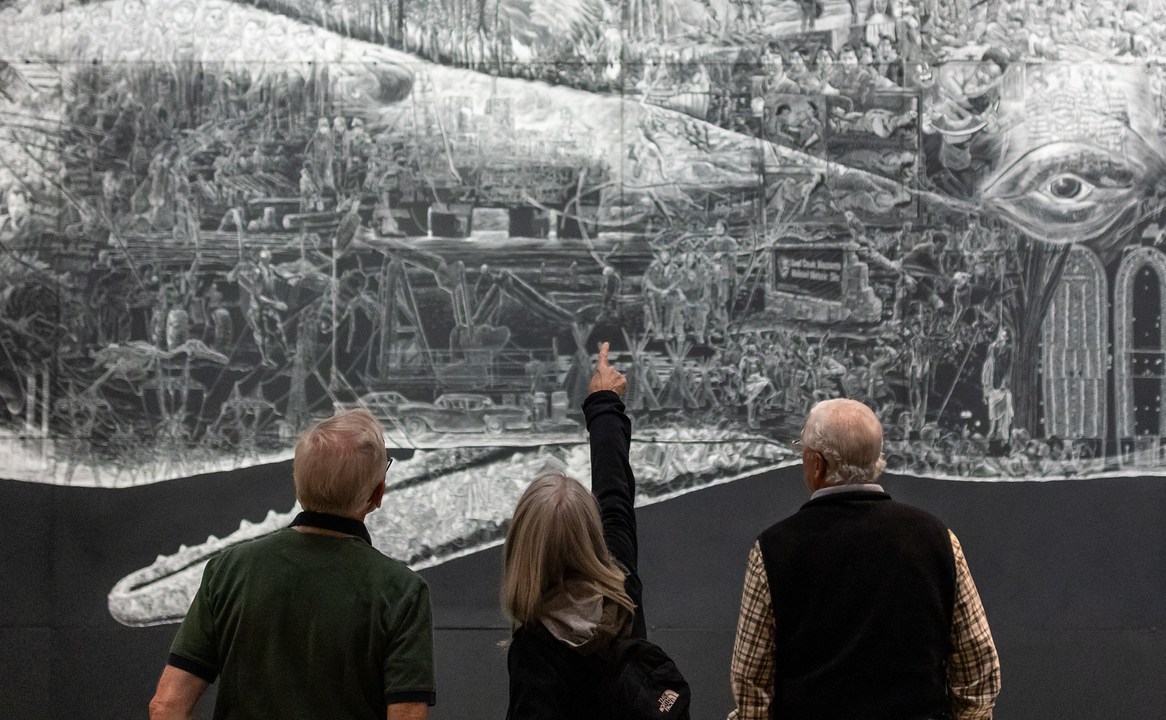
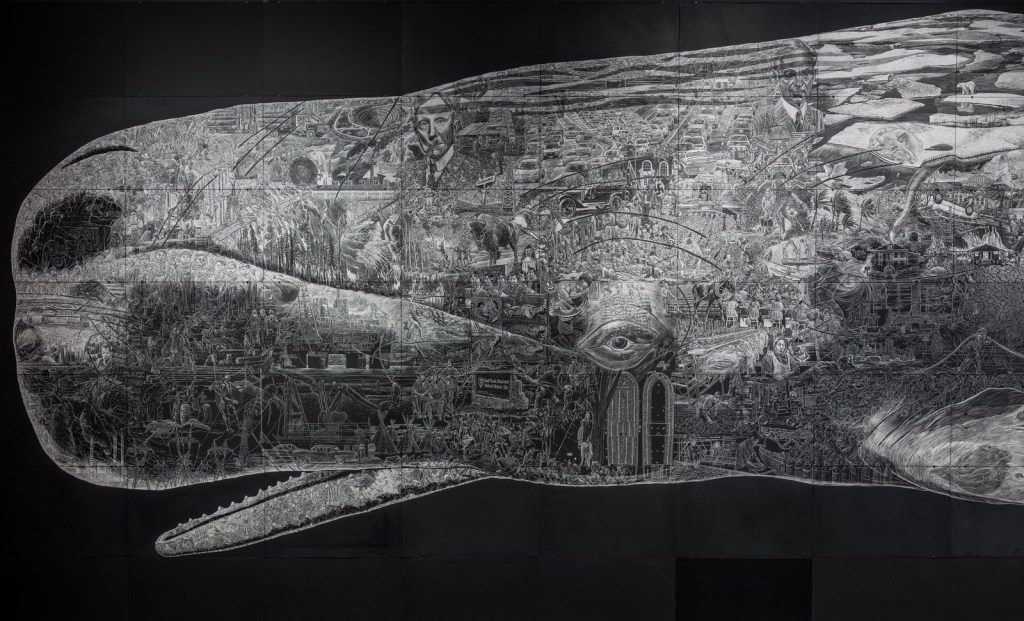
While all museums must prepare and empower their interpretation staff and volunteers to engage in contentious and complex stories with visitors, this becomes even more important at a museum like Mystic, where interpreters are vital to the experience. This article will explore front-line training for two recent exhibitions—Entwined: Freedom, Sovereignty, and the Sea, a major exhibition “centering maritime histories in Indigenous, African, and African-descended worldviews and experiences”; and Monstrous: Whaling and Its Colossal Impact, a whaling exhibit showcasing artist Jos Sances’s mural Or, the Whale, which depicts hundreds of years of American capitalism and exploitation through the lens of the commercial whaling industry—sharing what we learned about how to help interpreters confidently cultivate community conversations, bring history to the present, and make visitors feel seen, heard, and enlightened.
(Re)Contextualizing Maritime History
Entwined and Monstrous bothcame to be after the museum closed a long-standing and beloved exhibition: Voyaging in the Wake of the Whalers (VWoW). VWoW was installed in the summer of 2014 when the Charles W. Morgan made its 38th voyage—the first since its working era. Although the Morgan came back to Mystic in August 2014, VWoW did not close until 2023. VWoW was representative of the museum’s original approach to whaling history: sharing stories of life at sea and the material culture of whaling, while barely skimming the surface of the whaling industry’s racial diversity and environmental impacts. Interpreters acted as gallery guides and used the exhibition to contextualize the Morgan and the historic seaport village. No doubt, VWoW’scontent was intrinsic to sharing the Morgan’s story and to grounding visitors in our work—but the museum felt there must be other ways to share these stories effectively, while engaging with the broader and more complex history of whaling.
Mystic Seaport Museum is on Pequot land; it sits directly across the river from Pequot Hill, the site of the deadly 1637 Mystic massacre, which occurred toward the end of the Pequot War. The war-ending Treaty of Hartford granted English settlers economic and political control over Connecticut.[i]
Given this history, the museum and the local community needed to connect the region’s colonial origins to the political and cultural landscape today. Entwined answers this call in the present tense, showcasing Black and Indigenous historic and contemporary maritime culture to tell stories of resilience through strife (fig. 1).
The museum formed an exhibit advisory committee to work with curator Akeia de Barros Gomes on the belongings and stories presented in the show. Committee members were historians, artists, and cultural experts—almost every person a member of at least one of the communities represented in the exhibition. Together, the committee created a dugout canoe on the museum’s grounds using a combination of Indigenous and West African techniques, methods, and tools (fig. 2). Visitors can climb into the canoe and watch a short video about the process and cultural significance of the project from the creators themselves.
Entwined has multiple short videos throughout the exhibition, featuring advisory committee members and artists speaking on their work. These videos give agency to the creators to tell their own stories. We hope that when visitors watch real people sharing their experiences, it helps to dismantle the “myth of the vanishing Indian,” the enduring misconception that Native people no longer exist.[ii]
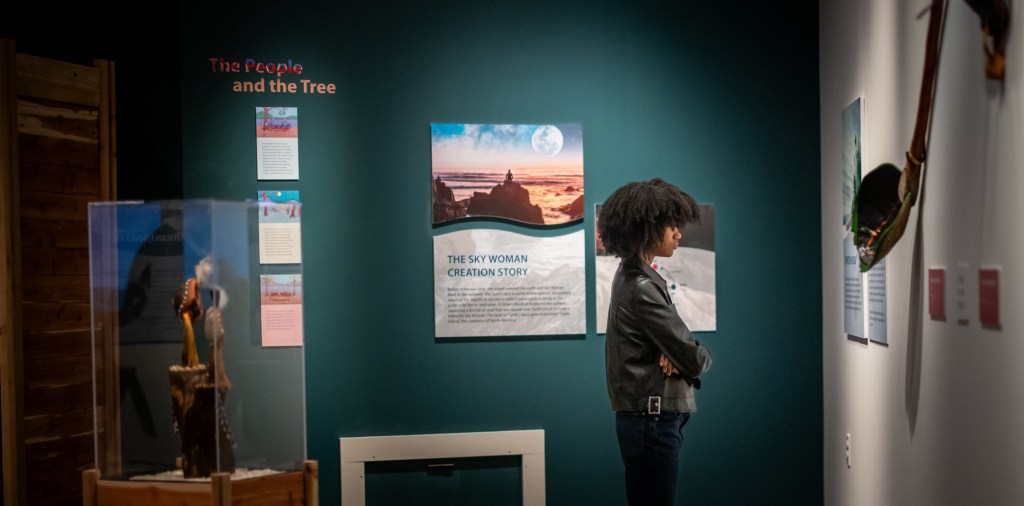
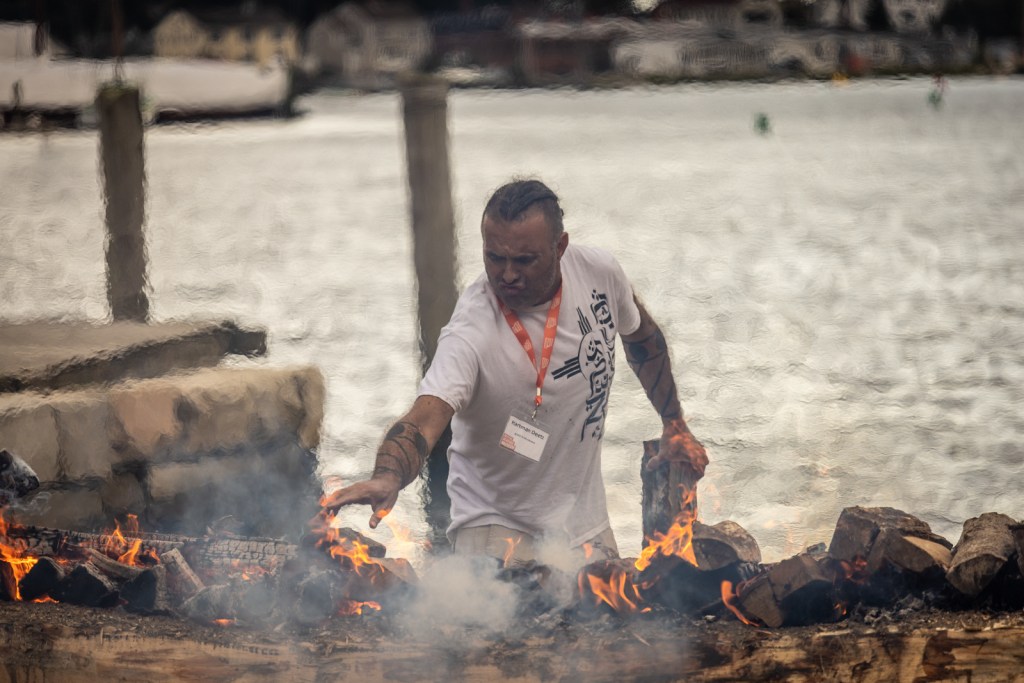
This, in turn, drives home Entwined’s message: these cultures have persevered and survived despite strife. Within the galleries, interpreters act as guides, monitoring the artwork and belongings, offering to elaborate on exhibition content, and encouraging visitors to climb into the canoe or view another part of the exhibition, and by sharing additional spaces around the museum’s campus where visitors can learn more about certain exhibition elements.
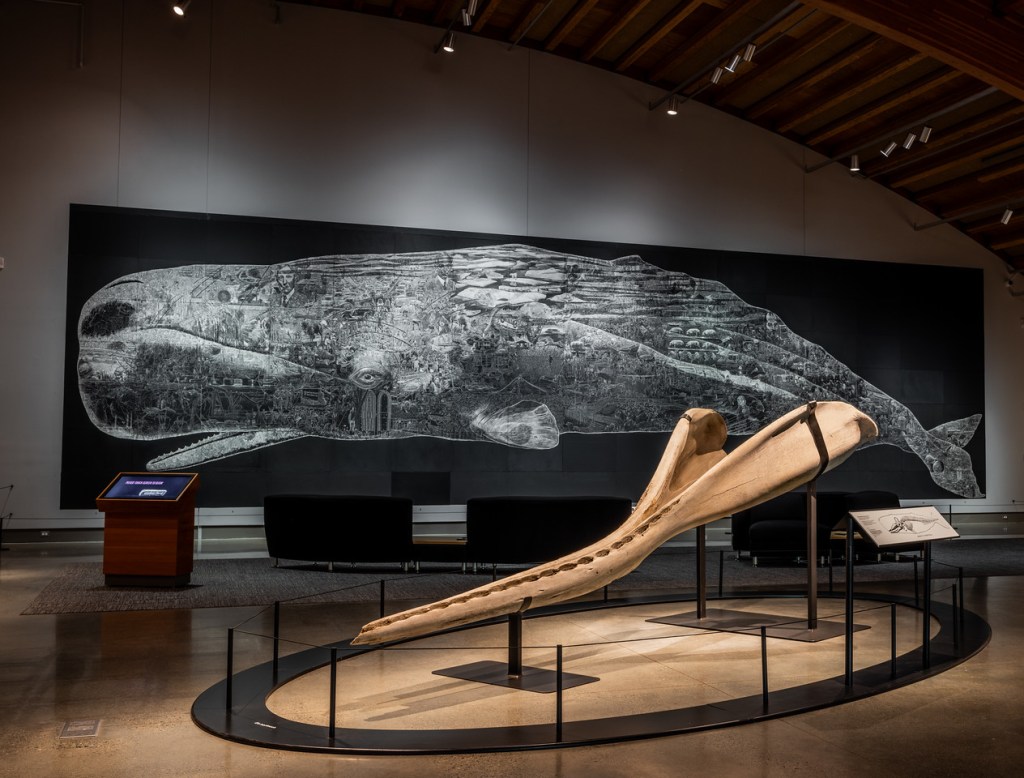
Monstrous: Whaling and Its Colossal Impact displays artist Jos Sances’s Or, the Whale, a mural that depicts scenes of American capitalism and exploitation within a life-size image of a sperm whale: 14 feet tall and 51 feet across (fig. 3). Sances created the work for his grandchildren, inspired by their interactions with marine wildlife on a trip to Todos Santos, Mexico, and by Sances’s reading of the iconic edition of Moby Dick illustrated by Rockwell Kent (fig. 4). Every scene in the mural references existing images, most focusing on American history from 1850 to the present, with only a few predating but integral events, such as the Mystic massacre. Sances combines scenes of historic events, climate change, pop culture, and even a depiction of his granddaughter Calliope showing off a sand dollar to tell the story of American history through the lens of one of America’s most exploitative practices: commercial whaling (fig. 5). As the artist emphasizes, “the whale is a metaphor for survival, immortality and a reason for optimism.”[iii]
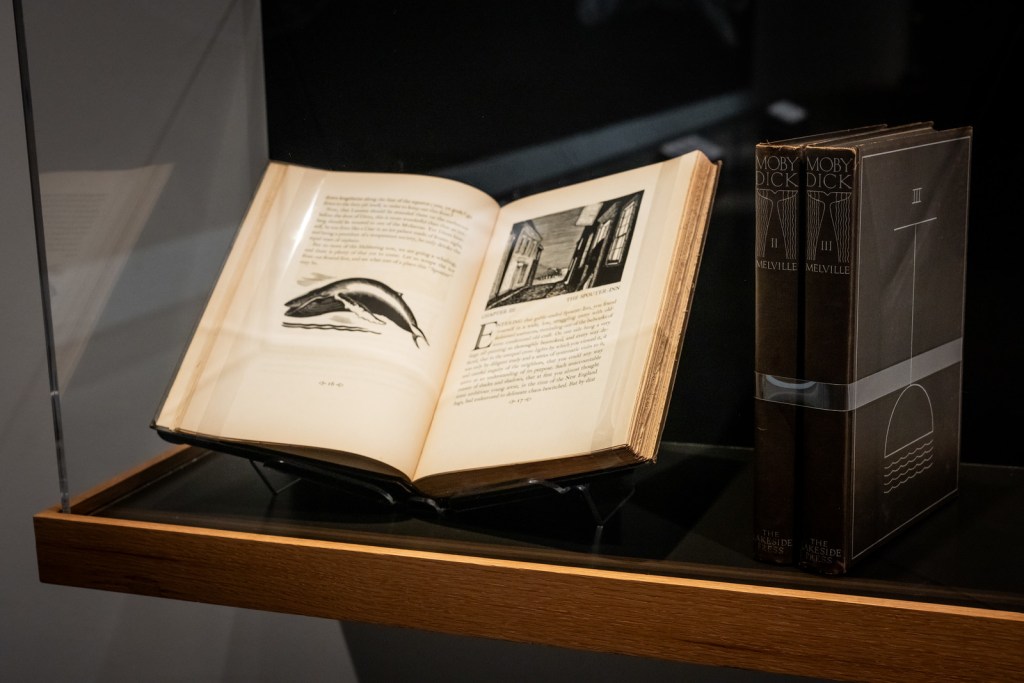
Curating Community-Oriented Spaces
Both Monstrous and Entwined are community-oriented exhibitions. Entwined emphasizes that the museum is on Pequot land and exhibits belongings and stories from southeastern Connecticut and Rhode Island. Local history and relevant themes in Entwined are integrated throughout the museum’s campus through “The Sea Connects Us” panels, which tell stories of the Pequot War and Black and Native historic figures in maritime culture and history.
Entwined keeps community dialogue going through comment cards that invite visitors to share their impressions of the show to display at the end of the exhibition. Comments include reflections on the exhibition’s resonance in this political climate, how enlightening or humbling it felt to learn about these stories, hope to continue pursuing these stories, or, as one visitor put it, that it was just “wicked cool.”
Sances also emphasized the importance of community-building conversations for Or, the Whale. The artwork features historic events and popular media that resonate with multiple generations, sparking conversations among staff, volunteers, and visitors. Couches line the wall facing the artwork, providing a place to rest, study, and contemplate. Gallery guides, written by Melville scholar Jeffrey Peterson, are available on the couches. Visitors spend a considerable amount of time sitting and looking through the guides, and the museum gift shop has sold 500 copies of the gallery guide so far.
Preparing and Empowering Interpretive Staff
Given the different nature of these exhibitions from what came before, staff training for Entwined and Monstrous sought to prepare interpreters for a range of potential visitor reactions, including:
- Confusion or disappointment for visitors who expected to walk into VWoW or an exhibition like it
- Offense or disassociation at the presentation of American history through a non-white lens
- Curiosity and open-mindedness about the content but confusion over how to engage with it
- A range of positive and negative emotions that might be experienced by members of the represented communities at seeing their histories and stories presented in our institution for the first time
Within the training sessions, we emphasized the following key ideas:
De-escalation training and visitor scenario workshops are essential.
For Entwined, interpreters-in-training brainstormed possible scenarios based on previous experiences or anticipated fears. As a group, we workshopped conversational strategies and protocols for each situation. Based on these scenarios, the group created the following principles:
- Be willing to listen and learn.
Provide space for the visitor to express themself and be open-minded to learning from their experience and perspective. - Meet the visitor where they are.
Everyone comes to you with a different perspective, background knowledge, and expectations for their museum experience. You must gauge this and be prepared with different stories, strategies, and levels of complexity to share with multiple visitors. - Seek to light a spark.
You might not change someone’s perspective overnight, but you can be one of many moments of inspiration that make them want to learn more. - Embrace complexity.
History is not clear-cut and does not need to be. You can learn a lot from acknowledging multiple perspectives and their complexity. - Take care of yourself and others.
Interpreting difficult histories requires a lot of emotional and mental energy. Do not burn yourself out; seek counsel and support from your peers and supervisors. (Supervisors are present in the exhibit to witness or experience visitor interactions first-hand, which was especially important in the first few weeks. Staff share non-emergent notes and personal experiences in logbooks. Open communication and administrative presence make a difference in supporting staff.)
In addition to completing a similar visitor scenario workshop, Monstrous trainees completed an online de-escalation training on their own during paid time. The Monstrous training group was much larger that the Entwined cohort, so the online program seemed more appropriate. We still discussed possible scenarios and our worries in person, but the program provided more uniformity and structure for the larger group.
Acknowledge perspectives and welcome visitors into conversation—do not lecture.
Rather than risk making visitors feel like everything they know about history is wrong, ourtraining encouraged interpreters to engage with visitors on topics they know and connect with, and only then to seek to expand their knowledge with diverse stories and well-rounded perspectives of historic events. We ask questions like, “This was the artist’s interpretation; what’s yours?” and, “I noticed that too; how does that make you feel?” We must give agency to the visitor, rather than spoon-feed them what we think they should take away.
Provide a safe and comfortable space for your audience to reflect.
Do not talk at visitors. Listen to their thoughts, feelings, stories, and reactions to exhibition content.Entwined offers notecards for visitors to share their thoughts and feelings, which interpreters selectively display at the end of the exhibition, including cards that share personal stories, appreciation, suggestions of what else visitors would like to see, and discarding a (rare) hateful message or unrelated middle schooler’s joke. Monstrous offers comfortable seating in front of the mural for visitors to view the art, chat with one another, and to read the gallery guide.
Give your interpreters access to the resources they need to feel confident with the subject matter.
To prepare interpreters to talk about the art in Monstrous, we arranged a special opportunity for Sances and Peterson to present on their creative process and academic analysis. Conversing with the artist and his academic collaborator supported the interpreters’ understanding of the art and how to convey its themes to visitors. We also included Peterson’s article and book recommendations from Sances and Peterson in the interpretation handbook.
American Association for State and Local History (AASLH) technical leaflets and interpretation book series helped us include approachable and effective methods for interpreting certain topics in the handbook. Most notably, Interpreting Energy at Museums and Historic Sites by Dr. Leah S. Glaser and Interpreting Difficult History at Museums and Historic Sites by Julia Rose supported the exhibition’s major themes and our interpreters’ most pressing concerns.
For Entwined, the interpreters took a training course with the exhibition’s curator and met with advisory committee members over multiple training sessions. Connecting your interpretative staff with storytellers and curating relationships with those communities creates a strong and authentic connection between your front-line staff and the exhibition’s content.
Designing for Front-Line Staff
When considering how front-line staff will work in your exhibition, ask: What type of institution is this? Are the front-line staff more accustomed to interpreting art, historic objects, doing demonstrations, or something else entirely? Interpreters at Mystic Seaport Museum have done all of the above, but before we started training, many expressed self-doubt at interpreting Sances’s dense, complex mural to everyday visitors. The history portrayed in Sances’s piece is some of the most explicit content this cohort of interpreters has worked with, and many feared aggressive responses from visitors—especially as the exhibition was announced around the same time as the 2025 presidential inauguration, at a time of deep political divisions. We anticipated and shared some of the interpreters’ concerns, so we had already started planning the training program by the time the exhibition was announced.
To support Or, The Whale’s interpretation, the exhibition includes reader rails describing thematic highlights, a panel summarizing the artist’s background/vision, and a hands-on interactive element—the ThingLink. This touch screen lets visitors interact with the art digitally. They can select a part of the mural they want to learn more about, and a paragraph will pop up briefly describing the imagery.
The panels, reader rails, and touch screen do not replace the interpreter; rather, they provide context and structure for the visitor. The information they offer can ground the interpreter, supporting them and providing a starting point for conversation. Museums should know how to connect historic themes to present-day issues. These topics should resonate with local issues or with concepts relevant to your museum’s mission. They should connect to other elements of the museum for cohesive, well-rounded messaging. This can happen when we empower and prepare front-facing staff for the complexity of these topics, and when exhibit design prioritizes visitor engagement and expression.
[i] “Battlefields of the Pequot War,” Mashantucket Pequot Museum & Research Center, 2025, accessed August 2025.
[ii] “Myth of the Vanishing Indian,” The Pluralism Project, Harvard University, 2020, accessed August 2025.
[iii] “The Art of Jos Sances,” 2022, accessed August 2025.
Andy King is Interpretation Volunteer Coordinator at Mystic Seaport Museum in Mystic, Connecticut.
Upcoming Events
-
Industry Showcase: Innovative Digital Solutions
Event Date: -
Getting Started in Local Advocacy
Event Date:Presented by: American Association for State and Local History (AASLH) -
Creative Museums Summit
Event Date:Presented by: MuseumNext -
So…You Want a Museum Career? Part II
Event Date:Presented by: Southeastern Museums Conference