This article first appeared in the journal Exhibition (Spring 2026) Vol. 45 No. 1 and is reproduced with permission.
In recent years, museums in the United States have been pulled into national debates about history, identity, and democracy.[1] The increasing political polarization that accompanies these discussions sometimes manifests in museums as cancellations, public clashes, and high-profile interventions.
However, most institutional risk management work unfolds quietly, through internal edits, delayed approvals, and anticipatory decisions that reshape exhibitions long before they reach the public. This article draws on a small survey of 23 U.S. museums to document the kinds of pressures institutions report in the present moment, the actions they take in response, and how prepared they feel for future constraints on their exhibitions.
The sample is small and directional, not representative. The goal is to provide a practical vocabulary for museum professionals facing similar challenges and to suggest four levers that museums can use to distribute exhibition risk more fairly across their organizations.
Methodology
The survey was distributed in July and August 2025 through professional networks and listservs. Respondents work across history, art, and interdisciplinary institutions with mixed collections and programs.
The respondents are based in the United States and hold curatorial, education, interpretation, design, and leadership roles. The survey included multiple-choice questions about governance, resources, and recent actions taken under pressure, followed by open-ended prompts on recent controversies and hopes and fears for the future (up to the year 2030).
The survey offers a modest, self-selected sample. The findings should be read as an early snapshot of pressures and responses, and as an invitation to document and share responsibility, not as a representative or definitive analysis.
What the Data Show
Uneven Fiscal Ground
The institutions in this snapshot occupy different fiscal positions, and that shapes how they experience risk (fig. 1).
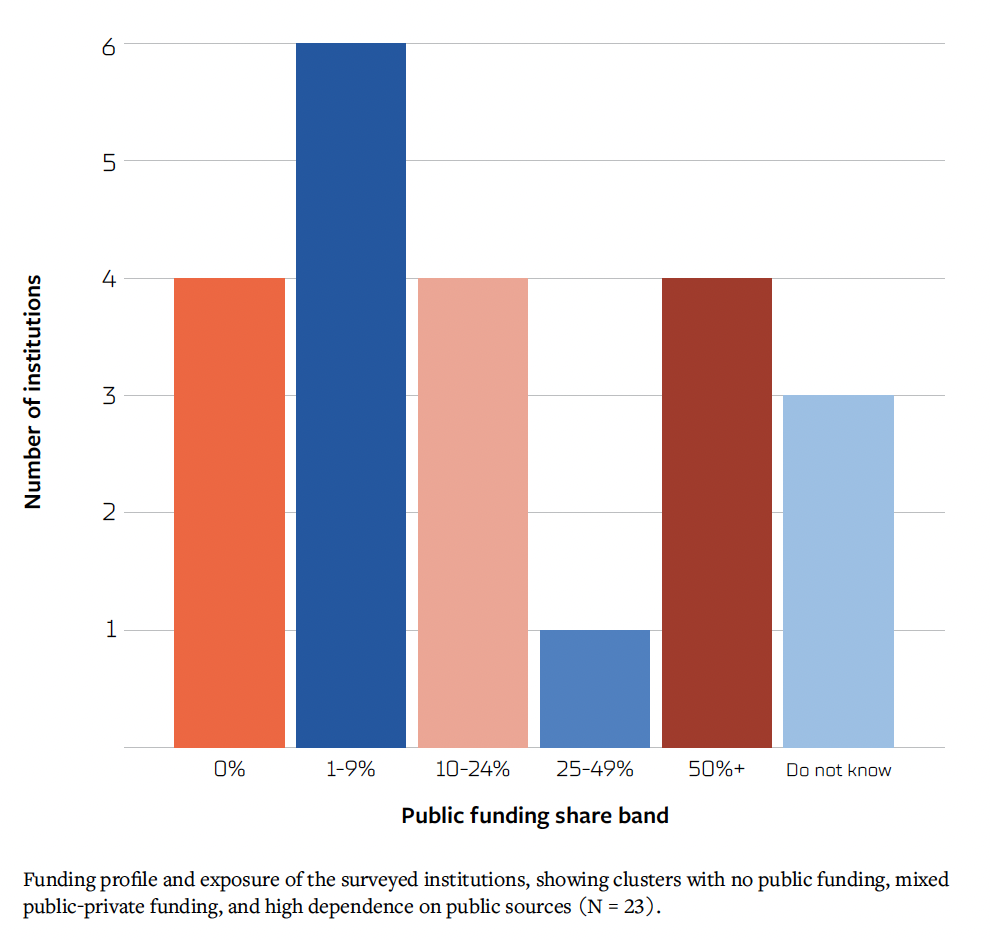
Four institutions report no public funding at all, while five report that more than 50 percent of their annual budget comes from public sources. This uneven exposure shapes how respondents talk about what “risk” means. For some, risk is public controversy and donor withdrawal. For others, it is a single budget vote or line item cut that could trigger layoffs, shuttered galleries, or canceled programming.
Respondents also describe a quiet shift in scope control: the narrowing of topics, the rephrasing of interpretive language, or the avoidance of certain objects or subjects not because of an explicit prohibition but to preempt conflict.
One respondent notes that a planned exhibition on the Ku Klux Klan was delayed multiple times after internal concerns about donor backlash and public safety surfaced. Another states, “We removed an object from the checklist after leadership review,” without documenting why. In these cases, risk appears not as a single moment of censorship but as an accumulation of small interventions that leave no public record of what is, and is not, discussed in museum galleries.
Legislative Constraints and Internal Self-Censorship
Respondents report a mix of direct and indirect pressures on exhibition content (fig. 2).
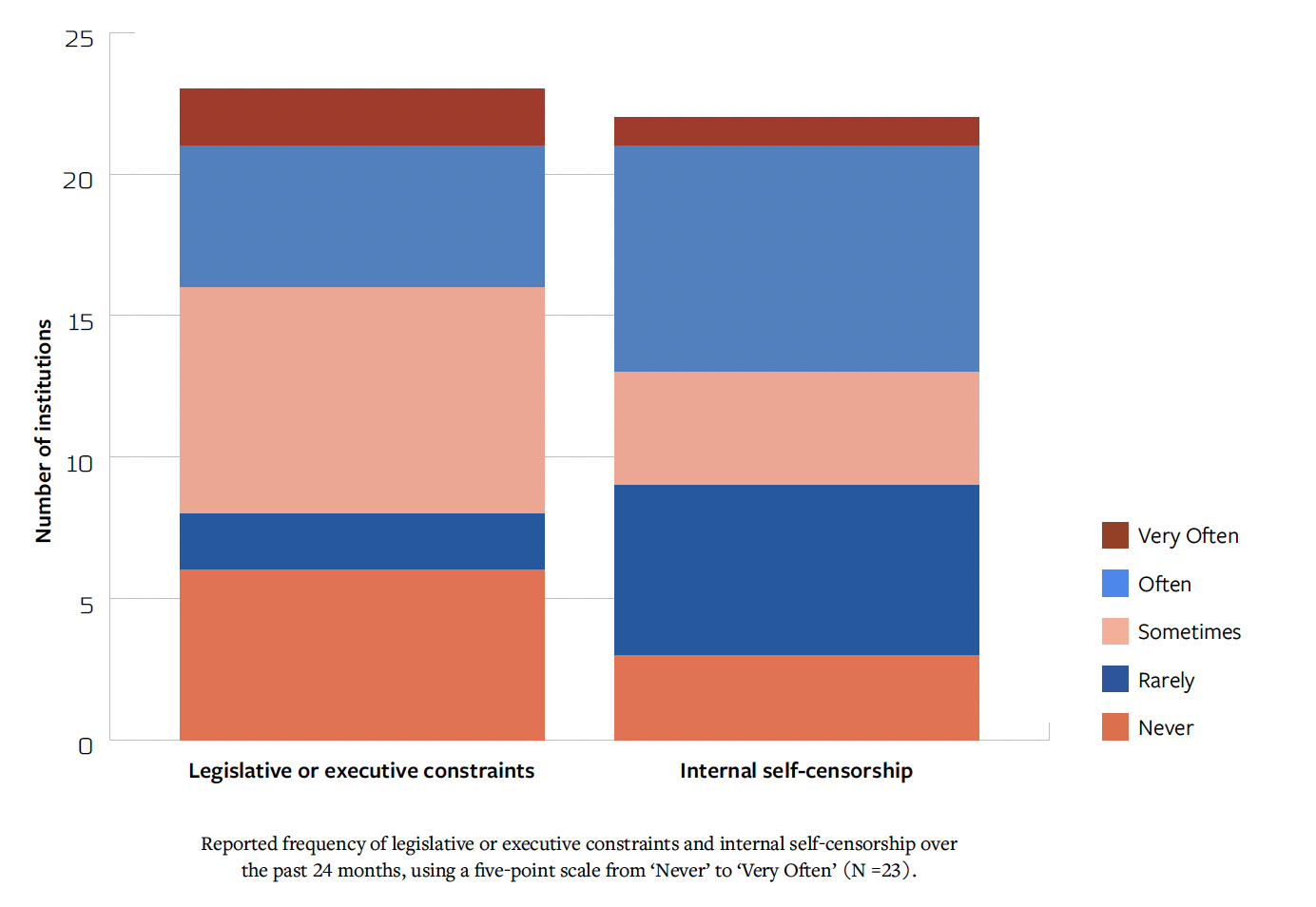
Some describe explicit requests from boards or donors to remove or soften material. Others point to new legal and administrative hurdles: executive orders on diversity programs, changing grant terms, or internal reviews framed as “alignment with institutional values.”
The data reveal a pattern in this sample: internal self-censorship is reported more frequently than direct legislative intervention. In narrative responses, colleagues describe exhibition edits made “to avoid escalation,” “to keep the doors open,” or “to prevent headlines.” These edits range from removing a reference in a label to shifting the framing of an entire gallery.
In many cases, the most consequential decisions are made not in public hearings or courtrooms, but in internal working groups or task forces where the main goal is to keep the institution operational. This pattern does not make the pressure less real; it changes where responsibility sits and how visible the conflict becomes.
Actions Under Pressure
The survey asked institutions to report specific actions taken in response to external pressures over the past 24 months (fig. 3).
The results show that most museums are not simply weathering criticism; they are actively reshaping their programs.
Only 12.5 percent of institutions report taking no action under pressure. Nearly 20 percent have canceled or re-scoped public programs; 18 percent have postponed or canceled exhibitions; and 14 percent have removed or restricted online materials.
These terms are used consistently throughout this article: An exhibition or program is canceled when it is withdrawn entirely with no expectation of resumption. It is postponed when its date is deferred with the intention of presenting it at a later time. A project is re-scoped when its concept or content is significantly modified (by narrowing the subject matter, substituting works, or altering interpretive frames), while the program continues under the same title.
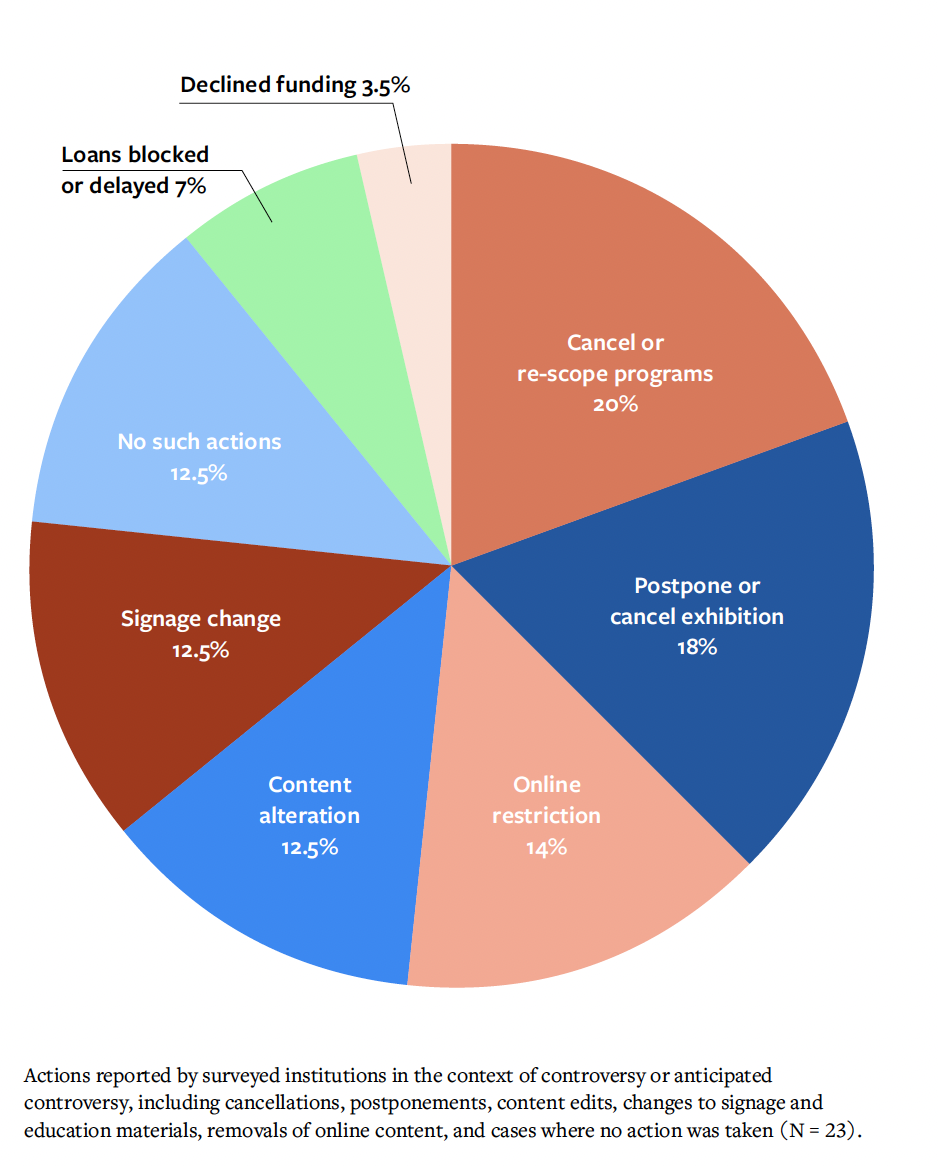
These actions produce cascading effects: The cancellation of exhibitions and/or programs eliminates not only public content but also erases months of work invested by staff, artists, lenders, contractors, and community partners. Respondents describe knock-on impacts on morale, retention, and trust. Several note that even when changes are framed as “temporary,” they require permanent labor: rewriting materials, renegotiating contracts, rebuilding schedules, and managing public messaging.
Although many decisions are made within leadership and curatorial teams, respondents emphasize that the burden of implementation often falls on mid-level staff, educators, designers, and visitor-facing teams who must translate decisions into new labels, altered spaces, or revised programming.
Governance Gaps
When asked, “In the past 24 months, how frequently has your institution experienced the following external pressures?” respondents’ answers reveal a mismatch between pressure and procedure (fig. 4).
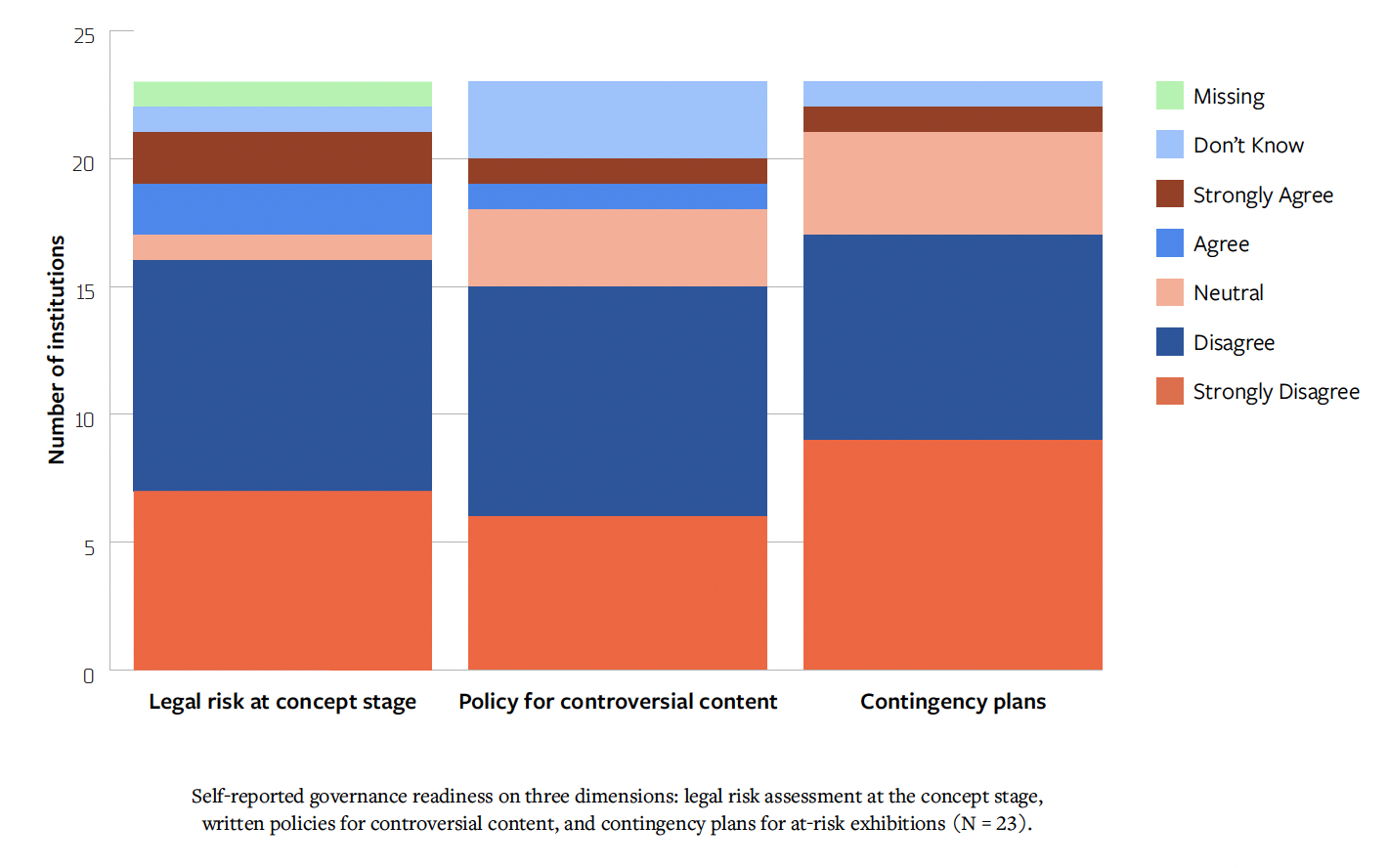
Museums act by canceling, postponing, or re-scoping, but many cannot show who decided what, on what grounds, and with what documented trade-offs. When reasons remain informal or undocumented, institutions lose the ability to learn cumulatively from controversy, and staff bear a greater share of the downstream exposure.
Many respondents report that their institution lacks clear written policies for handling controversy, escalation pathways for contested content, or consistent processes for documenting why changes were made. Several describe reliance on informal networks or individual relationships rather than institutional protocols.
At the same time, many respondents emphasize the importance of “ballast”: long-term relationships with local communities, staff members’ commitment to the mission, and peer support networks. This ballast does not remove pressure, but it can change how institutions absorb it. Respondents describe a need to formalize what currently operates as goodwill, moving from ad hoc decision-making to shared frameworks that do not depend on individual courage or personal risk.
Four Levers for Distributing Exhibition Risk
In healthy democracies, tensions between the state, institutions and their stakeholders, and the public can be productive when they arise from inclusive deliberation. But a different tension arises when authorities claim exclusive rights to define the past: A 2025 White House letter instructs the Smithsonian to implement “corrections” within 120 days.[2] The administration tasked Vice President JD Vance with overseeing efforts to “remove improper ideology” from the institution.[3] By January 2026, the Smithsonian faced demands to provide detailed inventories of all exhibit materials–displays, objects, wall text–planned for America’s 250th anniversary, with the explicit threat of withheld federal funding for exhibits deemed insufficiently positive.[4] Furthermore, the FY 2026 budget proposed eliminating the National Endowment for the Arts and terminating the National Endowment for the Humanities.[5]These past developments, and many more like them, sharpen the question of who bears the consequences of contested interpretation.
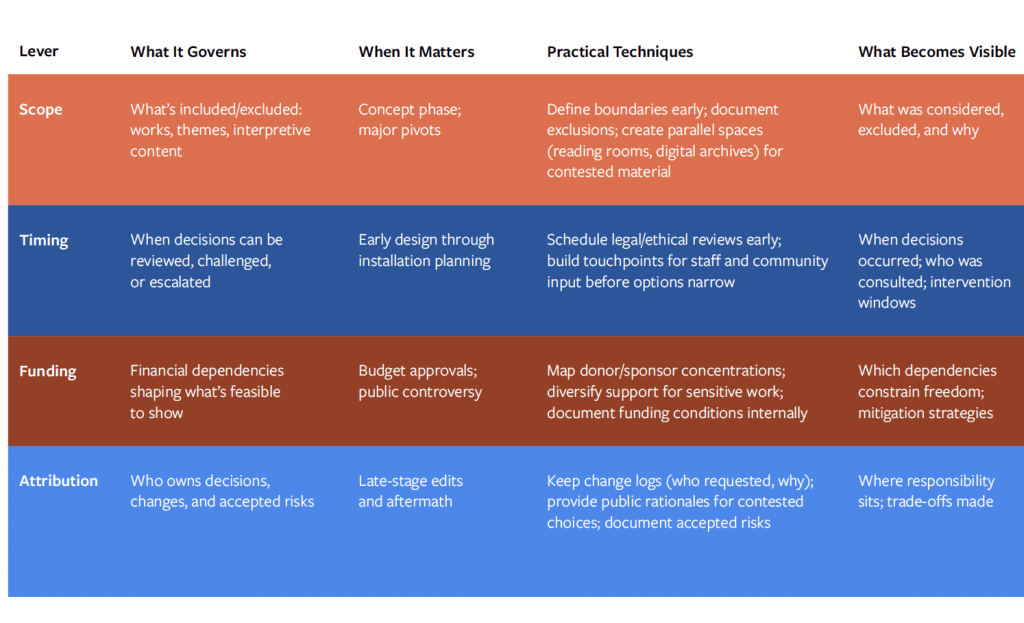
The survey suggests that museums are already taking many actions under pressure, but these are often reactive and unevenly documented. Taken together, these patterns suggest that the problem is not only pressure itself, but how its effects are distributed and recorded. This section proposes four practical levers that institutions can use to distribute exhibition risk more deliberately: scope, timing, funding, and attribution (fig. 5).
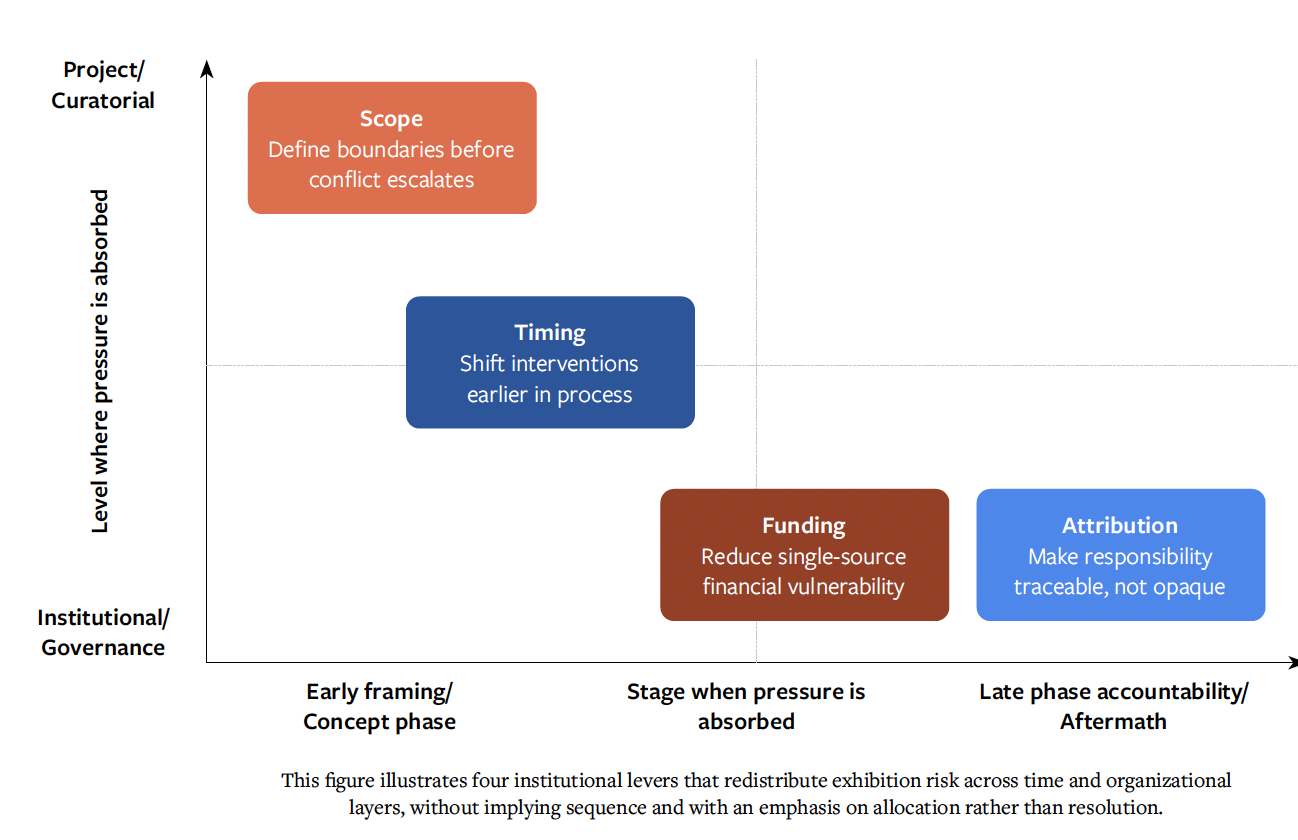
These levers do not remove conflict. They help make it visible and shared, rather than silently absorbed by a handful of individuals:
Scope
Scope concerns what is included and excluded at each stage of an exhibition’s development and display. Several respondents describe how risks increased when sensitive elements were added late or when topics were vaguely defined at the outset. Others note that they avoided specific works without recording that decision.
In practice, scope becomes actionable when institutions distinguish early between what is central to an exhibition’s argument, what remains adjacent, and what is out of scope, and when exclusions are logged as decisions rather than left implicit, even if the rationale is resource-based. Several respondents note that parallel spaces, reading rooms, evidence panels, and digital dossiers can expand interpretive capacity by accommodating more complex or contentious material without overloading the core installation.
A clear scope does not guarantee safety. It creates a record of what was considered and offers a basis for conversation when pressures arise.
Timing
Timing shapes who can intervene and when. Many respondents report that legal departments, insurance providers, or boards enter the process late, when most content decisions have already been made. In these cases, risk management often collapses into last-minute cancellations or hurried edits that are not fully thought through.
In practice, timing becomes a risk-distribution lever when legal, compliance, and governance reviews are brought forward into the concept and early design stages, rather than introduced at installation or launch. Several respondents describe the value of discussing risk frameworks and institutional values with boards in calmer, off-cycle settings, and of creating structured opportunities for staff, artists, and community partners to surface concerns early, without those conversations triggering drastic outcomes.
Better timing does not eliminate conflict. It gives people a chance to work through disagreement while more options remain open.
Funding
Funding is often the most visible axis of pressure, yet many museums keep internal conversations about money opaque. Some institutions rely on a small number of restricted gifts, while others depend on municipal line items that could be cut in a single budget cycle.
In practice, funding becomes a risk-distribution lever when institutions make fiscal dependencies explicit, whether those dependencies are on donors, sponsors, political bodies, or municipal line items. They then assess what these dependencies mean for curatorial freedom. Several respondents highlight the value of diversified support for sensitive programs, such as distributed gifts, member-based campaigns, or cost-sharing with partner institutions, along with clearer internal communication about the conditions attached to major gifts and sponsorships.
These steps do not solve structural underfunding. They can reduce the likelihood that a single funder or line item determines what can or cannot be shown.
Attribution
Attribution concerns who is named as responsible for choices, and how. Many respondents describe decisions that “come from above” without clear authorship, attributed vaguely to anonymous committees, “policy,” or “risk assessment.” When attribution is diffuse, staff can feel exposed while authority and responsibility remain opaque.
In practice, attribution becomes a risk-distribution lever when institutions document significant changes during development, including who requested them and on what grounds, rather than letting decisions dissolve into anonymous processes. Several respondents emphasize the value of short public-facing statements that explain contested choices, alongside internal records that acknowledge not only removals but also moments when risks were accepted.
Clearer attribution does not resolve the dilemma between protecting expression and protecting jobs. It does prevent responsibility from disappearing into the process.
Using the Levers Together
These four levers work in combination. Defining scope early creates space for meaningful timing interventions. Understanding funding dependencies clarifies which risks an institution can afford to take. Transparent attribution ensures that when scope narrows, timing shifts, or funding changes direction, the decision and its rationale remain visible. The levers do not resolve all the issues, but they can distribute the weight more fairly and keep the conversation public.
Holding Space for Contested Exhibitions
Exhibition risk in the present tense is not only about dramatic cancellations or new laws. It is also about the accumulation of minor edits, deferred projects, and undocumented decisions. The survey responses presented here show museum professionals working under uneven fiscal exposure, increasing procedural scrutiny, thin governance protocols, and significant emotional labor. They also show ballast in community support and commitment of staff to the mission.
From this snapshot, I propose four connected steps to help distribute pressures more evenly across the institution: document every change, share rationales for choices, host structured dissent, and diversify governance (fig. 6).
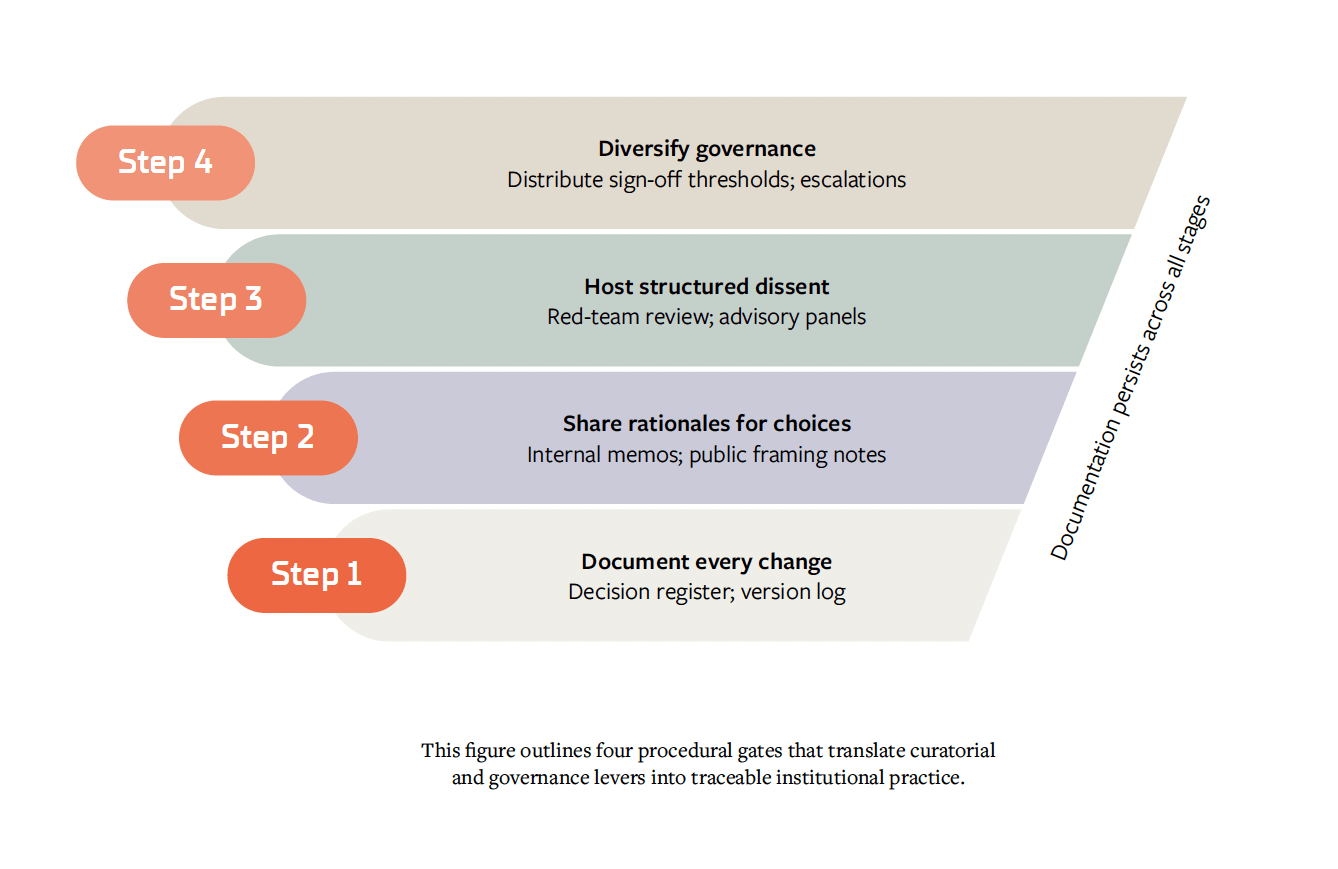
Together, these steps give concrete form to the levers of scope, timing, funding, and attribution. They encourage institutions to treat exhibitions not as isolated products but as shared processes that can be traced and discussed.
The pressures facing U.S. museums are likely to intensify toward 2030. What matters is not only whether specific exhibitions survive, but how decisions about them are made, recorded, and explained. By making risk visible and shared, museums can better protect the conditions for contested exhibitions to remain open to the public. Even when closure becomes unavoidable, documentation performs essential institutional work: it supports learning over time, clarifies how responsibility and risk are distributed, and enables more deliberate responses when interpretive work comes under pressure.
Difficult decisions, when properly recorded, become case studies that allow future practitioners to recognize patterns of pressure and build more resilient institutional responses.
All figures courtesy of the author.
[1] Author’s note: In revising this article, I used a large language model to help refine phrasing. All survey design, analysis, and interpretations are my own, and I reviewed and revised all text before submission.
[2] The White House, “Letter to the Smithsonian: Internal Review of Smithsonian Exhibitions and Materials,” August 12, 2025.
[3] Irie Sentner, “Vance to wipe ‘improper ideology’ from the Smithsonian,” Politico, March 28, 2025.
[4] Meg Kinnard, Gary Fields, and Calvin Woodward, “Smithsonian responds to White House pressure by handing over more plans on its exhibits,” AP News, January 14, 2026.
[5] National Endowment for the Arts, “Appropriations Request for Fiscal Year 2026,” NEA, May 2025; National Endowment for the Humanities, “Fiscal Year 2026 Congressional Justification,” NEH, May 2025.
Leander Gussmann is a postdoctoral researcher at the Art x Science School for Transformation, Johannes Kepler University Linz (JKU) in Linz, Austria.
Upcoming Events
-
Industry Showcase: Innovative Digital Solutions
Event Date: -
Getting Started in Local Advocacy
Event Date:Presented by: American Association for State and Local History (AASLH) -
Creative Museums Summit
Event Date:Presented by: MuseumNext -
So…You Want a Museum Career? Part II
Event Date:Presented by: Southeastern Museums Conference