This article first appeared in the journal Exhibition (Spring 2026) Vol. 45 No. 1 and is reproduced with permission.
Although museums often claim to be among the most trusted institutions,[i] that trust has been tested in recent years. In some communities, trust has fractured. As museum professionals navigate shifting political currents, social reckonings, and institutional contradictions, many are searching for deeper ways to build relationships and respond to the present moment with integrity.[ii]
Many expect museums to provide answers and convey truth. We interpret, explain, and contextualize with the authority of hindsight. Our exhibitions are regularly structured with a clear beginning, middle, and end—shaping complexity into clarity and ambiguity into takeaway. But what happens when the stories we are called to tell do not have clear conclusions, when the wounds are still open, the histories still contested, and the future uncertain?
Restorative justice (RJ) offers a way forward. It is a values-based framework rooted in relationship, accountability, repair, and healing. A foundational approach to justice in many Indigenous communities worldwide, RJ provides an alternative to punishment or avoidance in response to conflict. RJ calls on us to name harm when it happens and to design processes that honor the dignity and complexities of those most impacted. This is not about achieving consensus; it is about cultivating the courage to remain responsive, especially when there is pressure to resolve or retreat.
While RJ does not provide easy answers, it can help us ask better questions. This primer explores how RJ can inform exhibition practice as a guiding orientation. It offers an introduction to key RJ principles, highlights an early case study, and provides resources for those looking to begin or deepen this work. Most of all, it invites museum practitioners to ask: What would it mean to treat our exhibitions not as endpoints, but as openings?
What Is Restorative Justice?
According to RJ practitioner and theorist Howard Zehr:
Restorative justice is an approach to achieving justice that involves, to the extent possible, those who have a stake in a specific offense or harm to collectively identify and address harms, needs, and obligations in order to heal and put things as right as possible.[iii]
At its core, RJ asks: Who has been harmed? What do they need? What are our responsibilities in meeting those needs? It also prompts us to look at the deeper contexts—historic, structural, interpersonal—that made the harm possible in the first place.[iv]
RJ work begins with values such as empathy, accountability, respect, inclusion, and relational responsibility.[v] These values steer how conversations happen and what outcomes are honored. RJ:
- Centers the lived experience of those affected[vi] by harm, especially historically marginalized or excluded community members. Their voices are not secondary but central to understanding what repair and trust require.
- Privileges relationship repair over punishment.[vii] Rather than assuming that discipline or compliance will restore confidence, the approach asks: What does repair look like to the people hurt, and how can we rebuild trust together?
- Relies on transparency and dialogue,[viii] because values such as respect and dignity grow in spaces where people are listened to and meaningfully heard.
- Invites shared responsibility,[ix] meaning that leaders, staff, and community partners co-define the meaning of accountability and the criteria for righting harm.
For museum workers, this matters because museums do not operate in isolation from the communities we serve. A values-based restorative approach reframes institutional responses to conflict or harm from declaring what is “right” to deciding together what is honoring, healing, and trust-building. It adds moral and relational depth to standard institutional practices.
Though often associated with criminal justice reform, RJ draws from Indigenous knowledge systems -traditions that emphasize collective responsibility, interdependence, and the power of dialogue.[x] Over the past few decades, RJ has taken root in schools, community safety work, housing justice, and organizational culture change.[xi] Across these diverse settings, its core principles remain constant: repair relationships, center those most impacted, and hold space for truth to emerge without rushing to resolution.[xii]
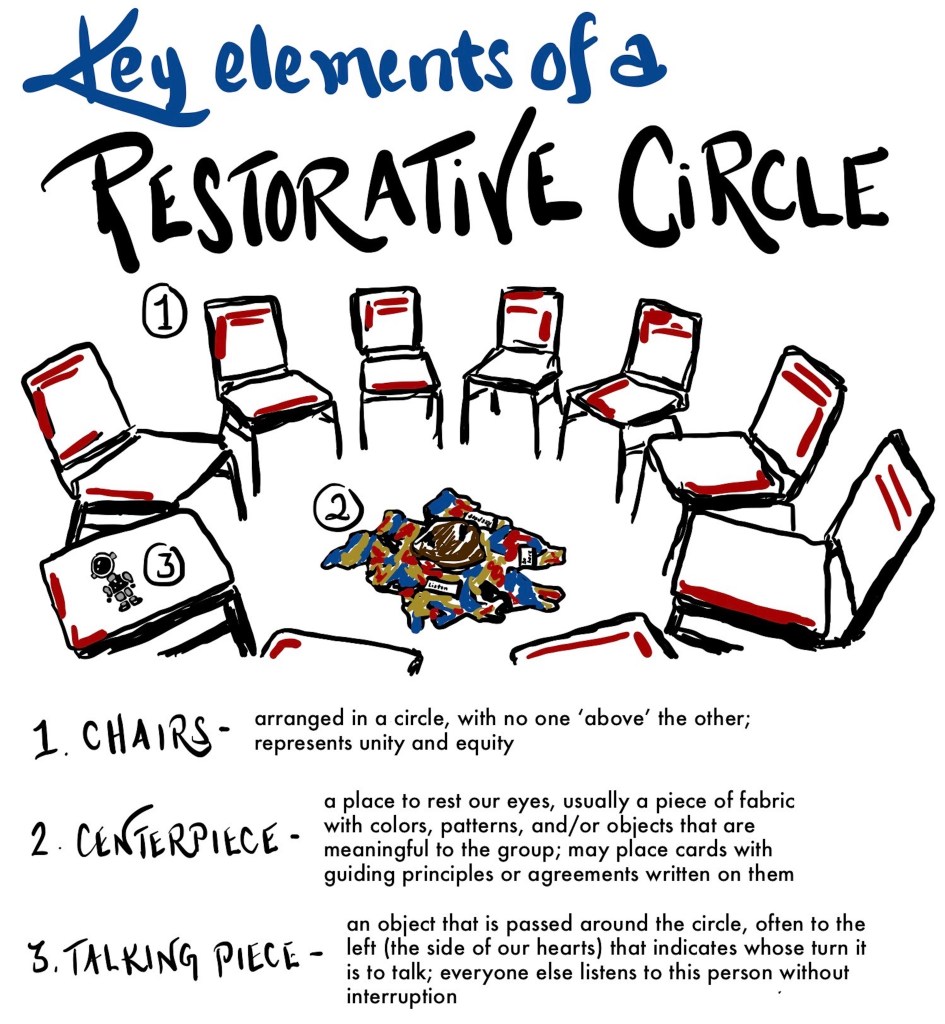
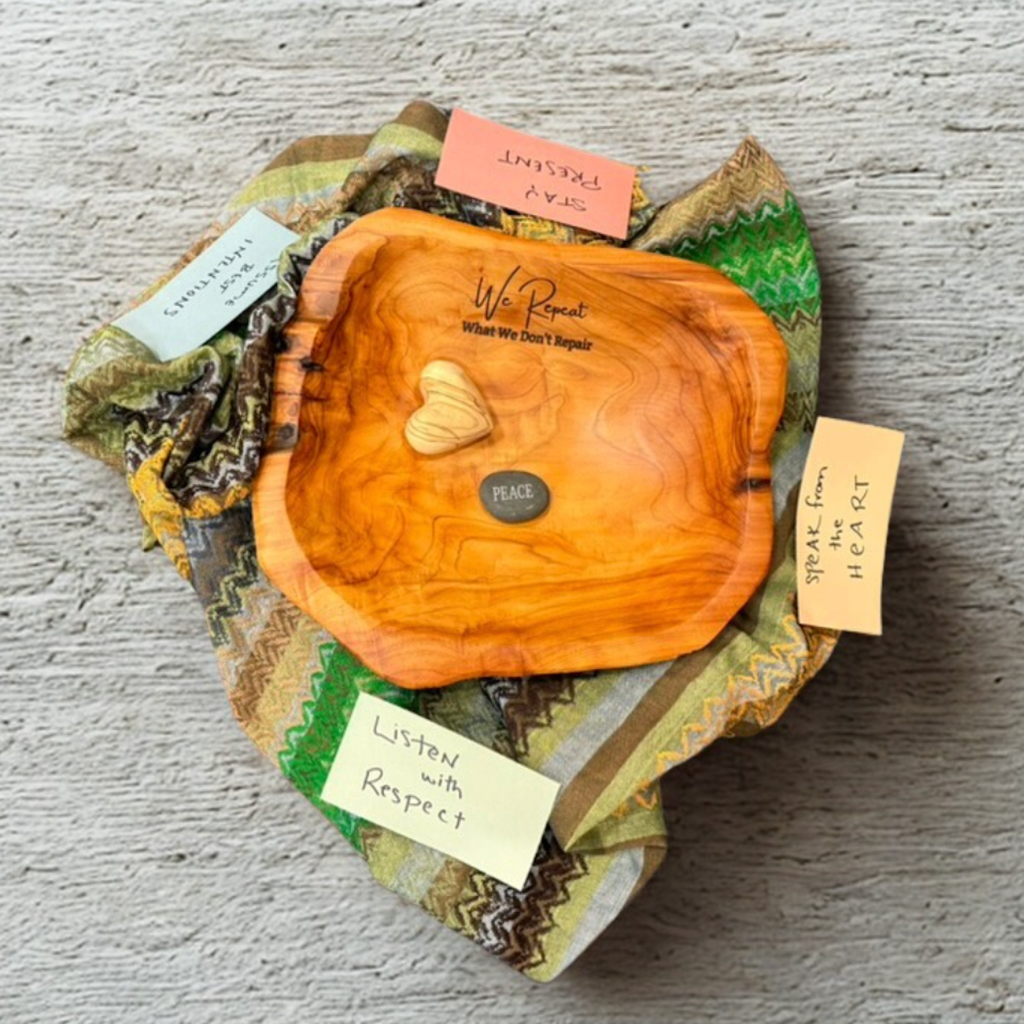
In practice, RJ might look like a circle process (fig. 1), a facilitated dialogue, a structured response to harm in a workplace, or a long-term relationship of accountability with a community.[xiii] What distinguishes it is not the format, but the orientation. RJ asks us to slow down, stay in relationship, and do the hard work of listening across difference (fig. 2).
Museums have both caused and perpetuated harm. This admission may feel daunting, but as shown in the case study below, RJ gives us concrete tools to respond in ways that are relational, specific, and grounded in accountability. In our exhibitions, RJ offers a way to move beyond representation and into responsibility by explicitly naming harm, centering those most impacted, and prioritizing repair. This means treating interpretation as a living conversation rather than a finished product. It begins with the acknowledgment that harm has occurred—and may still be occurring.
RJ Principles and Practices in Action:
- Start with relationships. Exhibition teams are often under pressure to produce a clear plan right away. RJ reminds us to pause first and build trust: listen to stakeholders, identify histories of harm, and invite those most impacted to help shape the priorities.
- Incorporate circle practices. It can be hard to know how to balance expert voices with community perspectives. Circle dialogue creates an inclusive and equitable structure for story collection and collaborative ideation, ensuring that voices often left out are included in meaningful ways.
- Allow stories to remain open-ended. Deadlines and funder expectations can push our exhibitions toward swift and decisive conclusions. RJ encourages exhibitions to hold multiple perspectives through layered storytelling, dynamic labels, and interactive interpretation.
- Treat prototyping and feedback as care. Feedback processes are too often rushed or framed as hurdles. RJ suggests treating prototyping and community review as acts of care and trust-building, where gaps can be surfaced and harm addressed along the way.
- Plan for accountability. Exhibition teams know the stakes of getting it wrong, yet accountability systems are rarely formalized. RJ encourages museums to plan in advance for responsiveness, utilizing relational evaluation, follow-up with stakeholders, and visible updates when changes are made.
Case Study: Museum of Kansas City
The Museum of Kansas City’s engagement with restorative practices emerged during the planning and revitalization process leading up to its reopening in 2021.[xiv] As Anna Marie Tutera, Director and Chief Executive Officer, explained, the institution had already committed to centering untold stories, working deeply with community, and addressing difficult histories long before encountering restorative practices as a formal framework. “We knew early on, as far back as 2015,” Tutera noted, “that for the revitalization of the museum, it was going to be really important to focus on untold stories, to work with community, to find a way to explore the complexity, the nuances of Kansas City’s past, present, and future, and to be bold and truthful . . . but not blame or shame our visitors.” When consultants familiar with the International Institute for Restorative Practices (IIRP) introduced restorative practices to the Museum, the framework felt immediately resonant. As Tutera recalled, “It felt very validating . . . like, ‘Oh my gosh, there is a name for what we want to do and how we want to do it.’” This orientation has also been articulated publicly through the Museum’s “Restore KC” initiative and prior field-facing reflections on restorative practice and healing.[xv]
Rather than treating restorative practices as a discrete program, the Museum gradually embedded them across exhibition development, educational programming, collecting policies, and leadership practices. Glenn North, Director of Inclusive Learning and Creative Impact, emphasized that this integration begins at the outset. When discussing exhibition interactives, North explained that restorative thinking is “baked in,” not layered on after the fact. “It’s not, ‘Let’s build this thing and then later on figure out how we can make it more equitable or inclusive.’ That is the place that we start from.”
The Museum’s most explicit application of restorative practices in exhibition design can be seen in the digital interactive Boundaries and Borders, developed with G&A (formerly Gallagher and Associates). For this project, restorative practices were intentionally framed as foundational from the start. Tutera described telling the design team, “Let’s really embrace this framework. Let’s have it be a design principle, a guiding principle from the beginning.” The resulting team was deliberately multidisciplinary and multicultural, bringing together museum staff, historians, educators, scholars, artists, and community representatives. As Tutera emphasized, this composition was intentional: “It’s not a group of people who all have PhDs. It’s not a group of people who are all white. It’s not a group of people who are all Black. It is very multicultural, and those teams are created purposefully.”
Tutera and North described the development of Boundaries and Borders as time-intensive and often challenging, particularly when navigating histories of land dispossession, racial violence, and exclusion. North offered a concrete example: “I participated in four-hour meetings over a sentence. Like, we have to get this one sentence right.” These extended consultations were not treated as inefficiencies or pain points, but as necessary conditions for ethical storytelling. Disagreement and tension were expected and welcomed. As North noted, “People are passionate . . . people are going to fight for who they represent, and you want that on a team.”
What ultimately distinguishes Boundaries and Borders on the gallery floor is the way restorative questions are embedded directly into the visitor experience. Each chapter of the interactive ends not with a conclusion, but with an invitation to reflect. Tutera explained that this is intentional: “We wanted to end each script with a restorative question.” These questions invite visitors to consider their own relationships to land, to displacement, and to responsibility, rather than positioning the museum as the final authority. Restorative thinking also extended to aesthetic decisions. North described careful deliberations about imagery and symbolism, noting the importance of understanding “what symbols might trigger people, how imagery might land,” and emphasizing that G&A offered multiple options so the Museum could ensure cultural sensitivity even at the visual level.
Both Tutera and North emphasized that this external work would not be credible without internal alignment. Restorative practices shape staff meetings, leadership dynamics, and approaches to conflict. North stated plainly, “If we’re not practicing it internally, we can’t be . . . authentic in how we are using restorative practices.” Staff meetings often begin with check-in questions that invite personal context, creating a culture in which colleagues are encouraged to bring their whole selves to work. North described how being able to say, for example, “my mom is sick this week,” helps create an environment where people want to support one another. Tutera keeps a small card she got from IIRP with her at all times. It reminds her to ask restorative questions like: “What has been the hardest thing for you?” and “What do you think needs to happen to make things right?” She explains: “it’s extraordinary when you start a conversation by just asking what happened . . . not asking why.” As this work unfolded, the institutional commitment was significant, touching leadership, culture, and the pace of decision-making across the organization.
Tutera shared that early visitor feedback indicates people feel “represented” and are discovering “new aspects of their city that they didn’t know about, even if they’ve lived here their whole lives.” For the Museum of Kansas City, restorative exhibition practice is not a finished model but an ongoing commitment. As North reflected, “It is hard . . . and you don’t always get to see the benefit of it in real time. But if you’ve made the decision to see it through and to stick with it, you will see the value of it.”
Taken together, the Museum of Kansas City’s work illustrates how restorative justice, understood as a values-based framework oriented toward harm, responsibility, and repair, can move from theory into the everyday decisions that shape exhibition content, process, and institutional culture.
Why RJ Matters to Museums Now
Museums today are navigating a period of profound tension. Longstanding questions about trust, authority, and accountability are surfacing in every corner of our field. Exhibitions often carry this weight most visibly: they are where communities encounter their histories, where staff balance competing narratives, and where curators, designers, and educators make choices under the constraints of time, resources, and expectations.
Restorative practices can help us find new ways to acknowledge what is unsettled while still providing clarity, dignity, and care for those most impacted. RJ provides a framework for navigating moments when community feedback reveals pain, when multiple truths resist easy synthesis, or when the interpretive path feels uncertain.
Restorative practices also resonate with the broader context in which exhibitions are received. Communities are asking how museums respond to harm, both historic and ongoing. Staff are calling for greater transparency and equity. Visitors are seeking spaces that feel relevant, honest, and alive. Exhibitions informed by RJ can meet these needs by showing that museums are willing to stay present and actively engaged, even as stories are unfolding in real time.
When applied to exhibitions, RJ reframes our work as building the conditions for ongoing trust and repair. It reminds us that every exhibition is not only an interpretive product but a relational encounter. In this sense, RJ offers us a new set of tools for sustaining the integrity of our work in a world that increasingly calls for it.
RJ-informed exhibition work often unfolds slowly and may ask more questions than it answers. That said, it also creates conditions for something more lasting: not just content that represents communities, but processes that honor them. Not just exhibitions about repair, but exhibitions that are part of repair.
Restorative Justice Resources
These resources offer multiple entry points—from case studies and podcasts to frameworks and practical tools—for those ready to explore restorative approaches further.
Books
- The Little Book of Restorative Justice, Howard Zehr
- The Little Book of Race and Restorative Justice: Black Lives, Healing, and US Social Transformation, Fania E. Davis
- The Little Book of Circle Processes: A New/Old Approach to Peacemaking, Kay Pranis
- Until We Reckon: Violence, Mass Incarceration, and a Road to Repair, Danielle Sered
Podcasts and Videos
- “The Transformative Power of Restorative Justice” – 2020 episode of The Gray Area podcast, featuring interview with sujatha baliga
- “What is Restorative Justice?” – 2023 Remaking the Exceptional video series, published by Teen Vogue
- The Restorative Lens – 2021–2023 podcast from the National Center on Restorative Justice
- Healing Justice – 2017 documentary by Shakti Butler (World Trust Films)
Organizations in Your Area
- Restorative Justice Map – National Association of Community and Restorative Justice
Museum-Specific Restorative Practices
- “Restorative History [Explained]” – Primer from the Center for Restorative History at the Smithsonian National Museum of American History.
Note: The Center was “sunsetted” in January 2026, and although the website was still live at the time this article went to press, it is not clear how long it will remain accessible to the public. Should this happen, shared resources from the Center can be found here. - “Effective Exhibitions Should Provoke!” – Tsione Wolde-Michael and Nancy Bercaw, Exhibition 41, no. 2 (Fall 2022)
- “ReStorying the Past: Perspectives from the Center for Restorative History” – 2022 webinar hosted by the Zehr Institute for Restorative Justice featuring Tsione Wolde-Michael and Nancy Bercaw
- Using Restorative Practices at the Museum of Kansas City (website overview)
- “History Is Healing” – Anna Marie Tutera and Paul Gutiérrez, Museum, May–June 2021
- “Peering into the bedroom: Restorative justice at the Jane Addams Hull House Museum,”
Lisa Yun Lee in The Routledge Companion to Museum Ethics: Redefining Ethics for the Twenty-First Century Museum, ed. Janet Marstine
[i] American Alliance of Museums and Wilkening Consulting, “Museums and Trust,” Spring 2021.
[ii] Dawn DiPrince, “The Messy and Vulnerable Truth about Trust and Museums,” American Alliance of Museums, Alliance Blog, April 21, 2023.
[iii] Howard Zehr, The Little Book of Restorative Justice, rev. and updated ed. (Good Books, 2015), 50.
[iv] Mariame Kaba, We Do This ’Til We Free Us: Abolitionist Organizing and Transforming Justice (Haymarket Books, 2021).
[v] Howard Zehr, Changing Lenses: A New Focus for Crime and Justice (Herald Press, 1990).
[vi] Mark S. Umbreit and Marilyn Peterson Armour, Restorative Justice Dialogue: An Essential Guide for Research and Practice (Springer, 2010).
[vii] John Braithwaite, Restorative Justice and Responsive Regulation (Oxford University Press, 2002).
[viii] Zehr, Little Book of Restorative Justice; Kay Pranis, The Little Book of Circle Processes (Good Books, 2005).
[ix] Pranis, Little Book of Circle Processes.
[x] Fania E. Davis, The Little Book of Race and Restorative Justice: Black Lives, Healing, and US Social Transformation (Good Books, 2019).
[xi] David R. Karp and Natalia Knott, Restorative Justice in the United States: An Updated Study of Policy and Practice (Skidmore College, 2022).
[xii] Zehr, The Little Book of Restorative Justice.
[xiii] “Restorative Justice Defined,” Restorative Justice Colorado, accessed December 13, 2025,
[xiv] This case study was developed in collaboration with the Museum of Kansas City and is based on an in-depth interview conducted specifically for this article. I first became aware of the Museum’s work through professional conversations in the field and subsequently worked directly with Museum leadership to document how restorative practices shape their exhibition development and institutional culture.
[xv] Anne Marie Tutera and Paul Gutiérrez, “History Is Healing,” American Alliance of Museums,Alliance Blog, May 1, 2021; Museum of Kansas City, “Restore KC,” accessed December 2025.
Kate Merrick is Founder and Principal of ExposeYourMuseum LLC and Kate Merrick Coaching in San Marcos, California.
Upcoming Events
-
-
-
AAM Member Week
Event Date:Presented by: American Alliance of Museums -
AASLH History Hour: Is This Place Haunted?
Event Date:Presented by: American Association for State and Local History (AASLH)