This article first appeared in the journal Exhibition (Fall 2026) Vol. 45 No. 2 and is reproduced with permission.
The Fitzwilliam, the main museum of the University of Cambridge, is home to more than 500,000 objects —from ancient Egyptian coffins to Impressionist paintings, ceramics, and rare manuscripts— and welcomes over half a million visitors each year. It attracts a huge mix of people from excited school groups and tourists ticking it off their Cambridge itinerary to students and local families, and each arrives carrying something different.
Many of these visitors arrive weary, having spent hours navigating the demands, deadlines, and constant information flow of our always-on digital world. They carry an undercurrent of stress that is almost impossible to switch off. And it’s not just here—across Europe and North America, research points to rising levels of attention fatigue and emotional overload, particularly among young adults.
To capture attention, museums often dial up their exhibitions with more spectacle, more layers of interpretation, and more to see, hear, and do. For visitors already overwhelmed, this can overload rather than restore. Perhaps it’s time we stop positioning well-being work as a “less serious,” optional add-on to core museum priorities and instead embed it at the center of exhibition design.
Drawing on Happy Place, a pop-up installation at the Fitzwilliam Museum, this article argues that calm, joy, and emotional recovery are essential elements of the museum experience. In an overstimulated world, quiet collective joy becomes a radical act—restoring attention and making meaningful engagement possible.
Museums, Well-Being, and Care
Museums have long been places of learning, curiosity, and extraordinary collections. Increasingly, they are also being recognized as places that can support health and well-being. At a time when many people feel lonely, overwhelmed, or stretched, museums offer something precious: space to pause, reconnect, and be. Sociologists describe these types of public areas as “third spaces”—places beyond home and work where people spend time, feel part of a community, and exist without pressure or obligation.[1] As many everyday gathering places that once functioned as third spaces have disappeared, museums are well placed to help fill the gap.
Research over the past decade has strengthened the case: Helen Chatterjee has shown how museum participation can reduce anxiety, improve well-being, and strengthen social connection;[2] John Falk argues that the lasting value of museums lies not simply in what they contain, but in what visitors leave with;[3] and in her book Art Cure, Daisy Fancourt highlights evidence that regular museum visits can generate well-being benefits comparable to a substantial increase in household income.[4] Other studies, using smartphone GPS data, have found that people often leave museums and galleries feeling happier and more relaxed than when they arrived.[5]
As evidence has grown, museums have begun to move beyond treating well-being as something delivered through occasional programs or partnerships with health-care providers and are increasingly exploring how well-being can be designed into the museum experience itself.
In the UK, Manchester Art Gallery pioneered this approach with Room to Breathe, a dedicated gallery designed for restorative engagement with art, while the Wellcome Collection has combined exhibitions exploring health and human emotion with quiet spaces, sensory-friendly design, and opportunities for reflection, such as the current exhibition Rudy Loewe: Intimacies of Care – Spaces of Grief and Possibility. Internationally, the Van Gogh Museum’s Open up with Vincent program uses art as a catalyst for conversations about mental health through mindful looking, meditation, and creative workshops. The Getty Museum’s Mood Journey tours invite visitors to choose audio tours based on how they are feeling (or how they hope to feel), using artworks and gardens to encourage reflection and emotional connection. Meanwhile, Museum of New Zealand Te Papa Tongarewa draws on Māori concepts of manaakitanga (care and hospitality), whanaungatanga (relationships), and hauora (holistic well-being) to shape the visitor experience from the moment people arrive.[6]
These examples point toward a shift in museum practice. Rather than seeing well-being as an additional outcome or a specialist program, they suggest it can become a guiding principle for exhibition design itself. Happy Place allowed us to test these ideas in practice, exploring how well-being might be designed into an exhibition from the outset.
Co-Creating Happy Place
Happy Place formed part of the Fitzwilliam Museum’s Practitioner Research Associate (PRA) program, which explores the societal role of museums. It began with a simple question: What would a museum experience look like if it were designed to support well-being and spark joy? Our attention turned to young adults—a priority audience for the museum and a generation experiencing increasing levels of stress and loneliness. We knew that for the project to feel genuinely relevant, it couldn’t be designed in a meeting room. So, instead of creating another well-being program for young adults, we set out to create one with them.
Happy Place was led by the PRA team with input from colleagues across the museum, including the visitor experience, learning, curatorial, and public programming teams. Museum staff worked alongside 49 young adults aged 16 to 25 as co-designers. Recruited through an open call and through outreach to local youth, university, and mental health organizations, participants represented a wide range of lived experiences, including students, neurodivergent young people, LGBTQ+ communities, and people from refugee and migrant backgrounds. Around half had never visited the Fitzwilliam before.
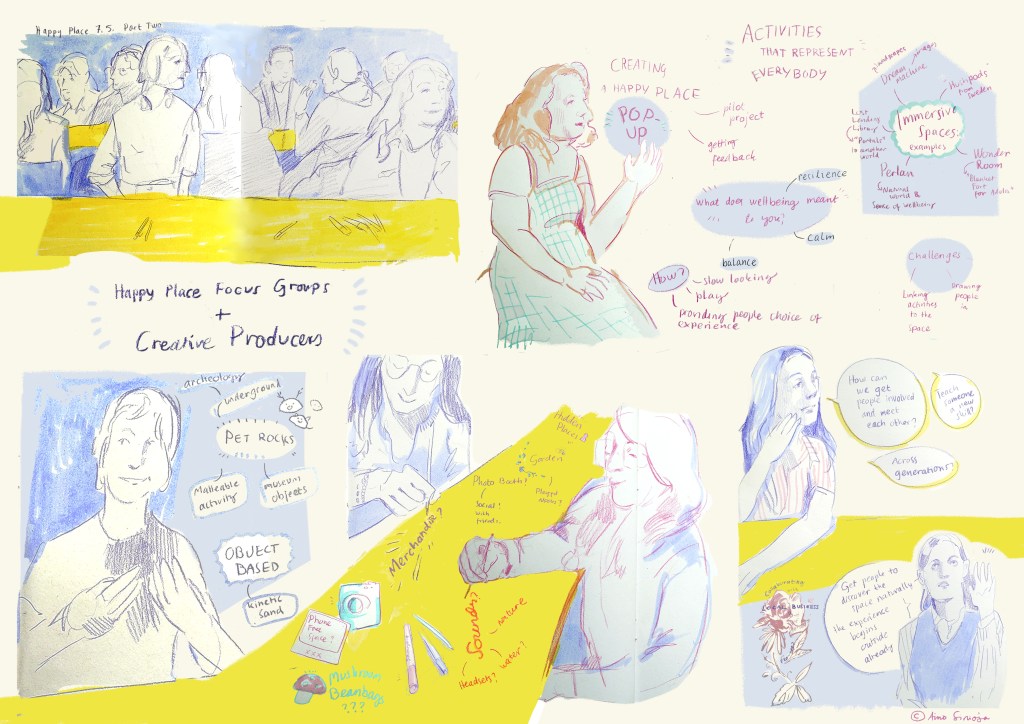
Over the course of 10 months in 2025, the group shaped every aspect of the project through interviews with 25 community and well-being organizations, conversations with 40 museum staff, 10 creative focus groups, and six design and build sessions. Ideas were tested, challenged, and refined throughout. The result: Happy Place, an immersive installation inspired by a magical garden, facilitated activities (Happy Hour), and a self-guided well-being trail through the galleries (Down the Garden Path). This space for pause, play, and connection allowed visitors to spend time in an environment that felt slower, softer, and more restorative.
Understanding the Scale of the Problem
I’m always overthinking. I feel like I can’t fit it all in my head . . . I just want some peace of mind.
Participants’ anxieties—over financial insecurity, academic pressures, loneliness, and a looming awareness of global instability—reflect a broader picture. In the UK, one in three young people report experiencing mental health issues, while NHS services are stretched and difficult to access.[7] Countries such as Canada and Australia report similar patterns.[8] Young people reported needing more informal places where they could spend time without expectation or cost. Museums are well placed to meet this need, yet the qualities these young people are seeking are often treated as by-products rather than intentional outcomes of museum practice. The challenge is to move beyond isolated well-being initiatives and begin designing exhibitions where care is woven into the visitor experience from the outset.
What Young Adults Wanted
When the group spoke about well-being, they rarely described happiness in simple terms. Instead, they talked about balance, autonomy, belonging, and making room for joy. They wanted somewhere they could slow down, feel safe, and exist without any expectation to perform. As one participant explained: “I’d appreciate somewhere I can just be. I don’t want to be under pressure to do anything.”
What did we actually mean by joy? We assumed we might eventually arrive at a shared definition, but we never did. Instead, joy emerged as something deeply personal and often surprisingly quiet. Young adults spoke about feeling lighter, at ease, freer, more playful, and more connected—to themselves, to nature, to other people, and to the museum. They described joy as having permission to slow down, to laugh, to make something without worrying whether it was good, to notice small details, to rest without feeling guilty, and to spend time somewhere that asked nothing of them.
We stopped thinking of joy as something an exhibition could deliver and began thinking about the conditions that made it more likely to emerge. Choice, autonomy, beauty, gentle sensory experiences, and opportunities for quiet connection became our design principles. Instead of trying to manufacture happiness, we set out to create an environment in which different people could experience moments of joy in their own way.
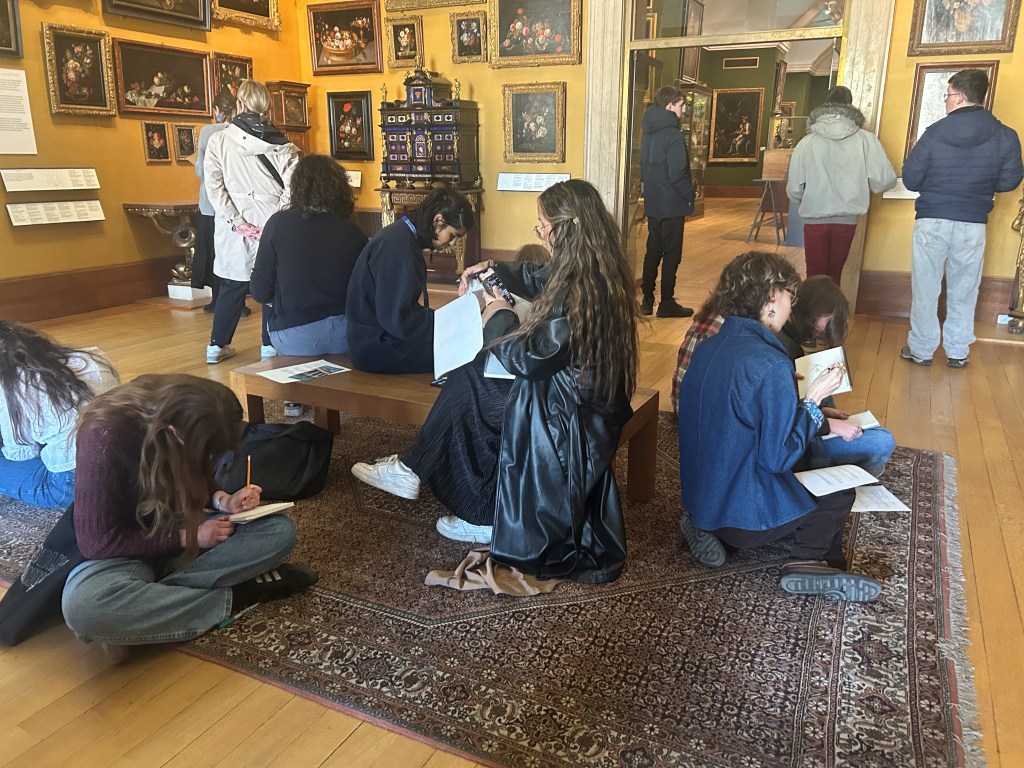
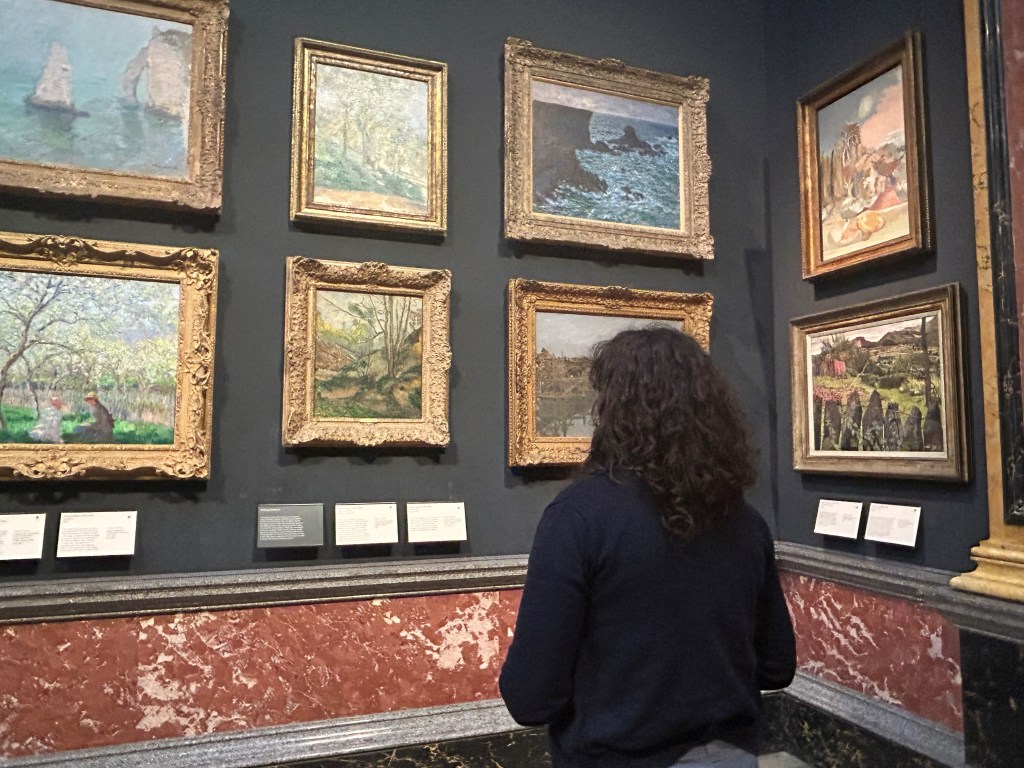
Creative research methods, including slow looking —spending extended time with a single artwork rather than moving quickly through a gallery (fig.1)— revealed that well-being for the group was often rooted in simple experiences such as being in nature, listening to music, making something, or sharing quiet moments with others. The museum’s collection became an important part of these explorations. Through empathy and imagination exercises, participants were invited to step inside artworks and move beyond looking into feeling. One participant, engaging with Monet’s Springtime (fig.2), described a vivid, multisensory moment:
Light above, making me squint. I can see blossoms; pinky-rose tones contrasting against the bright blue sky and the lacy clouds drifting past. I can hear birdsong, softly rustling leaves, and quiet laughter from the people ahead. I can smell the grass, tree bark, and —faintly— the stream. No one can find me here, it’s so good to lie in the grass, hidden from the hurly burly. I take a deep breath and close my eyes. I feel safe and completely at peace.
Objects opened up unexpected conversations. A 12,000-year-old carved fragment of reindeer bone gave participants a powerful sense of perspective, triggering reflections on time and our place within a much older human story. Ancient funerary objects invited discussions about remembrance, grief, and the things that bring us comfort. Botanical paintings became windows into the natural world, allowing people to imagine themselves somewhere quieter and greener, while Japanese kintsugi (the art of restoring broken pottery) resonated as a symbol of resilience, healing, and the beauty of repair.
Growing a Magical Garden
We chose the Creative Studio as the location for Happy Place rather than one of the museum’s permanent galleries. Its flexible space allowed participants to develop, test, and refine ideas while prototyping a different kind of museum experience designed for emotional restoration. The space’s constraints —low ceilings, no natural light, and restrictions on the use of organic materials— shaped the design. Instead of creating a realistic garden, co-designers imagined an overgrown, slightly magical landscape that captured the feelings they associated with being in the natural world.
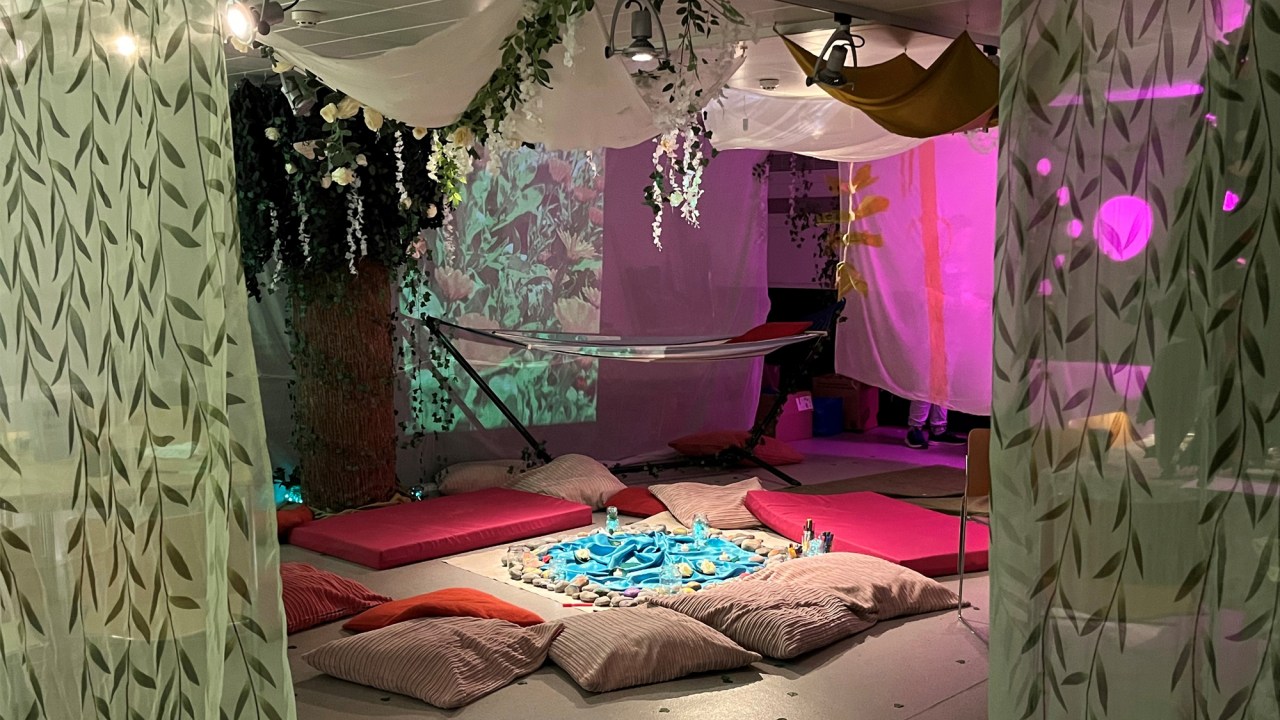
Participants repeatedly described green spaces as places they felt calmer and more themselves and as difficult to access in everyday life. Happy Place became an imaginative landscape celebrating curiosity, imperfection, and delight rather than a realistic garden (fig. 3). Constructed largely from recycled materials, it embraced a visibly handmade aesthetic that reflected peoples’ environmental values and their preference for spaces that felt welcoming and unapologetically imperfect.
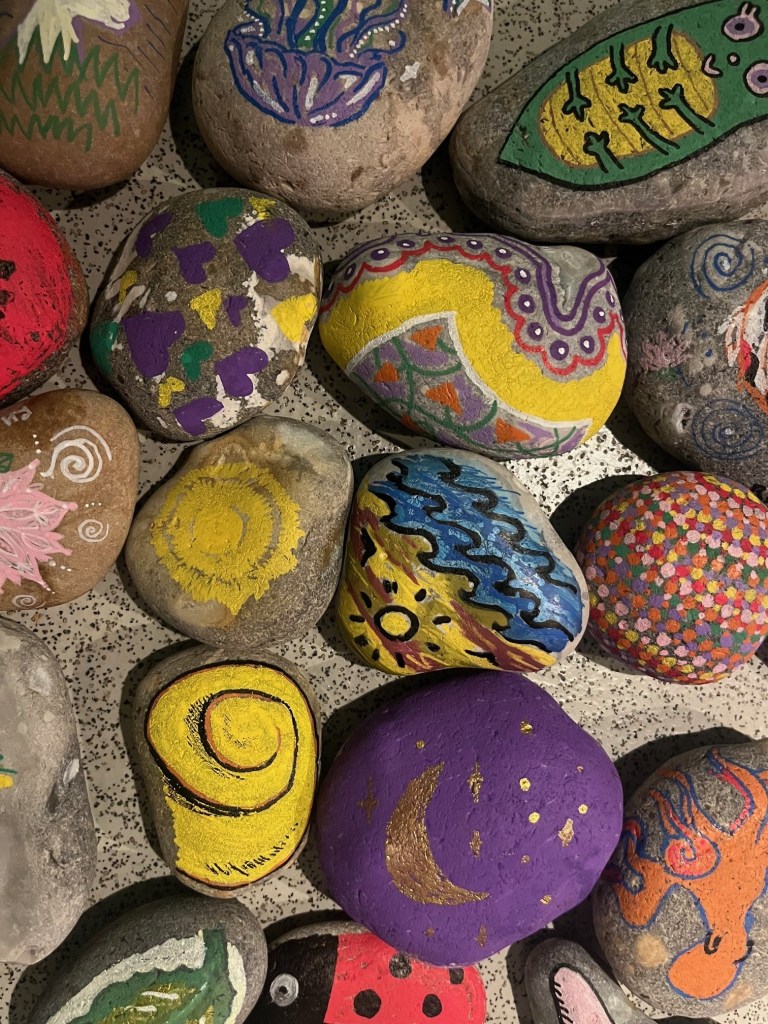
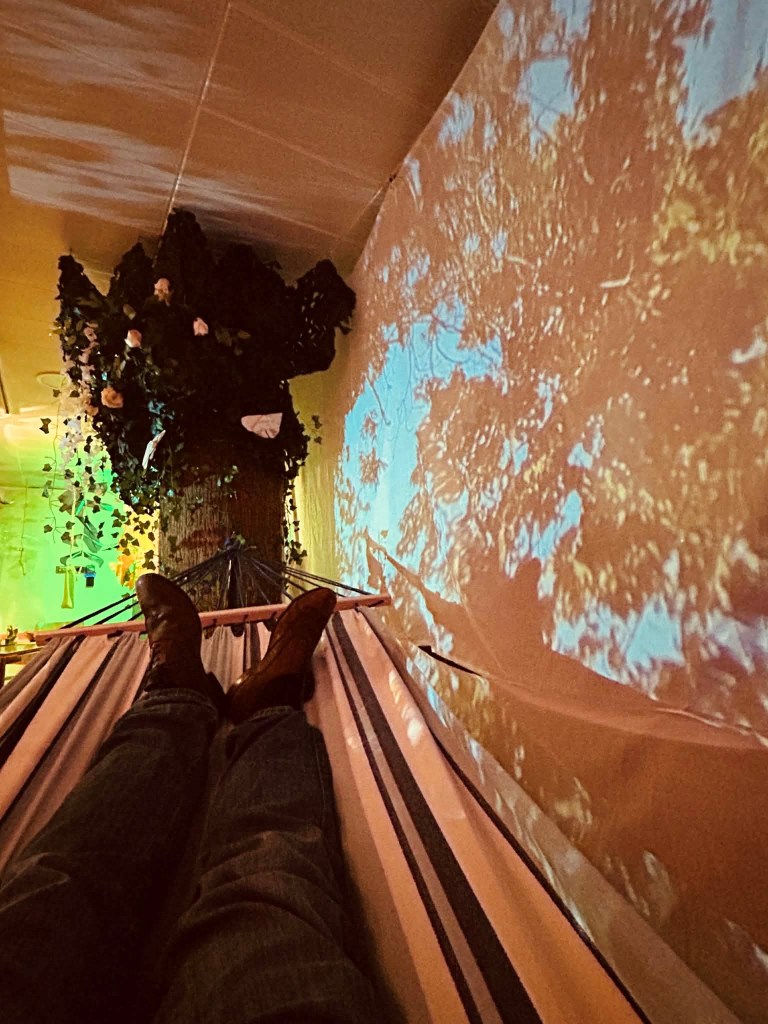
Cardboard was cut and layered to create a forest of head-high 3D trees, while organic forms gradually softened the hard edges of the room. Bed sheets in shades of green, gold, and brown became translucent canopies reminiscent of hanging branches, blossoms, and leaves, suspended from the ceiling with magnetic hooks. Origami butterflies, birds, and flowers folded from old sheet music brought movement and life to the cardboard foliage (intro image). Visitors were invited to sit, rest, and decorate rocks as a simple act of reflection (fig. 4). Soft floor lamps, twinkling fairy lights in repurposed jam jars, and oversized cushions created nest-like spaces for gathering or retreat, while a suspended hammock beneath the leafy canopy offered a secluded place to relax.
A soundtrack combining birdsong, wind, and water sounds created a feeling of distance from the outside world. Projected footage, captured by the group on their mobile phones, animated the space with close-up details of swaying grass, nodding flowers, and bees filmed in local fields and gardens.
Fragrance became one of the installation’s most subtle yet powerful design elements. Conversations during the co-design process repeatedly returned to the smells of the natural world as powerful triggers for well-being. Aroma boxes with blends of grass, jasmine, rose, and moss were placed throughout the space, with scents building and fading as visitors moved, encouraging them to slow down. As one visitor reflected, “I felt relaxed as soon as I walked in. The smell was delightful, so evocative of walking through a summer garden, and I could hear the bees buzzing away.”
The installation was organized into loosely defined zones, each responding to a different emotional need:
- Connection invited quiet chat and shared reflection over cups of tea, with playful gnomes and gentle prompts to spark discussion.
- Calm created a space where visitors could breathe, rest, and settle in the hammock, surrounded by birdsong, rustling leaves, and mossy aromas.
- Creative offered mindful making activities, with no expectation that anything should be polished or permanent.
The result was a living museum experience that rewarded lingering, connecting, and recharging rather than looking or learning.
Emotional Pacing and the Permission to Slow Down
Happy Place deliberately resisted the pace of everyday life. There was no fixed route, no expectation of completion, and no single “right” way to engage. In contrast to the hectic lives young adults described, it gave permission to slow down and choose how, or even whether, to take part. This approach extended through Happy Hour, a program of mindful lunchtime activities including yoga, crochet, printmaking, and aromatherapy. Designed around participants’ busy lives, the short weekday sessions made well-being feel less like another commitment and more like a natural pause in the day.
The self-guided tour, Down the Garden Path, carried the experience of Happy Place beyond the Creative Studio into the museum’s permanent galleries, weaving the installation and the museum’s collections into a single, restorative experience. An illustrated booklet, available at the entrance, invited visitors to follow a gentle botanical trail, creating the impression that the overgrown garden had spread throughout the Fitzwilliam. Reflective prompts and creative activities encouraged people to wander, to notice, and to encounter carefully chosen objects in new ways. Along the route, visitors could collect garden creature stickers to transform the booklet into a personal record of their experience. The trail ended back at Happy Place, where a cup of tea offered a final moment for pause and reflection.
The impact of this approach was evident in how visitors used the space. Happy Hour programs and Down the Garden Path were consistently described as grounding, accessible, and free from pressure. As one visitor reflected, “My breathing slowed, my body felt less tense, and I could feel my heart rate coming down.” More revealing still was how long people chose to stay. Many remained for several hours, moving between making and conversation. Others laid in the hammock, sitting in stillness or even sleeping beneath the cardboard canopy (fig. 5).
Measuring What Matters
Happy Place was evaluated using a mixed-methods, participatory approach, reflecting the project’s ethos of care and collaboration. Alongside visitor surveys, interviews, and creative responses, participants helped define what meaningful impact looked like, identifying outcomes such as feeling more welcome, more able to slow down, and more confident engaging with the museum.
During its four-day public run, Happy Place welcomed 403 visitors, with 49 people completing surveys.[9] Every respondent reported a positive change in mood after visiting, often describing an immediate sense of ease or relief on entering the installation. Visitors particularly valued the freedom to engage on their own terms, moving between solitude and connection without pressure. The exhibition received an average engagement score of five out of five, prompting one person to remark, “This is absolutely amazing—every museum needs a Happy Place.”
The creative development process itself also proved restorative. Participants spoke of feeling more valued and connected, while many described rediscovering creativity, playfulness, and confidence. As one participant reflected, “Happy Place was fun . . . it gave me permission to play as an adult.”
The evaluation also highlighted a challenge for exhibition practice. Conventional measures such as visitor numbers, dwell times, and completed activities reveal only part of the story. Some of the project’s most significant outcomes were remarkably quiet: people resting in the hammock, sitting in stillness, returning repeatedly, or simply spending time. As one visitor reflected, “It was wonderful to relax in such a caring, safe space. Today’s visit has soothed my soul.”
Happy Place suggests that these moments are not signs of passive engagement but meaningful outcomes in their own right. Rather than asking only, What did visitors do? we might also ask, What did the exhibition make possible? By inviting participants to help define success from the outset, the project also broadened how impact was understood, placing lived experiences of belonging, restoration, and connection alongside more traditional museum metrics.
Joy as a Serious Strategy
The Fitzwilliam has a long tradition of exhibitions centered on artists, collections, and art history. By contrast, Happy Place began with a question about well-being and the emotional experience of visitors. While colleagues were enthusiastic about exploring this new territory, there was understandable apprehension: Could an exhibition centered on hammocks, handcrafted cardboard trees, and opportunities simply to rest be taken seriously? Could designing for joy deepen, rather than dilute, engagement with collections?
These conversations became one of the project’s most valuable outcomes. They revealed that genuine co-creation is less about implementing every idea than negotiating between participants’ aspirations, institutional identity, and practical realities. The young adults wanted to shape the installation and its visual identity, interpretation, and publicity, sparking discussions about creative ownership, artistic expression, and decision-making. Some ideas—hiding garden gnomes throughout the galleries or dressing the museum’s iconic stone lions in seasonal costumes, for example—were enthusiastically explored but ultimately not pursued because they stretched beyond the museum’s established visual identity and public presentation. These discussions were not failures; they demonstrated how exhibitions are built through dialogue, compromise, and shared decision-making.
The public opening marked an important turning point. Visitors engaged deeply with both the installation and the collections, often staying far longer than anticipated and describing the experience as joyful, thoughtful, and restorative. Equally revealing was the response from colleagues. Many museum staff enthusiastically joined creative Happy Hour activities, dozed in the hammock, and spent time in the space during their breaks. Several even commented that they wished something similar existed more permanently within the museum. What had begun as an experiment quickly became a catalyst for wider conversations about how we care for our staff and visitors through immersive design techniques and future well-being exhibitions.
Perhaps the project’s most significant organizational learning was that designing for joy strengthened rather than diminished engagement with collections. Participants connected more deeply with objects through slow looking, imagination, and personal reflection, bringing their own memories into dialogue with artworks and artifacts. Joy functioned not simply as an emotional outcome but as a mechanism for collaboration, trust, and institutional change.
Rather than treating well-being as something delivered through programs or activities, Happy Place suggests it can be intentionally designed into exhibitions through the choices we make. Designing for joy became one way of achieving this—not because joy itself can be designed, but because exhibitions can create conditions in which it is more likely to emerge. In a world where noise increasingly compels our attention, designing exhibitions that foster well-being through quiet moments of joy may be one of the most radical acts museums can aspire to.
[1] Ray Oldenburg, The Great Good Place: Cafés, Coffee Shops, Community Centers, Beauty Parlors, General Stores, Bars, Hangouts, and How They Get You Through the Day (Paragon House, 1989), 14–16.
[2] Helen J. Chatterjee and Guy Noble, Museums, Health and Well-Being (Ashgate, 2017), 19–27.
[3] John H. Falk, The Value of Museums: Enhancing Societal Well-Being (Roman & Littlefield, 2021), 45–52.
[4] Daisy Fancourt, Art Cure: The Science of How the Arts Transform Our Health (Cornerstone Press, Penguin Random House, 2026), 42, 238.
[5] Daniel Fujiwara, Museums and Happiness: The Value of Participating in Museums and the Arts (Arts Council England and Museum of East Anglian Life, 2013); Daniel Fujiwara and George MacKerron, Cultural Activities, Art Forms and Wellbeing (Arts Council England, 2015), 25–37.
[6] “How do we find peace and joy in this time?” Teaching Resources, Museum of New Zealand Te Papa Tongarewa, accessed July 23, 2026.
[7] NHS England, Young People’s Mental Health Statistics Report (NHS England, 2024).
[8] World Health Organization, Mental Health of Young People: Global Report (WHO, 2024).
[9] Visitors who completed the survey ranged from eight to 81 years of age.
Becky Jefcoate is Practitioner Research Associate, Collections & Wellbeing, at the
Fitzwilliam Museum, University of Cambridge, in Cambridge, United Kingdom.
Upcoming Events
-
From Informational Interview to Real Connection
Event Date:Presented by: American Alliance of Museums and National Emerging Museum Professionals Network -
Understanding the U.S. History Workforce
Event Date:Presented by: American Association for State and Local History (AASLH) -
TrendsWatching: To Live or Die in AI Webinar
Event Date:Presented by: American Alliance of Museums -