This article originally appeared in the March/April 2019 issue of Museum magazine, a benefit of membership with the Alliance. Click here to learn more about membership!
On June 5, 2018, on Twitter and Instagram, Paola Mendoza posted a group shot of children ages 3 to 10 on the steps of Immigration and Customs Enforcement in New York City. The shot was an homage to the iconic Ernest Withers’ photograph of the 1968 Memphis sanitation strikers with I AM A MAN signs. In her initial posting, Mendoza stated: “A child is a child no matter what country they were born in. A child is a child even when they cross the border. A child’s desire to stay with their parents is a human right. In homage to the iconic I AM A MAN photo, I am proud to present I AM A CHILD.”
After she posted the photos, teachers on Twitter began to ask Mendoza if they could use the photos in their classrooms. I, too, wanted to use the photos—for an exhibition at the National Civil Rights Museum (NCRM). I reached out to Mendoza via direct message on Twitter and via email. She called me within a couple of hours, and we briefly talked about potentially collaborating on an exhibition; we planned to talk the following week with the rest of the NCRM Interpretation, Collections & Education team.
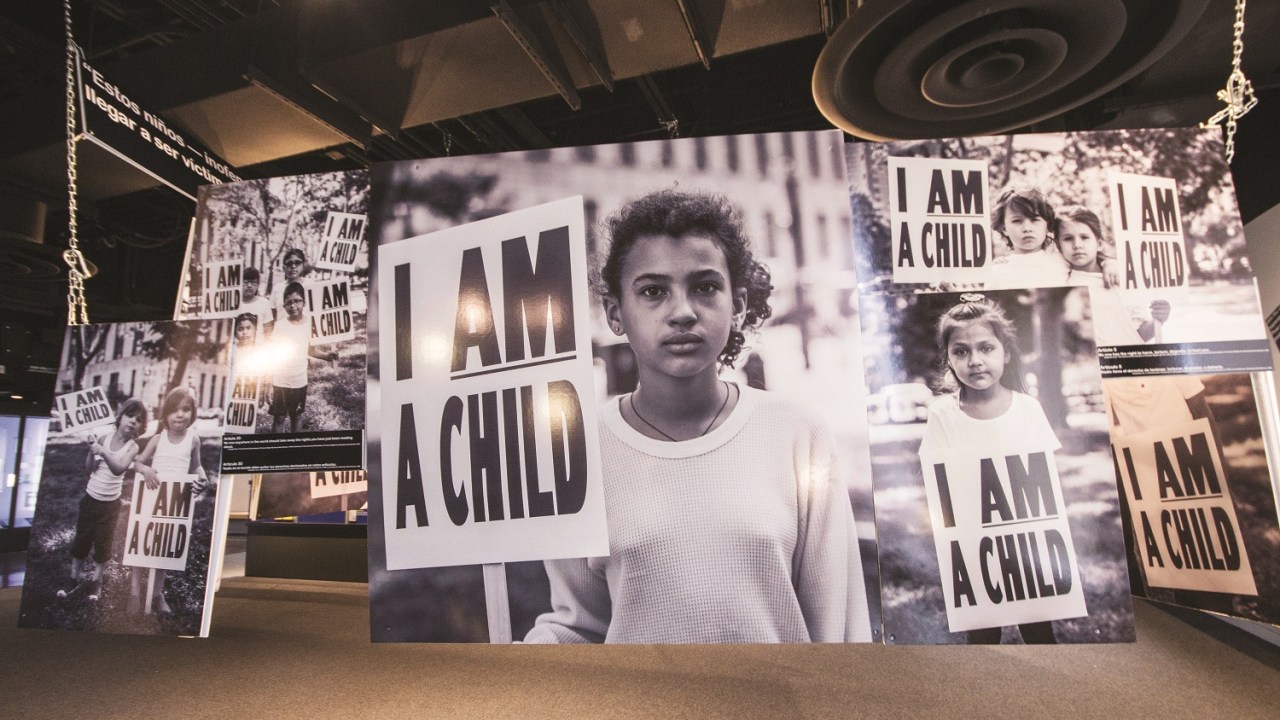
Fast forward to July 26, 2018, a few weeks after Mendoza’s initial posts. On that day, NCRM staff gathered for a quick photo shoot in front of its latest exhibition, “I AM A CHILD,” as part of a national day of action to draw attention to the ongoing family separation crisis at the US-Mexican border. The photo would be posted and shared on social media, a fitting launch for an exhibition that essentially started on Twitter and went from concept to opening in approximately 45 days.
Why We Needed to Do This
NCRM is located in Memphis, Tennessee, in the historic Lorraine Motel, the assassination site of Dr. Martin Luther King Jr. Opened in 1991, NCRM is the first museum in the United States specifically dedicated to telling the African American civil rights story. The museum’s mission is to chronicle key episodes of the American Civil Rights Movement, examine today’s global civil and human rights issues, provoke thoughtful debate, and serve as a catalyst for positive change. With this mission, NCRM has a unique ability to address both historical and contemporary issues through exhibitions, programming, and collections.
I AM A CHILD was a bold human rights statement inspired by the 1968 Memphis Sanitation Strike, which brought King to Memphis. The Memphis Sanitation Strike began on February 12, 1968, after two sanitation workers, Robert Walker and Echol Cole, were tragically killed in the back of a malfunctioning garbage truck 11 days earlier. Sanitation workers were, at the time, among the lowest paid city employees, and they had been demanding better working conditions from the city government for years.
The phrase “I AM A MAN,” which was printed on signs carried by the striking workers, had several inspirations. In February 1968, noted activist and strike supporter Rev. James Lawson told the sanitation workers: “For at the heart of racism is the idea that a man is not a man, that a person is not a person. You are human beings. You are men. You deserve dignity.” Also, in the segregated South, “boy” was frequently used to address black men regardless of their age. The assertion that black men and women were not children was a rallying cry against the systemic racism they were experiencing.
In the famous sign created by African American Joe C. Warren and white minister Rev. Malcolm Blackburn, AM is underlined. The emphasis on this verb affirmed their present state of being and reasserted their humanity and human rights. Since 1968, I AM A MAN and I AM A WOMAN signs have been used throughout the US labor and civil rights movements.
In the case of I AM A CHILD, the slogan was used to emphasize the humanity, innocence, and vulnerability of society’s youngest members. At the border, children were being ripped away from their parents and given responsibilities beyond their comprehension. Children as young as 2 were placed before judges as major life-altering decisions were being made on their behalf.
The children of asylum seekers were being treated as adults in the public sphere; their vulnerability and innocence was lost in the dialogue.
About the Exhibition
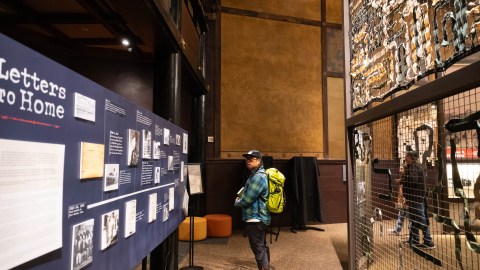
The connection between I AM A CHILD and its predecessor I AM A MAN was clear, and NCRM made that connection apparent to our visitors. The exhibition was placed in the Legacy Building, which is located across the street from the Lorraine Motel. Since the exhibition appears at the end of the visitor’s experience, chain-link fencing was used to mount and hang the photos and panels. In addition to clear, succinct interpretive panels, we incorporated paraphrased excerpts from the Universal Declaration of Human Rights into the overall design.
For example:
Article 1 All people are born free and equal with dignity and rights. People should treat each other kindly and nicely.
Article 2 Everyone has the same rights, no matter their skin color, their language, their gender, how much money they have, what religion they practice or what they believe in, where they come from, what country they live in, or their political beliefs.
A paraphrased quote from King on the tragic deaths of the young girls killed in the 1963 bombing of the 16th Street Baptist Church in Birmingham, Alabama, hung above the exhibition: “These children—unoffending, innocent, and beautiful—should never become victims of vicious crimes perpetrated against humanity.” The exhibition also featured an iPad stand with an open-source, illustrated version of the Universal Declaration of Human Rights and a selfie area with a chalkboard background featuring “ALL CHILDREN HAVE RIGHTS” with words like “family,” “home,” “friends,” etc., in English, Spanish, and Arabic.
In a major achievement, we translated all of the exhibition text, including social media hashtags, into Spanish. Foreign language translation is notoriously expensive, but we were able to crowdsource the translation through the staff’s network of local Spanish speakers. The Spanish translators’ time and expense were processed as an in-kind donation to the museum. We also gave them passes to the museum.
Flexibility was the key to success for “I AM A CHILD.” Initially, the museum team wanted to include more detail on the history of immigration in the exhibition. However, time and existing commitments made this unrealistic. Instead, the team focused on the most immediate needs: acquainting visitors with the family separation crisis at the border, introducing them to the concept of human rights, and opening the exhibition while the issue was still receiving a high level of media coverage. We created the exhibition, which ran through the end of 2018, with the assumption that additional details could be added as the issue evolved.
To make rapid-response exhibitions a reality, museums also need to be flexible with time, money, and resources— which can advantage small to medium-sized institutions. This flexibility, however, still needs to coexist with an institution’s standards for exhibition design and research. We were able to minimize costs by printing the images on gator board and using our in-house exhibition preparator/designer for the exhibition design, fabrication, and installation.
More than an Exhibition
The successful launch of the “I AM A CHILD” exhibition led to the second phase of the project. On September 30, 2018, NCRM, along with Mendoza and photographer Kisha Bari, who collaborated with Mendoza on the New York City photo shoot, hosted an I AM A CHILD photo shoot at the museum. After months of planning and collaboration, this was the first face-to-face meeting between the museum team and Mendoza and Bari.
The Memphis photo shoot differed in several ways from its New York counterpart. Since Memphis was ground zero for the I AM A MAN protest, NCRM invited Jesse Jones, the son of union organizer and strike leader Thomas Oliver “T.O.” Jones, along with men who were in Memphis in 1968, local fathers with their children, and museum tour guides to participate.
The men held I AM A MAN signs while children of diverse backgrounds held I AM A CHILD signs.
The group portrait, as well as individual portraits, offered a visually stunning link between the past and the present. The goal of the Memphis photo shoot was not only to create an I AM CHILD series unique to Memphis, but also to educate the participants about the 1968 Sanitation Strike and the importance of protest.
Additionally, our K-12 educator, Dory Lerner, designed a program where she read children books on protesting—Cynthia Levinson’s The Youngest Marcher—and on the Universal Declaration of Human Rights—Alexandra Penfold’s All Are Welcome Here. The children then created their own signs about what they would stand up for using large index cards and popsicle sticks. The I AM A CHILD—MEMPHIS photo shoot was launched via digital gallery at the end of October 2018.
Family trauma at the border has not stopped. In December 2018, two children tragically died in US detention facilities near the border. Thousands more children remain separated from their families.
Museums are not direct services agencies; however, they have a unique role in shining a light on social injustices and compelling audiences to re-examine a variety of issues. If museums are to be engaging public spaces, deploying exhibitions on contemporary issues is a critical piece of our work.
Rapid-Response Exhibition 101
Museums that want to engage visitors on the pressing issues of today will need to throw out their regular exhibition development timelines. Here are some things the National Civil Rights Museum learned in rapidly deploying the “I AM A CHILD” exhibition.
- Create an MOU among all project participants to prevent misunderstandings.
- Be innovative and creative with the concept and implementation. You can do a lot with a little.
- Do your research. Museum-level standards of research and vetting should always be observed no matter the timeline.
- Be flexible and consider installation in phases as the issue evolves.
- Get buy-in from staff at all levels of the organization.
- Communicate, communicate, communicate! Calls, emails, and documents reinforcing process, designs, and implementation are critically important to holding a successful exhibition on an abbreviated timeline.
Noelle Trent, Ph.D, is the director of interpretation, collections and education at the National Civil Rights Museum in Memphis, Tennessee.