This article originally appeared in the September/October 2019 issue of Museum magazine, a benefit of AAM membership.
Over the past decade, the Oakland Museum of California (OMCA) has begun to apply the principles of equity and inclusion across all aspects of its work. Building on several decades of community engagement programming, we have focused on dismantling the barriers to participation for low-income communities and communities of color in our surrounding area, and we have worked to reflect and authentically engage the full diversity of people living in our community.
In addressing those goals, we realized very quickly that we also needed an internal focus. We wanted to create an environment where staff members feel comfortable bringing their whole selves to their work; we needed to provide appropriate resources and tools for our staff, and we needed to measure the effects of the changes we’re making so that we can make the appropriate staff investments.
In making these changes, we’ve learned how hard it is to create a “new normal.” As new team members come on board, we’ve recognized the tendency to drift back to the status quo, and we’ve realized tools that worked at one point outlive their relevance over time.
Nonetheless, we believe that any museum can also do this work, albeit with a slightly different approach that fits its own culture and context. The important thing is to start and then keep going. And while we don’t have all of this figured out, we hope this behind-the-scenes peek at some of the tools and techniques we’re using at OMCA can be a jumping-off point for your own efforts in creating a more inclusive and relevant organization.
Create New Roles and Structures
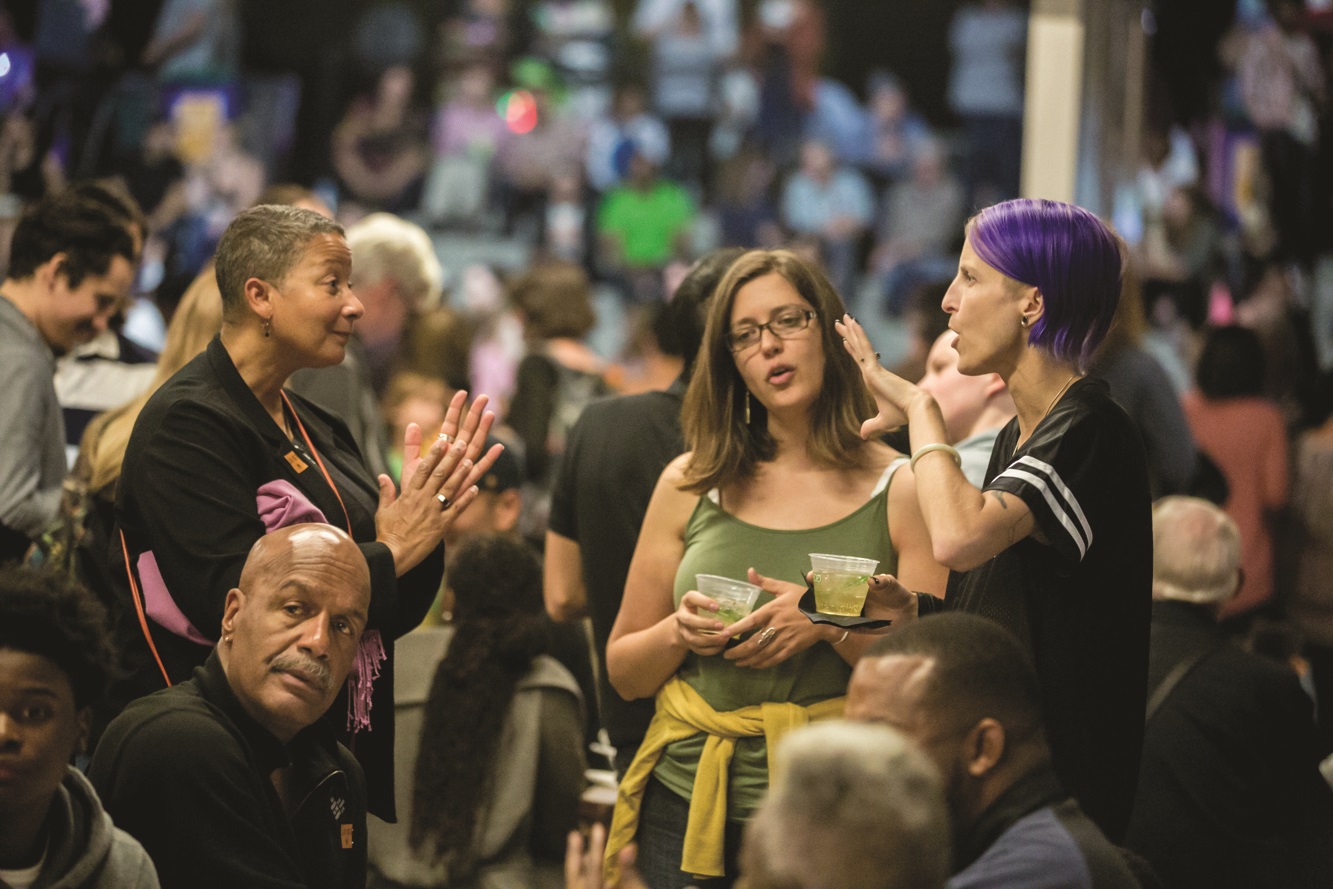
As new staff members of different demographics and experiences joined our ranks, and as we thought more deeply about the practice of collaboration and inclusion, we began to consider the tools and structures we would need for different kinds of interactions and decision-making.
No department or function has been left untouched. Some of the changes include:
- Redesigning our organizational structure into a “flower” shape, a shift from the tradtional hierarchical structure, to encourage more collaboration between functions and departments and to put the community at the center of our work. For example, our marketing and public programming functions are now both within the Center for Audience and Civic Engagement. This allows us to consider the full continuum of audience engagement, starting when visitors learn about the museum through marketing efforts and progressing to their deeper engagement through on-site programming.
- Creating new roles such as “experience developers” who work alongside curators to make
exhibitions more interactive and accessible to all kinds of learning styles and experiences and support the work of community collaborators. In addition, we have gallery guides” who are responsible for supporting visitors’ responses to exhibitions and customizing their visit and experience. - Shifting role responsibilities so that our curators aren’t just the sole content experts, but instead act more as facilitators of many different kinds of knowledge from many different kinds of people.
- Establishing frameworks for collaboration within all aspects of our work. We have created a practice that allows stakeholders from across the organization to weigh in early and often on a range of institutional projects, from our seasonal exhibition and program calendar to revenue generation and beyond.
We’ve profoundly changed the way we work,” says Rene DeGuzman, our director of exhibition strategy and senior curator of art. “Curators are no longer the default experts with everyone else bowing to the altar of our knowledge. We want to learn what issues our community believes are important, what cultural forms should be represented here, how aesthetics are different across communities. We can’t do any of that without talking to, and collaborating with, each other and the people in our community.”
Invest in Internal Capacity Building
We’re asking everyone on staff to potentially modify their behaviors and ways of thinking, so we need to provide the tools and support system for those changes to stick. Everyone comes to work with their own set of power and privilege dynamics, so we’re learning to practice the harm-reduction model of meeting people where they are and investing in knowledge-building. Specifically, we are:
- Offering training around equity and inclusion for all museum staff. We are using multiple strategies, including all-staff trainings, cohort learning in partnership with community facilitators, and function-specific workshops such as customized training for frontline staff and volunteers, programmers, evaluators, and more.
- Offering training for specific exhibitions and programs to provide all museum staff with essential cultural competency, historical context, and vocabulary. This training allows staff to connect with visitors, and each other, around potentially sensitive topics highlighted in our galleries, such as queer history, Black power, and Native genocide. For some of these trainings, we partner with community collaborators to provide deeper and personalized knowledge. The education director for Our Family Coalition, an advocacy organization for LGBTQ+ youth and families, led staff and docent training for our “Queer California: Untold Stories” exhibition, for example, and the community programs manager for the African American Male Achievement Program of Oakland Unified School District provided training for our “Respect: Hip-Hop Style & Wisdom” exhibition.
- Learning from peer museums, which is critical to learning new ways of operating. We have sent staff to do field research at museums and brought people on-site from organizations we believe are at the forefront of equity and inclusion in our industry, such as the Levine Museum of the New South and the International Coalition of Sites of Conscience.
- Establishing “OMCA You,” our learning and professional development program for, and by, our staff members. The program allows staff to practice and share the technical and people skills required to be successful in a highly collaborative, community-engaged organization. We are committed to cultivating a workforce that expresses a sense of agency, collaboration, and empathy with colleagues and the external community in an effort to advance our mission, vision, and values. “I’ve worked in the museum’s finance department for eight years, so I’ve seen the change in the diversity of our staff and the vocabulary we’ve learned to use in conversation,” says Joan Perry, associate director, accounting and finance. “We all leave the office and carry those experiences and knowledge back to our own communities, so the changes don’t stop at the walls of our museum.”
Measure Progress
As a nonprofit organization, we are accountable to ourselves, our stakeholders, and our community. We have found that accountability doesn’t just happen on its own. We must be more transparent about what we’re trying to achieve, measure new things in new ways, and be more intentional about our actions and decision-making related to this work. Furthermore, it’s not enough that we hold ourselves accountable for achieving true equity and inclusion; we are providing the tools and resources to help our stakeholders and community also hold us accountable. Therefore, we are:
- Conducting evaluations of our staff and board to survey their demographics, attitudes, understanding of our goals, and their roles in relationship to those goals. We’ve learned that describing the difference you want to see and then measuring whether you achieved it can be transformative. For the past five years, we have conducted an annual anonymous staff survey to track agreement with statements like, “Our organization has a strong commitment to community engagement,” and “Representatives from our organization work to actively strengthen our ties to diverse communities.” We also conduct anonymous surveys of all staff involved in creating major new exhibitions to identify ways we can improve our work, and we facilitate exit interviews with all staff who leave the museum. We use all of this data to inform our planning and investments in staff training and process improvement.
- Creating a visitor metrics dashboard and sharing it widely across our staff. This is one of the more unusual ways we’ve tried to increase transparency and hold ourselves accountable. The dashboard tracks visitor demographics, attendance, and aspects of the quality of their experience, and it shows how we are performing against our goals. When we don’t meet our targets, we’ve had difficult but fascinating conversations across the organization about what we could do differently or how we might need to set different goals.
- Tying performance goals to how well individual staff members have implemented and lived these values throughout their department or role. Staff members have formal personal development plans and performance goals that help them set and achieve their intentions, plan their work and measure the impact they have on others, at all levels of the organization.
- Investing in research early in our equity and inclusion work by commissioning a Neighborhood Identity Report to better understand the key issues and needs of neighborhoods surrounding the museum. Insights directly from community members have laid the foundation for so much of our community engagement work over the past five years. In fact, our neighbors have reinforced the importance of providing spaces for communities to come together and celebrate diverse cultural traditions, and they have underscored the need to lift up Oakland’s multiple histories, particularly in the context of growing gentrification.
There are so many other ways that we are working to embed equity and inclusion principles throughout the museum. For example, we have changed how we recruit and retain new staff and board members, implemented more inclusive policies from human resources to collections, fundamentally shifted how we collaborate with community partners, and radically rethought our exhibition content to center on the relevant and pressing issues of our time and in our community.
“I think about very granular and prosaic changes we’ve made in the collections department to be a more equitable and inclusive organization,” says Valerie Huaco, director of collections. “For example, we look at industrial hygiene through a community engagement lens. Mitigating toxins used to preserve Native American materials is not just about worker safety, it’s about providing safe access to our Native community.”
As we’ve put these practices into place, we’ve learned two overarching things: equity and inclusion are a fundamental aspect of every person’s job, and a commitment to equity and inclusion has to affect the entire continuum of our staff, board, volunteers, community partners, and programming. So far, we’ve gotten good feedback from staff. “
This is the first institution that I’ve applied to that asked me what my pronouns were; that made me tear up in my onboarding meeting,” shares Scotty Graham, a gallery guide.
Our campus and our walls have changed every bit as much as our people and our processes, but we’re not finished yet—there are always new stones to uncover in practicing equity and inclusion.
Things We Keep In Mind Everyday
- Authentically engaging in this work takes time, practice, and investment.
- Set a specific goal, measure it, discuss the outcome, and take action.
- Repeat the vision and values more often than you think is necessary.
- Look out for implicit bias in “the way things have always been done.”
- This work is hard and ongoing. Be kind and generous to one another.
- Dedicate resources to internal community-building if you want to see long-term change.
- Expect and manage the tension between the self, the community, and the institution.
- Consider generational differences in communication, working styles, and expectations.
- The hardest work to do will always be just around the corner.
About the Authors
Lori Fogarty (she/her/hers) is director and CEO, Kelly McKinley (she/her/hers) is deputy director, and Ayanna Reed (she/her/hers) is director of human resources at the Oakland Museum of California.
Upcoming Events
-
Understanding the U.S. History Sector
Event Date:Presented by: American Association for State and Local History (AASLH) -
-
-
Industry Showcase: Innovative Digital Solutions
Event Date: