Here’s a happy thought: COVID-19 will—at some point—recede, and like pandemics of the past it will be history, another story to tell. But after the disease is gone, will any of the effects linger, possibly even forever? People have speculated as much, forecasting positive and negative effects on our economy, our public policy, and our professional and social lives.
In the museum field, many have asked whether some of the adaptations to programming and exhibitions will stick, with more available online and an increased focus on service to the local community. But what about museums’ physical presences themselves: their buildings? Will they be reimagined and reoriented to follow suit?
To find out, we talked to architects and engineers at two leading firms: Cooper Robertson—known for projects like the Whitney Museum and the Studio Museum in Harlem, and Buro Happold—a contributor to projects like the Academy Museum of Motion Pictures and the Louvre Abu Dhabi. Here’s what they had to say about planning in a pandemic.
Bruce Davis, Partner, Cooper Roberston
Beyond measures to create a safe environment for visitors and staff after reopening, institutions are all assessing the status quo and looking for opportunities in crisis.
Financial challenges are prompting reconsideration of planned expansions. In some cases, we are being asked to look at phased expansions that can better align with reduced funding projections. In other cases, there is a desire to wait and see regarding the longer-term impact of the virus before moving forward with future plans which may need to reflect new or modified strategic goals.
There are questions about whether attendance will continue to be an important metric driving museum growth, which has implications for space. Financial pressures are compelling museums to consider how to use their existing spaces more effectively and to question whether growth is necessarily the best way forward. Several of our recent museum planning projects have focused on existing spaces, finding ways to fix the mistakes made in earlier expansions. At the same time, the focus on online content has enabled museums to reach larger and broader audiences than is typically possible within their physical space. The expectation is that online engagement will, among other benefits, encourage more, and more diverse, in-person visitation in the long term.
Working from home arrangements have clear environmental and work-life benefits. More flexible work arrangements are likely here to stay and are expected to decrease the need for onsite staff offices and workspaces. A portion of these existing spaces could be repurposed, while the need for expanded staff spaces could decrease.
There is greater interest in strengthening connections to the outdoors with spaces for the display of art, for programs, and for dining. This relates to a larger trend of emphasizing spaces that foster a sense of health and wellbeing.
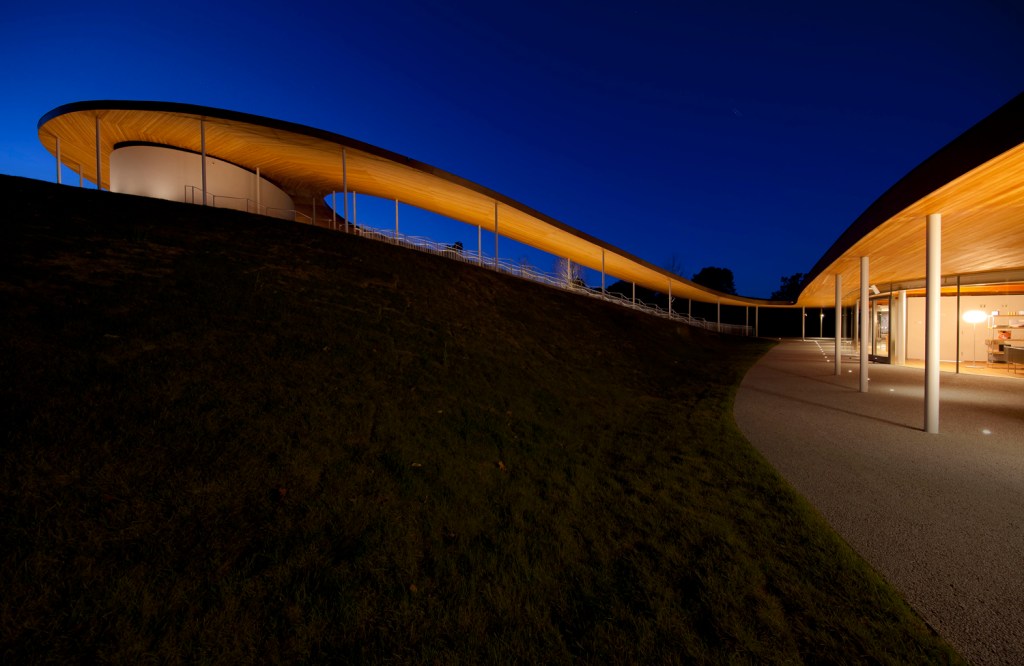
There is concern about how gathering spaces—classrooms, theaters, and event spaces—can continue to provide important sources of revenue for museums while social distancing remains necessary. Museums have been looking for new sponsorships that can support the use of gathering spaces for temporary artist programs or for performances with no or socially distanced audiences that are streamed online, although the revenue-generating possibilities for these activities do seem limited. Spaces with the inherent flexibility to transform from lecture or event hall to art spaces or other uses can better respond to the future, including unexpected changes such as those imposed by COVID-19.
In addition to their responses to COVID-19, social justice movements have compelled museums to prioritize how they can better reflect and engage with their communities. These actions could change the balance of space needs. While already a feature of many recent museum expansions, physical spaces will emphasize a greater sense of welcome and community, which can be expressed through an emphasis on flexible public spaces, the transparency between inside and outside, and the principles of universal design.
Ron Elad, Principal, Buro Happold
We’ve seen many and varied ideas for reopening museums, including some from cultural and performance venues like the Barbican Centre in London. These ideas offer potential avenues for museums that go beyond today’s baseline—which generally involves following state ordinances and guidelines and can lead to very generic solutions: reduced occupancy, for example, along with timed ticketing, timed exits, and touchless visits throughout. These offer some level of near-term risk reduction, but they are figuratively as well as literally sanitized, creating a much more sterile cultural experience. Additionally, most museums are offering no food and, in many cases, no restrooms or waste bins, and no group tours—which also highlights existential challenges resulting from a purely near-term approach: Cafés and gift shops are vital sources of revenue for a great number of institutions, for instance. How many can survive without these spaces?
At Buro Happold, our perspective is to work with museums to explore going beyond this. We’re asking, “How can we provide additional and different ways to support institutions in reopening, and not just follow prescriptive guidelines?” This is because for many museums (some of them are our clients), operating at prescriptive lower occupancy rates, such as 25 percent, means running at an operational loss.
We don’t have all the answers, but we do have certain analytic tools that can help address some of these challenges and increase visitor engagement. Instead of facing the prospect of reduced operational income, for instance, we’re helping our clients first by doing computer simulations of people movement analysis, which allows museum operators to see their specific spaces in use. In some cases, these data-based simulations show how spaces can allow entry to more people than the mandated occupancy rates would suggest, because of the spatial situations presented by the campus or building’s program. The analysis results also could provide additional scenarios, testing the benefits of modifying a facility’s spatial organization. For example, the scenario study could look at adding more entrances or exits and can consider how staff will be moving or assisting visitors. In concert with this, we’ve shown how museums can improve air quality with better HVAC and filtering and the supply of more outdoor air.
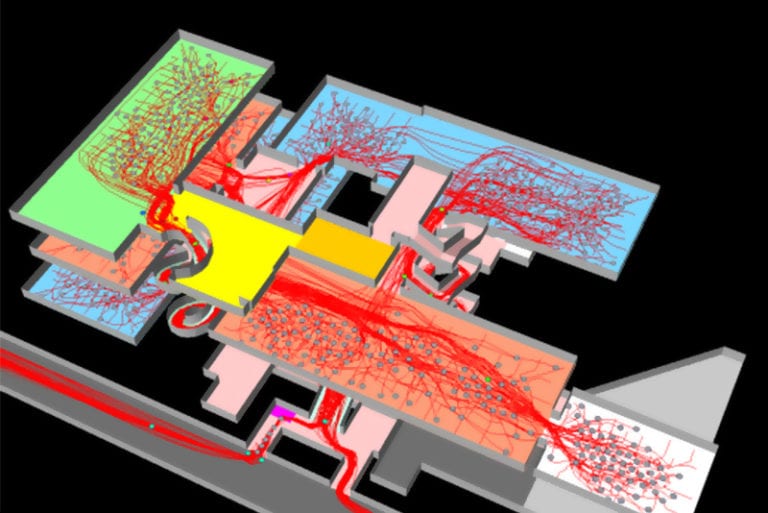
Armed with this data, we then study the chokepoints, bottlenecks, and pinch points that museums share—such as the entrances, queuing zones, and access area for exhibits. We develop unique strategies for restrooms, for example, to allow their use. For foodservice and cafés, we look at ways that all food may be consumed outdoors, which works for museums with the right environmental conditions. Similarly, those cultural venues may have opportunities for outdoor temporary exhibitions, if their artworks and exhibits can be properly protected. These provisional modifications have other benefits, for example, by offering patrons a change of pace from the usual museum experience.
We’ve found that museum directors and staff are interested in pushing the boundaries in these ways, though of course they also face significant financial hurdles and staffing issues during the COVID-19 recovery period. Still, those cultural leaders who are thinking most strategically about how to reopen have found unique avenues to boosting revenues.
Dealing with the current situation is very challenging, so a well-thought-out strategic approach is vital now, especially as institutions face layoffs—in some cases, 30 to 40 percent of their employees. Loss of tourism is a factor, which puts a dent in visitorship; loss of business travel, which has taken the biggest hit, also plays a role, since business tourism drives many museum visits as well. We are starting to see consolidation, and in some extreme cases the closings of smaller museums that play an essential role in serving communities, towns, and city neighborhoods that need them the most.
But challenges could also inspire other solutions stemming from collaboration between large and small institutions to make art more accessible and equitable. An example of this is Los Angeles County Museum of Art’s (LACMA) collaboration with Charles White Elementary School, a gallery that brings art to a wider range of underserved communities in LA County. Could this decentralized approach support more communities interested in high-quality, shared cultural experiences? In the current stay-at-home way of life, people are surviving with the sufficiency of digital cultural experiences, but in public they can share the luxury of the same thing.
In all events, through 2020 and into 2021, we will continue to be involved in this learning process alongside cultural leaders. We will see variances of the current situation, but with amendments to space and careful planning, institutions can begin to reopen—which is the most essential first step.
The museum experience will look and feel different than in the pre-COVID era, and we’ll have to be adaptable. Finding ways to allow the public to interact with these spaces and their exhibits is crucial for survival, and employing all the tools at our disposal will be essential. Cultural leaders are creative people, so we believe that in working together, we’ll find innovative paths forward.
Upcoming Events
-
AASLH-NCPH Joint Conference
Event Date:Presented by: American Association for State and Local History (AASLH)Providence, RI -
All You Need to Know to Drive Success for Your Museum Store Sunday!
Event Date:Presented by: Museum Store Association -
Transit Insurance in Practice for Traveling & Co‑Organized Exhibitions
Event Date:Presented by: American Alliance of Museums -
Digital Collections Summit
Event Date:Presented by: MuseumNext