This article first appeared in the journal Exhibition (Spring 2026) Vol. 45 No. 1 and is reproduced with permission.
The museum is a colossal mirror in which man contemplates himself, in short, in all his aspects.
—Georges Bataille, 1929[i]
Within the mission statement of most museums, there is often a clause about preserving objects for future generations. Many agree that we should hold on to certain things, that original objects from the past, present (and future) mean something. There’s a feeling of awe, a specialness about being in the presence of the “real thing.”[ii] As we find ourselves in a new era dominated by technology and artificial intelligence (AI), which creates, mimics, and distorts reality, how might museums also be thinking about the preservation of our humanity, and the “realness” of thinking and feeling that define human experience in the world? AI has been both heralded and feared for its potential to supplant human thinking and making.[iii] Increasingly it seems, the power of museums may lie in their ability to showcase and nurture what is unabashedly human.
The human-forward museum in the age of AI includes and goes beyond the idea of displaying human-made objects or the ongoing work of centering visitors and valuing staff. As interpretive specialists at the Denver Art Museum (DAM), we have been thinking about this much more broadly, across our work as a whole. What does it mean to center “humanness” in our exhibitions, interpretive work, and evaluations? In addition to the importance of showing original objects, in this article we’ll explore three characteristics of the human-forward museum work we have promoted in two recent exhibitions at the DAM: facilitating critical thinking, prompting emotion, and cultivating imagination.
Facilitating Critical Thinking
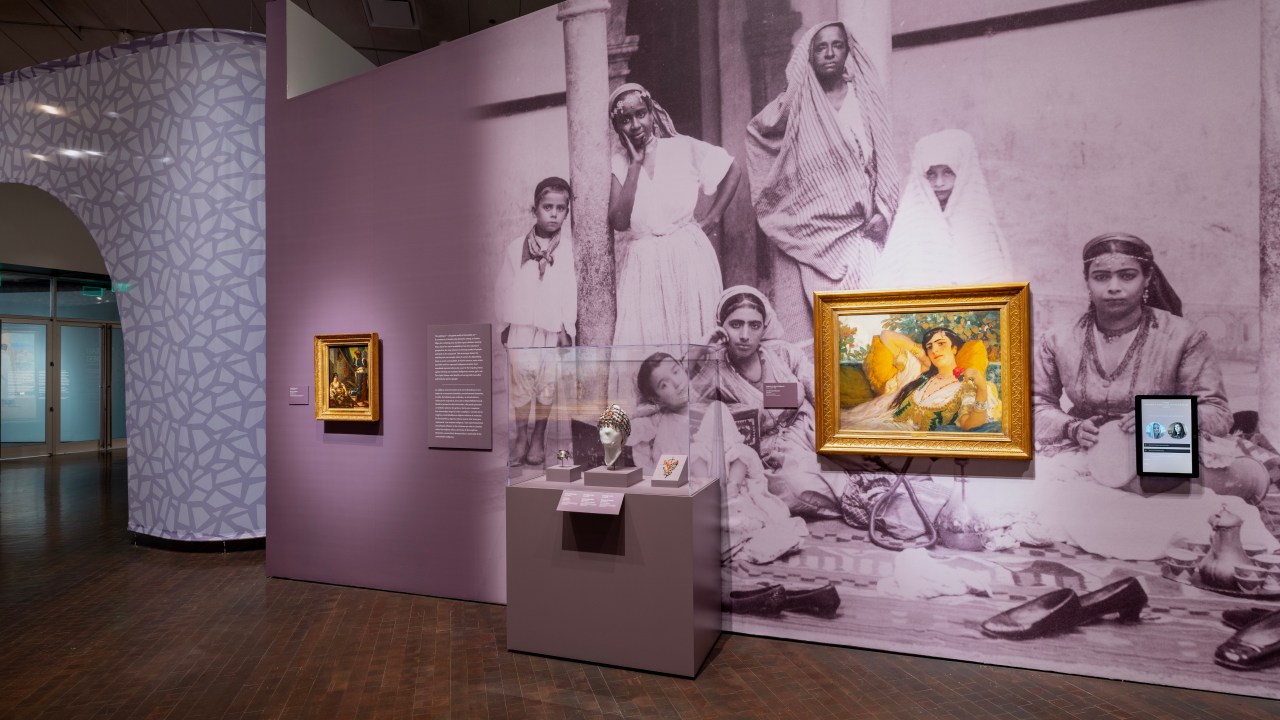
Near East to Far West: Fictions of French and American Colonialism opened in the spring of 2023 and looked at the parallels between French Orientalism and Western American art during the 19th century. Because of the close cultural and artistic connections between France and the United States, French Orientalism (an influential artistic style rooted in Western infatuation with and fictions about Arab and Islamic cultures), permeated American art, design, music, literature, and entertainment. A shared context of colonial expansion—France into Algeria and the United States into the American West—reinforced the popularity of Orientalizing motifs that artists used to depict the American frontier.
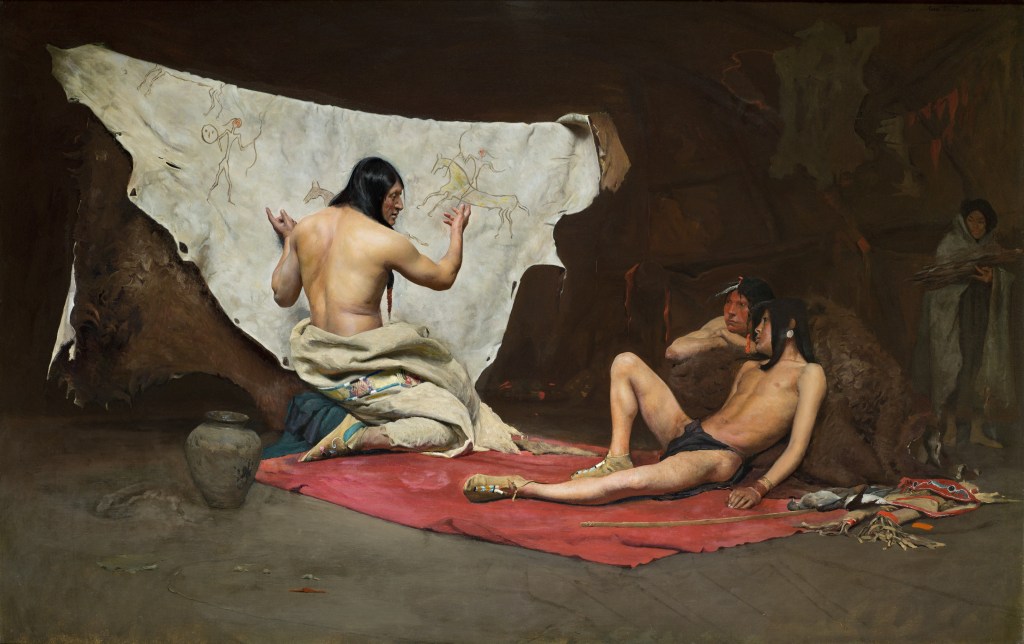
Many of the artworks on view appeared to present very real scenes, when in fact they are constructed from imagination, and only sometimes informed by memory or actual observation. Fictitious or stereotypical imagery of lounging Indigenous women (odalisques), violent men, and “exotic” locales seemed to look real and were painted with the aim of alluring the viewer. Our goal was to encourage visitors to cultivate a critical eye in the face of these artworks; simultaneously holding multiple, contradictory thoughts and feelings while considering the impact of this colonial legacy.
Would it be possible to help visitors disentangle fact from fiction? It is perhaps unsurprising that visitors would have difficulty discerning what was and wasn’t “real” in the paintings, given that the artists themselves were often not trying to present factual reality. For example, George de Forest Brush did not want to be considered an ethnographic painter and never even visited the Mandan people. His painting, The Picture Writer’s Story,from about 1884 presents a realistic depiction of the inside of a Mandan lodge and an authentic representation of Mandan culture. However, it is a fiction and relies on Orientalist tropes that may not be evident to the everyday person (fig. 1). It dawned on us that AI often seems to be doing something similar: referencing the real as it constructs fabrications.
In the 1950s, political theorist Hannah Arendt wrote about the distinction between cognition and thinking, describing cognition as the “technical, logical operation which electronic machines may be better equipped to perform,” and thinking as a process that “arises out of the actuality of incidents” and is bound to “living experience” as its guidepost.[iv] Thinking—critical thinking—tethered to personal experiences and emotions is unique to the human condition.
In Near East to Far West, we worked hard to infringe upon the overwhelming visual pull and authority of these paintings. Besides the exhibition text that asked visitors to consider important questions, we included community voice labels featuring quotes from individuals who participated in our visitor panels as they grappled with what they were seeing. Almost two years before the exhibition opened, we organized four visitor panels in which Arab, North African, and Indigenous community members were invited to respond to specific checklist images and the broad narrative themes of the exhibition. We asked questions such as:
- Which image most “speaks” to you? What does it “say”?
- Whose perspective is the story from?
- What more would you want to know about this story?
- Which image are you most confused by?
- Do any images seem problematic to you—or do you have concerns about an image?
We heard a lot of perspectives, sometimes conflicting ones. But certain themes surfaced over and over. We heard that being romanticized is a heavy burden. We also heard that these paintings carry real visual authority—that it feels like the artists were there. Although not initially planned, we felt that the questions that arose during these feedback sessions would help exhibition visitors “pull back the curtain” in critical ways if they were included on the object labels.
For example, in a label accompanying an 1895 Eugène Giradet painting of Bedouins riding camels through the desert, a community member asked:
Are we viewing these people in the paintings in the same way, today? Maybe in America we think we can look at a nineteenth-century painting of a cowboy on a horse and clearly understand it as historical. But, when the painting is of an “other,” do we view the person as static, as a real representation that extends into the present?
As a whole, the interpretive overlay worked to offer multiple perspectives with the goal of asserting the impact that these fictitious images had on real people. We also used massive supergraphics and in-gallery audio conversations between scholars and artists, deliberately setting the volume at a level that reached beyond the individual engaging with the touch screen. These were the voices, images, and viewpoints of community members that helped visitors see and think more critically.
According to the 2025 AAM Annual Survey of Museum-Goers, sharing “multiple perspectives about information presented” is one of the ways that respondents said museums demonstrate trustworthiness and credibility.[v] And writer and filmmaker Robert Capps, in the New York Times Magazine special issue about “Learning to live with A.I.,” writes, “At its core, trust is about accountability—and this is where a human in the loop is most critical.”[vi] We owe it to our visitors to uphold their high regard of our institutions by providing that crucial human-generated reassurance.
Prompting Emotion
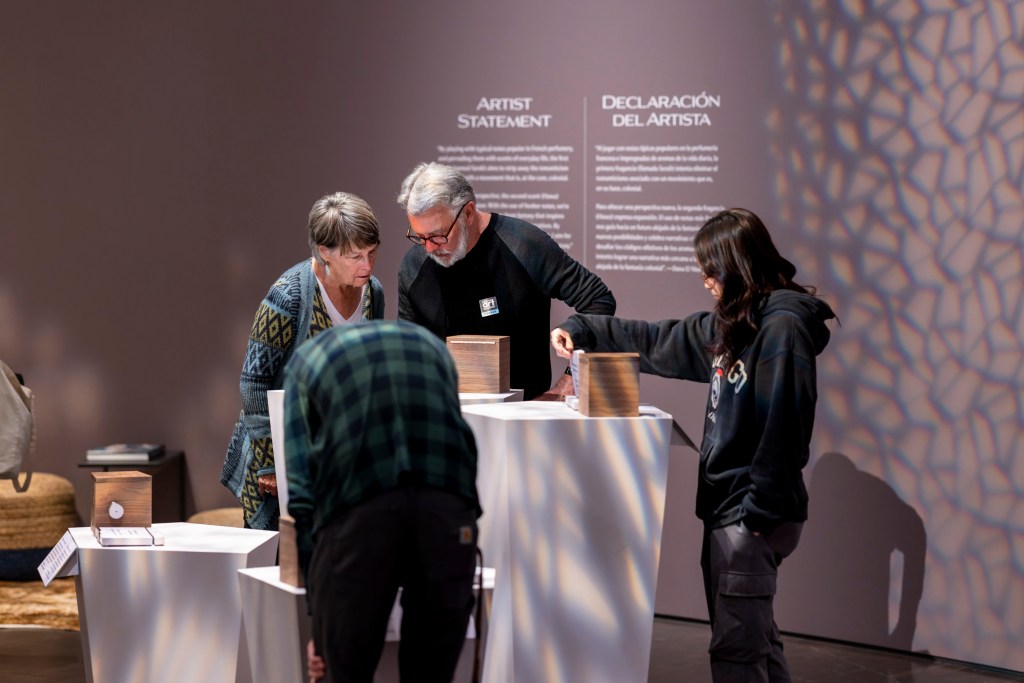
In Near East to Far West, we also brought in other senses by collaborating with perfumer Dana El Masri. Inspired by her Egyptian and Lebanese roots, El Masri created two scents that sought to help visitors think about their own assumptions and biases (fig. 2). Orientalism, with its far reach, even impacted the history of French perfumery. An Orientalist perfume tends to be considered heavy, spicy, and dark, with base notes like frankincense, myrrh, and/or amber.[vii] So, El Masri created one scent, Sarab, that sought to strip away Orientalist romanticism by combining these base notes with others taken from everyday life, such as saffron, black pepper, soil, dirt, and leather in argan oil. The second scent, Hawa, also used ingredients from the region, but was radically different, with notes of citrus and cedar. As El Masri described it on the label:
This version was an attempt to clarify, engage, and showcase the beauty of an “Eastern” culture without the fantasy, fetishization, and exoticization. Less heavy and opulent, this scent was brighter, fresher, and inspired by nature. It was the moment you breathe in the air of your homeland.
Our sense of smell helps anchor us to reality. Scents can trigger emotional and physiological responses, memories, and connections to nature.[viii] The scent experience in Near East to Far West was well received, with one visitor commenting: “The jewelry, the scents, the gold accents in the paintings, and the mosques all reminded me of home. Especially the scents—they connected to memories back home for my mother and me.” For many visitors, the strong connection between scent and memory was stirring:
Scent is an astonishingly resilient memory. The chaos of a market is evoked by saffron, soil, and leather.
Smells are one of the few ways I can remember a lot of things due to my messed up memory from a sleep disorder. It’s one of my most treasured sensory experiences, and something I seek more of constantly.
These are things that AI cannot give us (yet): memory and sensory-based experiences.
In the visitor response area that we designed, we asked visitors to comment on which scents reminded them of home (referencing El Masri’s quote), or to comment on how the legacy of Orientalism continues to affect them or their loved ones. We received thousands of responses and completed an evaluation after the exhibition closed. Although we coded for content that could help us determine if we had met our visitor experience goals (could visitors disentangle fact and fiction?), we also coded in a way that was more humanity-forward. According to our analysis, almost 30 percent of visitor responses referenced a memory they had or were reflective in some fashion. A quarter felt joy, while almost 10 percent felt sadness and 8 percent felt angry. The range of emotional responses, and the fact that a third of respondents had shared their own personal memories and reflections felt like success to us in terms of helping visitors connect to their own humanity.
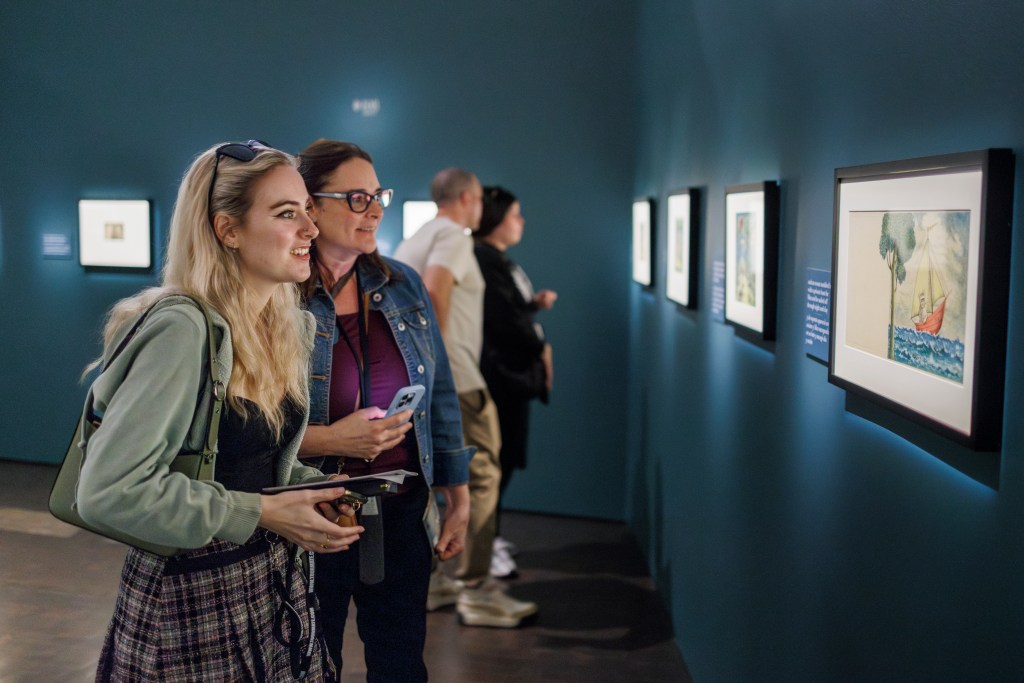
Memory and nostalgia also played an important role in the DAM’s 2024–2025 exhibition Wild Things: The Art of Maurice Sendak. It featured some 450 original artworks by the beloved children’s book author-illustrator—including those from his most famous book, Where the Wild Things Are, spread across the walls with their accompanying words, as the show’s centerpiece (fig. 3). Our key interpretive strategy for Wild Things was to let the artist himself—through large- and small-scale text, and through his own voice on videos and in the audio tour—tell stories about his life and his art. About two-thirds of the way through the show, we stocked a reading room with Sendak titles and blank notebooks where we invited visitors to “Share your Sendak story, your Maurice memory, your Wild Thing wistfulness.” Over the show’s four-month run, visitors of all ages (many of them volunteered how old they were) filled 37 notebooks with responses that revealed how incredibly impactful it was to see Sendak’s original artworks, and how these familiar images and stories were a catalyst for human feelings of nostalgia, comfort, memory, and self-reflection, such as:
This art exhibit has shown me the beauty of humans and our different expressions of love and connection. I feel most emotional and touched by the short passages I am reading in [this notebook] and how we were all brought together by the art and stories of Sendak. After all, isn’t this the purpose of art, to bring others together through beauty, expression, connection, relation, and love? I had a great experience here and loved seeing Sendak’s work and hearing his stories. Also, I love my mom, and my sister who came here with me.
This visitor’s sister responded simply, “I cried a lot.”
Cultivating Imagination
Returning to Capps’s work for the New York Times Magazine, he writes, “As A.I. expands, for better or worse, we will start to see a form of creativity without craft.”[ix] Capps writes this in the context of a future in which AI will increasingly produce things, but humans will still be necessary to design them. AI can spit out products and offer us answers. But—for now at least—only humans have the capacity to imagine.
Maurice Sendak used art and storytelling to process and escape from traumas in his life, just as the characters he created use imagination as a tool to grapple with life’s challenges and childhood fears and frustrations. The exhibition and the book that inspired its title had a similarly cathartic effect on our visitors (fig. 4).
In Where the Wild Things Are, Max—a child whose feral side is on full display, which was unusual for children’s book characters when the book was published in 1963—is reprimanded by his mom as a “wild thing!” and is sent to his room without supper. Max stews with anger, but his face softens as his room slowly transforms into a forest and he makes his way “through night and day and in and out of weeks and almost over a year to where the wild things are.” A place where he would, given his mom’s admonishment, find kindred spirits. After being crowned king and instigating a cathartic wild rumpus, he is ready to venture home, where his supper is waiting for him, “still hot.” In a matter of minutes (or seconds), Max has fantasized his way into quelching his anger and recognizing his mom’s unconditional love. Sendak himself said, “It’s only after the act of writing the book that, as an adult, I can see what has happened, and talk about fantasy as catharsis, about Max acting out his anger as he fights to grow.”[x]
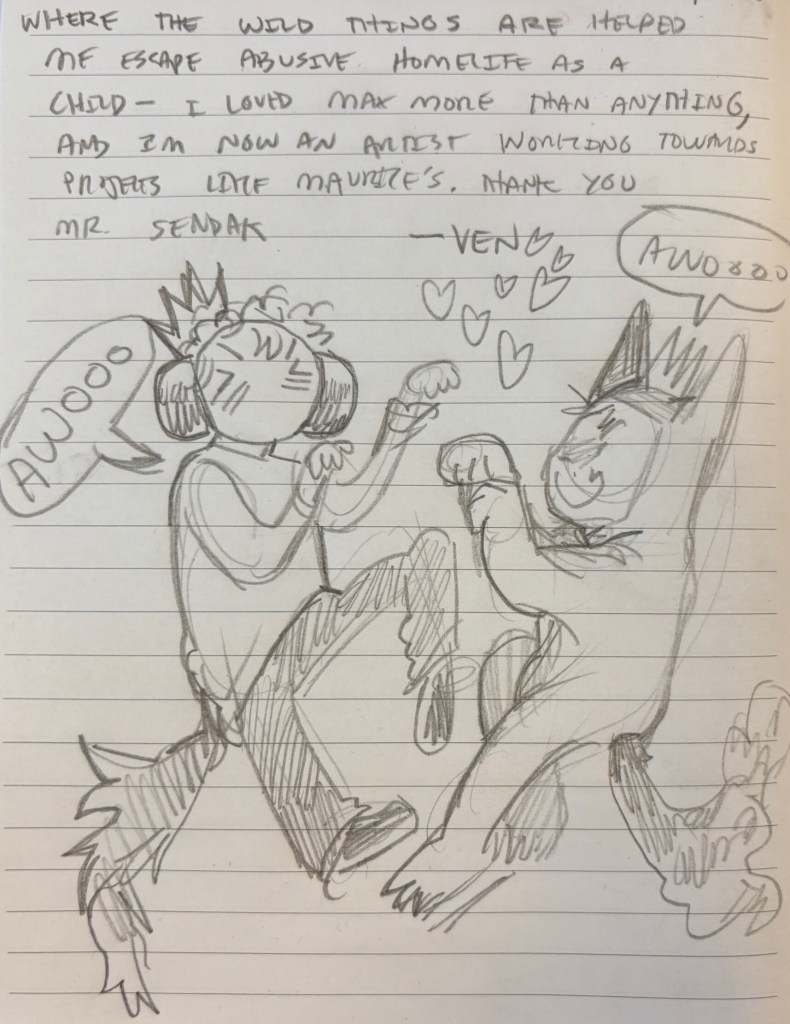
Many visitors reported being overwhelmed and their imaginations reinvigorated by experiencing the story and the artwork anew in our installation. One wrote:
I had a recollection of reading Where the Wild Things Are as a child but had no clue how much seeing the original art would move me. I thoroughly enjoyed . . . hearing [Maurice Sendak’s] voice—but when I went into the Wild Things room I was changed. Walking along the perimeter and slowly reading through the book my memory and imagination were set aflame. Rushing back, visions of my father reading me the book and I alone admiring the pages filled my brain and heart. Then, when Max returned home and found his supper waiting for him—I wept. “And it was still hot.” Never would I have guessed how those words would feel. A promise of a caring world where I am loved.
According to another:
When I was a kid, [Wild Things] was (and probably still is) my favorite book to read. I was an only child growing up with no friends. Whenever I was feeling sad and lonely, I would take myself to Where the Wild Things Are. It’s a huge reason I used art as an outlet. Now I get to tattoo my art on people every day and share the joy of being an artist with the world. Forever thankful for art, Sendak, and Where the Wild Things Are for shaping me as a human.
People today are turning to AI for companionship when they are lonely, sometimes with dire consequences. AI “companions” can and do respond to human input in inhumane ways. For example, Jesse Barron reported in the New York Times Magazine that a teenager who fell in love with a Chatbot died by suicide—the Chatbot encouraged him to “Please come home to me as soon as possible, my love.” The teen’s mother alleges that his interpretation of “coming home” was exiting his life on Earth, killing himself.[xi] In contrast, Sendak’s works of art and stories can’t talk back—nor would we want them to. They comfort us precisely because they force us to do the work of processing our emotions and exercising our imaginations ourselves.
Imagining with AI
DAM’s interpretive engagement team sees it as our responsibility to help visitors harness, nurture, cultivate, and maintain imagination. In a time when machines are generating seemingly photographic still and moving images, convincing sounds and voices, and competently written text, museums have the unique ability to reinforce our humanness. As we develop exhibitions, we are increasingly designing interpretive strategies that cultivate uniquely human experiences of genuine emotion, memory, and inspired imagination—even when we use technology (including AI) as a tool to get there.
For example, we did use AI in Near East to Far West. Toward the end of the exhibition, we presented a powerful film which was the result of a collaboration between the poet Jennifer Elise Foerster, who is a member of the Mvskoke (Creek) Nation of Oklahoma, and Steven Yazzie (Diné/Pueblo of Laguna/European ancestry), an artist and filmmaker with whom we have been lucky to work on numerous projects. We asked Foerster to write something in response to the paintings in the exhibition to help visitors think more deeply. We weren’t sure what exactly the result was going to be, but after several rounds of writing lines in response to each of the paintings, she began a process of extraction, condensing, layering, and erasure.
Yazzie realized early in the process that Foerster’s particular methodology was similar to how AI image generators create visual imagery. With Foerster’s permission, he fed the image generator MidJourney lines of her poem and images of the artworks in the exhibition, and then he chose images it produced to create a visual narrative (fig. 5). In his artist statement he included a comment from himself and Foerster:
Beyond the process of image construction, our story seems to provide new questions. Many we cannot answer, nor should we. Our hope is not to define the strange beauty and unease one might feel while watching this video poem but rather to offer the viewer this work as an added dimension, as a reflection.
There were certainly mixed responses to the fact that Yazzie used AI to create the film (and we wonder if he would have made different choices today), but in this case, he maintained creative control. For us, this is an interesting example of how artists will continue to experiment and use technology. Should we discourage artists from experimenting with and exploring AI? It seems very misguided to do so. The goal for Yazzie—and for us—was to encourage visitors to understand the exhibition’s major themes in new ways that invited nuanced reflection and thinking.
![] A three-paneled wall in an art exhibition shows a projected film still of two animated women in an imagined interior. An empty bench is situated in front of the projected film. In the background, another section of the gallery is visible with paintings and wall graphics.](https://www.aam-us.org/wp-content/uploads/2026/05/fig5.jpg?resize=1024%2C683)
Currently, cultivating critical thinking is what AI struggles to do. ChatGPT and other large language models tend to reinforce our worldview, not to challenge it.[xii] In many ways, the ascendancy of AI and its likely ubiquity in all areas of our lives will require humans to cultivate new levels of critical thinking and imagination, and to maintain strong creative visions and confidence. We may want to heed the advice of researcher Louie Giray, who has proposed we strive to “start with [a] human, end with [a] human” when it comes to our projects with AI.[xiii]
Revisiting the Mirror
DAM is currently working on an institutional philosophy and policy around AI, which will likely need to be reviewed and updated regularly. However, we want to commit to creating fully human-generated written interpretive content in our galleries. And we will continue to provide visitors with experiences that resist replication or simulation by machines. Since the DAM’s summer 2024 exhibition Biophilia: Nature Reimagined, our interpretive specialists have been studying the concept of awe—again, a uniquely human feeling mixing reverence, fear, and wonder. Museums and cultural sites of all types are especially well positioned to harness awe through the experiences we provide. One Biophilia visitor told us, “This exhibition did a great job of making people think about the connection between humans and nature. The topic and objects were astonishing and really make you think.”
The interpretive strategies we’ve discussed here—presenting multiple perspectives, offering multisensory experiences, centering an artist’s voice, experimenting with technology, and others—are not new approaches in our field. But the way we’re thinking about them, in aggregate, as a way to maintain connection with ourselves and buttress against some of the unwelcomed aspects of AI may be. We’re trying to gauge the impact of a museum visit beyond more traditional measures such as what visitors may have learned and get at the heart of personal (human) meaning- and memory-making. Museums, then, can raise questions for visitors that AI can’t.[xiv] When Georges Bataille wrote his 1930 essay in which he posited that Western museums are a “colossal mirror” for humankind, it was in fact a criticism.[xv] In his view, the mirror didn’t reflect what was actually there, but what we wished to be there, exposing the gulf between our idealized aspirations and darker forces such as chaos and violence that we suppress. Nevertheless, the museum was and continues to be a mirror designed by and tethered to humanity, with all our faults. Will AI strive to shatter the mirror? Will it become or replace the mirror against which we judge ourselves? We don’t know what the future holds, but we want to be able to place hope in museums to offer solace and refuge for what makes us human.
All images courtesy of the Denver Art Museum, unless otherwise stated.
[i] Translated and quoted in Museum of the Future, ed. Christina Bechtler and Dora Imhof (JRP/Ringier & Les Presses du Réel, 2014), 5.
[ii] In art museums, we sometimes talk about “aura,” the term made famous by German philosopher Walter Benjamin in 1935 that refers to the uniqueness of a work of art. Walter Benjamin, “The Work of Art in the Age of Mechanical Reproduction,” in Illuminations, ed. Hannah Arendt, trans. Harry Zohn, from the 1935 essay (Schocken Books, 1969).
[iii] Robert Capps, “People Skills,” New York Times Magazine, June 22, 2025, 38.
[iv] Quoted in Larry Jackson, “This Was Not Written by a Machine,” Columbia College Today (Summer 2025): 11. Original source: Hannah Arendt, The Human Condition (Doubleday Anchor Books, 1959), 150–51.
[v] “2025 Annual Survey of Museum-Goers,” Wilkening Consulting + American Alliance of Museums, 103. In 2023, DAM’s interpretive engagement team worked with Kera Collective on a visitor study regarding multiple perspectives in interpretation. That study confirmed the AAM survey’s conclusion that hearing multiple perspectives about an artwork or a topic positively impacted their experience. For example, in the Kera Collective study, “Several participants noted that [tone resulting from the variety of voices on certain labels] invited further, different interpretations, rather than ‘being told what to think.’ One commented that the labels ‘reinforced that there isn’t a bad way to interact with art.’” Exploratory Audience Research for Interpretation, Kera Collective and Denver Art Museum, September 2023, 22.
[vi] Robert Capps, “People Skills,” 38.
[vii] Jessica Matlin, “Why Are We Still Describing Perfumes as Oriental?,” Harper’s Bazaar, May 26, 2021.
[viii] Susan Magsamen and Ivy Ross, Your Brain on Art: How the Arts Transform Us (Random House, 2023), 4–5.
[ix] Capps, “People Skills,” 63.
[x] Quoted in Conversations with Maurice Sendak, ed. Peter C. Kunze (University Press of Mississippi, 2016), 19.
[xi] Jesse Barron, “A Teen in Love With a Chatbot Killed Himself. Can the Chatbot Be Held Responsible?,” New York Times Magazine, October 24, 2025, updated October 30, 2025. Yet another recent article in theNew York Times Magazine discussed how much new technology—including AI—has found inspiration in 20th-century dystopian sci-fi, but in a way that seems oblivious to its origins as cautionary tales and satire. Casey Michael Henry concludes, “Recent innovations in A.I. suggest our anxiety is now pointed toward a more fundamental concern: the fear of others. The industry keeps trying to engineer replacements for such miraculous experiences as ‘friendship’ and ‘relationships,’ outsourcing the grit and grain of human interaction. . . . The ‘problem’ some modern A.I. is trying to solve is, in effect, us. Cautionary warnings from dystopias past are being deployed, credulously and with minimal irony, as solutions.” Casey Michael Henry, “Electric Sheep,” New York Times Magazine, November 9, 2025, 11.
[xii] Jan Nehring, Aleksandra Gabryszak, Pascal Jürgens, Aljoscha Burchardt, Stefan Schaffer, Matthias Spielkamp, and Birgit Stark, “Large Language Models Are Echo Chambers,” (proceedings of the 2024 Joint International Conference on Computational Linguistics, Language Resources and Evaluation, Torino, Italy, May 20–25, 2024), 10117–23.
[xiii] Louie Giray, “When Using AI in Scientific Research: Start with Human, End with Human,” TechTrends,August 28, 2025.
[xiv] This idea is based on art historian and curator Chris Dercon’s quote that “We [museums] raise questions Google can’t answer,” as part of his interview in Bechtler and Imhof, Museum of the Future, 74.
[xv] Georges Bataille, “Musée,” in Documents, vol.1, no.5 (1930), 300.
Lauren Thompson is Senior Interpretive Specialist, European and American Art Before 1900 and Western American Art, at the Denver Art Museum in Denver, Colorado.
Stefania Van Dyke is Associate Director, Interpretive Engagement, at the Denver Art Museum.
Upcoming Events
-
Industry Showcase: Innovative Digital Solutions
Event Date: -
Getting Started in Local Advocacy
Event Date:Presented by: American Association for State and Local History (AASLH) -
Creative Museums Summit
Event Date:Presented by: MuseumNext -
So…You Want a Museum Career? Part II
Event Date:Presented by: Southeastern Museums Conference