This exhibition critique first appeared in the journal Exhibition (Spring 2026) Vol. 45 No. 1 and is reproduced with permission.
Museums and ethnographic collections did not reflect reality; they created a new reality, parallel to the legitimisation of colonial agents.
—Maria Figueira, Quintino Lopes, and Elisabete Pereira[i]
Exhibition: Confrontar o Legado Colonial no Museu (Facing Colonial Legacy in the Museum), Museu Municipal Santos Rocha, Figueira da Foz, Portugal. March 12–October 31, 2025
What discussions would emerge if museums exposed their constructed realities? In postcolonial contexts, honesty, transparency, and the acknowledgement of the colonial histories behind cultural heritage acquisitions are essential.[ii] Examining colonial collections prompts important questions: What perspectives are represented? What stories are omitted?[iii] As museums worldwide seek innovative ways to engage visitors and to address sensitive topics amid rising political polarization, Portugal’s institutions have remained remarkably silent on colonialism, decolonization, and repatriation, with few museums directly engaging with the nation’s 600-year colonial legacy.[iv] But, as Confrontar o Legado Colonial no Museu (Facing Colonial Legacy in the Museum) demonstrates, sometimes it’s the simplest ideas that are most effective at challenging fabricated realities.
Beginning with the 1415 conquest of Ceuta (today an autonomous Spanish city bordering Morocco on the North African coast) until the independence of Macau (a special administrative region of China, west of Hong Kong) in 1999, Portugal maintained the longest colonial empire in history.[v] The Portuguese monarchy initiated the transatlantic trafficking of enslaved people, and of the 12.5 million people trafficked, 46.8 percent (5.8 million) were transported under Portuguese or Brazilian flags.[vi] With no internal abolitionist movement, Portugal was the last European nation to abolish transatlantic trafficking following pressure from other nations.[vii] The so-called “Era dos Descobrimentos” (Age of Discoveries) involved wide-spread slavery, pillaging, and looting—brutal realities that museums gloss over, framing objects acquired through this history as the results of “discovery” or “trade.”
As a PhD researcher in museum repatriation and colonial histories who is based between Portugal and England, I often feel a deep frustration when exhibition texts use passive language to minimize colonial violence or to obscure questionable acquisition methods. I fight the impulse to scribble over labels—to make them confess the true story. It was therefore a cathartic relief when Confrontar o legado colonial no Museu, on view at Museu Municipal Santos Rocha, in Figueira da Foz, Portugal, actively invited visitors to do just that: rewrite exhibition labels using marker pens. This approach allowed people to share their thoughts about the ethnographic collection in a space where curators openly admitted their limited knowledge. Confrontar transformed a traditional object-focused display into an interactive space that encouraged dialogue and reflection on living cultures and contemporary concerns about colonial collections.
Confrontar emerged from the four-year TRANSMAT research project, a collaboration among Museu Municipal Santos Rocha, University of Évora, Institute of Contemporary History (IHC), and IN2PAST.[viii] The exhibition opened on the first night of TRANSMAT’s three-day conference, which gave speakers and guests—including myself—the first chance to contribute. Curated by IHC researcher Dr. Elisabete Pereira, Confrontar showcases historical documentation of the museum’s international ethnographic collection, exploring how information has been—and continues to be—constructed through this collection. Recognizing that conclusions are impossible when information is lost or erased, the TRANSMAT team acknowledged these uncertainties, prompting reflection on colonial collections, the enduring legacy of imperialism in museums, and colonialism’s impact today.
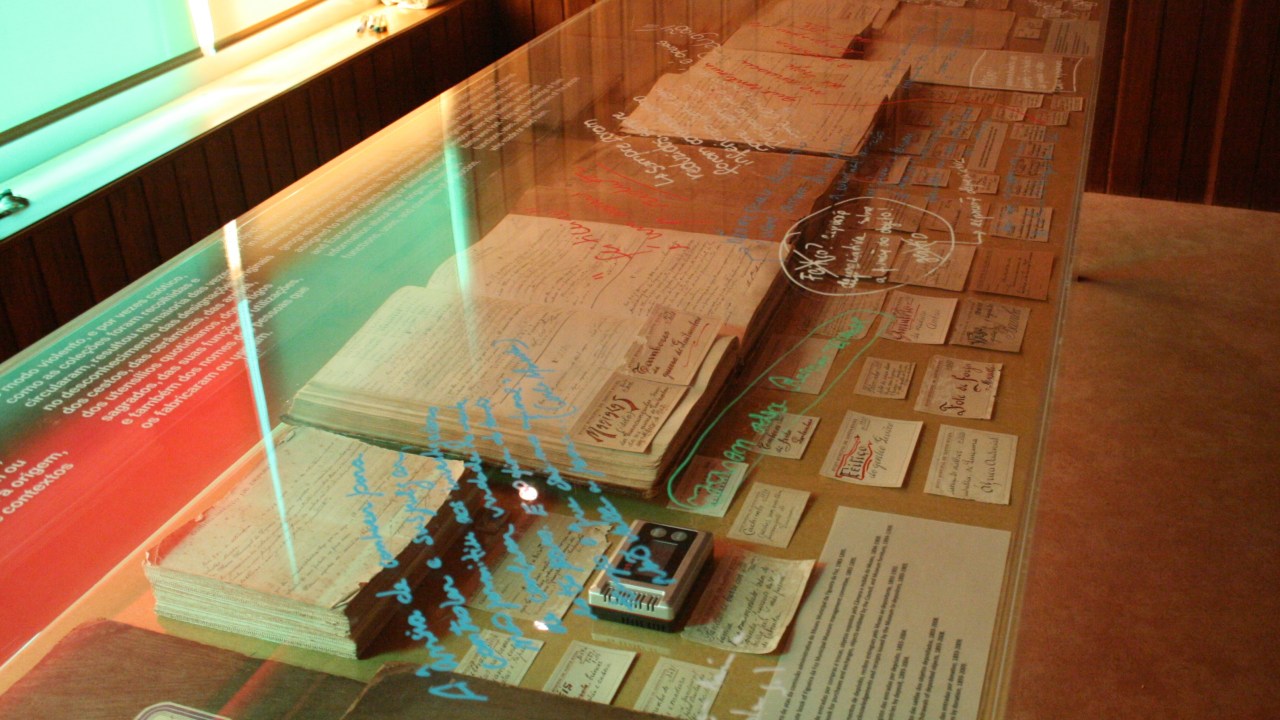
Before entering the main gallery, visitors were introduced to the show’s premise by windows overlaid with brightly colored vinyl sheets, bearing Portuguese and English text. Parallel to the windows, a low display case contained piles of museum records and old labels that document the ethnographic objects’ evolving interpretations since their accession. These records reveal past caretakers’ alterations and misrepresentations, driven by their beliefs and impressions. White vinyl text on the glass clarifies why many records lack comprehensive provenance, often emphasizing collectors, geographical origins, and Eurocentric designations that omit or distort crucial details.
Although the tiny, cursive Portuguese writing on the older documents is difficult to read, one visitor had already used a pen to write, “‘Feiticeiro’ [sorcerer] is a reductive name.”[ix] This critique prompted a rich debate: someone argued, “They have always been reduced, always considered inferior, this word will always be pejorative”;[x] another, “I do not think it is derogatory, it is just a common name for a practice. Any negative connotation comes from those who view ‘spells’ and ‘sorcerers’ as malevolent entities, a condition that is intrinsic to them.”[xi] By reminding visitors that museums are interpretative institutions influenced by biases and agendas, Confrontar encouraged critical engagement with the inherent limitations and subjective nature of its ethnographic collections.
From this space, the show progressed into the Ethnographic gallery, transformed into an archive that preserved its 2014 layout while adding three new interpretive label types to the glass cases. Minimalist and sparse, the gallery featured 19th-century objects from Portugal’s colonial occupations of Angola, Democratic Republic of the Congo (DRC), and Timor. Timorese objects lined the first three walls, housed in cases with plain brown backings and yellow lighting. Materials from Angola and the DRC were displayed on the walls behind the entrance, distinguished by their warm yellow walls and white lighting. Three sculptures from Angola and the DRC sat on plinths within the room’s central case (fig. 1). The carpeted floor and low, wood-panelled ceiling helped to mute the noise. The absence of electronics, QR codes, videos, audio, CCTV, and staff created an atmosphere free from distractions and the anxiety of being watched.
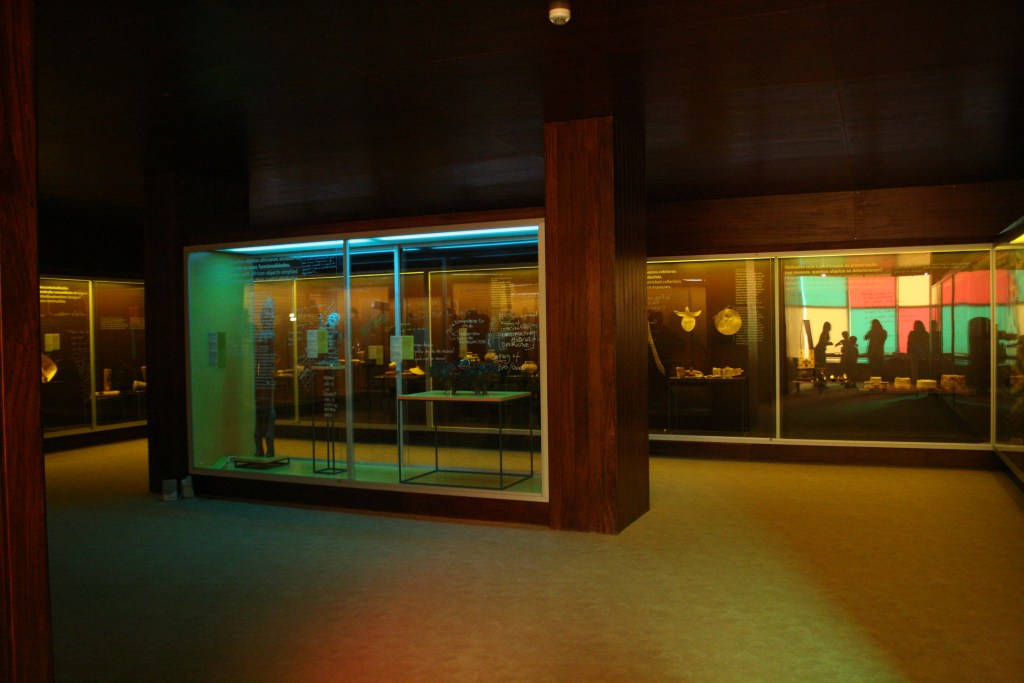
The focused atmosphere enabled me to engage with the new labels. The first set offered reflections on colonialism’s impact on the ethnographic collection’s development (fig. 2). Located in the upper left corners of the cases, these questions left ample space for visitors to mark-up, write over, and continue conversations with the provided pens. On a display of Timorese objects, prompts asked, “How many objects were lost in this long-lasting practice of usurpation and extraction?” Visitors counter-questioned, “How many lives? How many dreams? How many futures?”[xii] Another person drew an arrow to their observation:
I see lots of complaints about colonialism, with reason, of course. We cannot change the past, it is written in history, but PORTUGAL is still today, more than ever, a refuge for many citizens all over the world.[xiii]
This prompted yet another guest to respond:
Yes, I agree you cannot change the past, but that past of great tragedies is still greatly glorified! Especially by history books that refuse to tell the sad truth for the sake of Portuguese “patriotism.”[xiv]
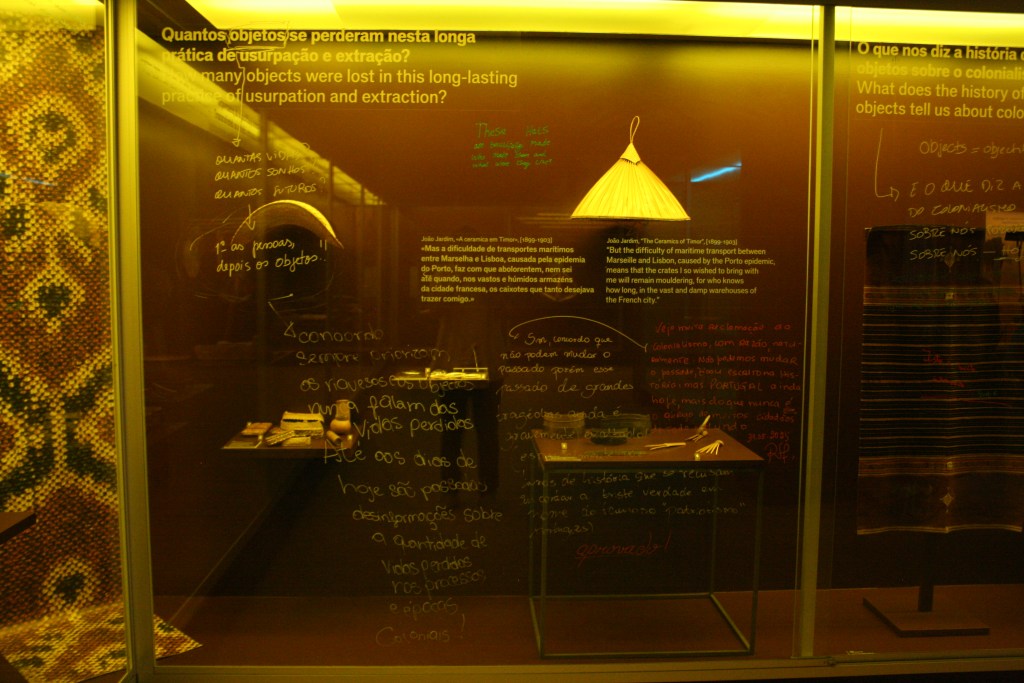
In an exhibition with minimal object information—only donor names and acquisition locations—these real-time conversations were the most engaging aspect of the interpretation. By ceding curatorial authority, the museum opened up space for visitors to question (mis)conceptions, which provoked critique and debate. This approach echoes the Contemporary Jewish Museum in San Francisco’s 2010 exhibition Our Struggle: Responding to Mein Kampf, in which curators invited visitors to debate and to express their feelings about the exhibition on a giant chalkboard and on an artist-altered copy of Mein Kampf.[xv] As research has shown, allowing visitors to share their perspectives and interpretations within exhibition spaces promotes confidence, the embrace of diverse viewpoints, and meaningful engagement with content.[xvi] Responses to visitor-written labels are more expressive and frequent than curator-written labels, encouraging open discussions about the objects, their history, and questions about museum acquisition policies.[xvii] Within Confrontar, I was struck by how being able to witness debates and retorts connecting 19th-century objects to present-day issues demonstrated how visitors astutely linked history to contemporary life.
The second label set, featuring quotes from archival sources, elicited considerable visitor feedback.Positioned across the centers of the glass cases, these quotes disclosed the actions, beliefs, and cruelty of two key donors—Portuguese naval officer João dos Santos Pereira Jardim (1865–1907) and colonial administrator António d’Oliveira—toward the people of Timor and Angola.[xviii] In front of a display of woven-straw containers, an 1894 letter from d’Oliveira described the widespread European settler obsession with collecting items regardless of their value, prompting a visitor to reply, “See the problem António?” (fig. 3). Beside a Timorese cup, a quote from Jardim notes that he acquired a chalice from the kingdom’s chief as a novelty; a visitor retorted, “If it belonged to the ‘chiefs,’ what meaning does it have here?”[xix] Another person replied, “It has lost all meaning!”[xx]
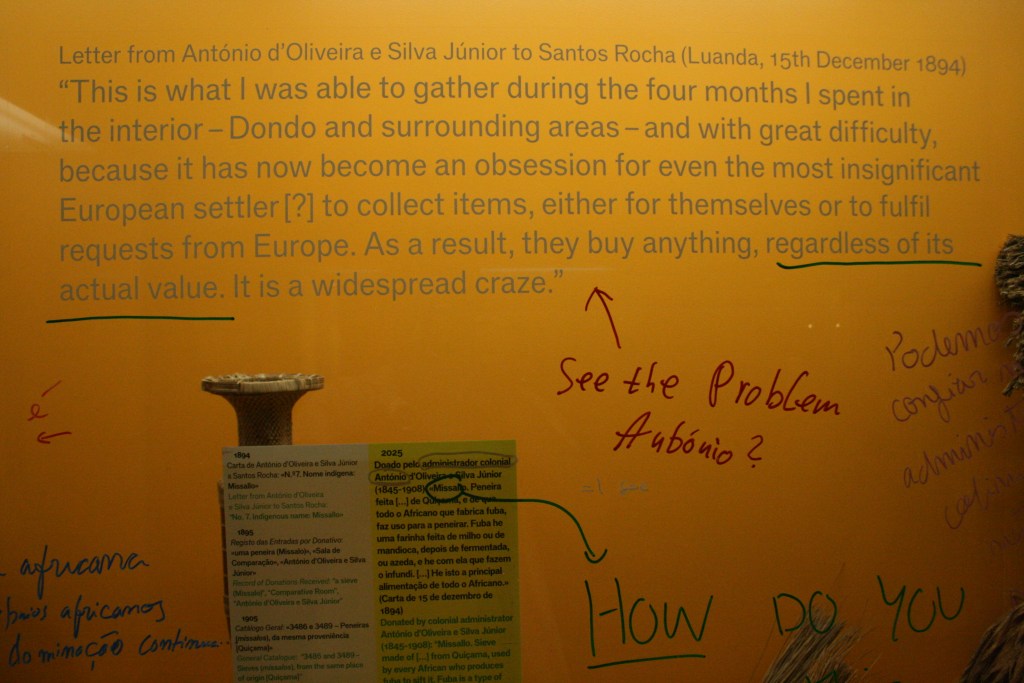
These quotes sparked broader conversations about colonialism, shifting from glorification to accountability. Visitors expressed anger and contempt toward the perpetrators, holding them culpable in the present for their barbarity in the past. Presenting these quotations verbatim made it difficult to defend such violence, while also exposing the collectors’ perceived hierarchies of human value and deliberate racism toward the peoples of Timor, Angola, and the DRC. But the descriptions of “violent, unforgettable revenge,” Portuguese control, and forced obedience, also caused discomfort. One visitor questioned, “Why give these violent voices so much space?” Balancing portrayals of violence in a colonial legacy exhibit is difficult. During a public talk, curators clarified that they had debated including images of violence but ultimately chose not to, as such depictions neither explain perpetrators’ motives nor humanize victims.[xxi]
Visitors also highlighted the absence of the original contexts and creators from the archive. Beside a Timorese palm leaf guitar, someone asked, “What would it sound like? Can we return life [to] this instrument?”[xxii] Nearby, another visitor questioned, “What happened to the Ambrizette princesses who wore these ‘manilhas’?”[xxiii] Next to text about an Angolan “amulet,” a visitor deduced that it was used as, “A way for brothers to communicate when they are physically separated,”[xxiv] demonstrating how visitors interpret human stories through labels and formulate meaning. Despite the glass barriers preventing a tactile connection, people repeatedly invoked the objects’ makers, wanting to know how the objects were crafted, their uses, Indigenous names, and what happened to the people after their belongings were taken.
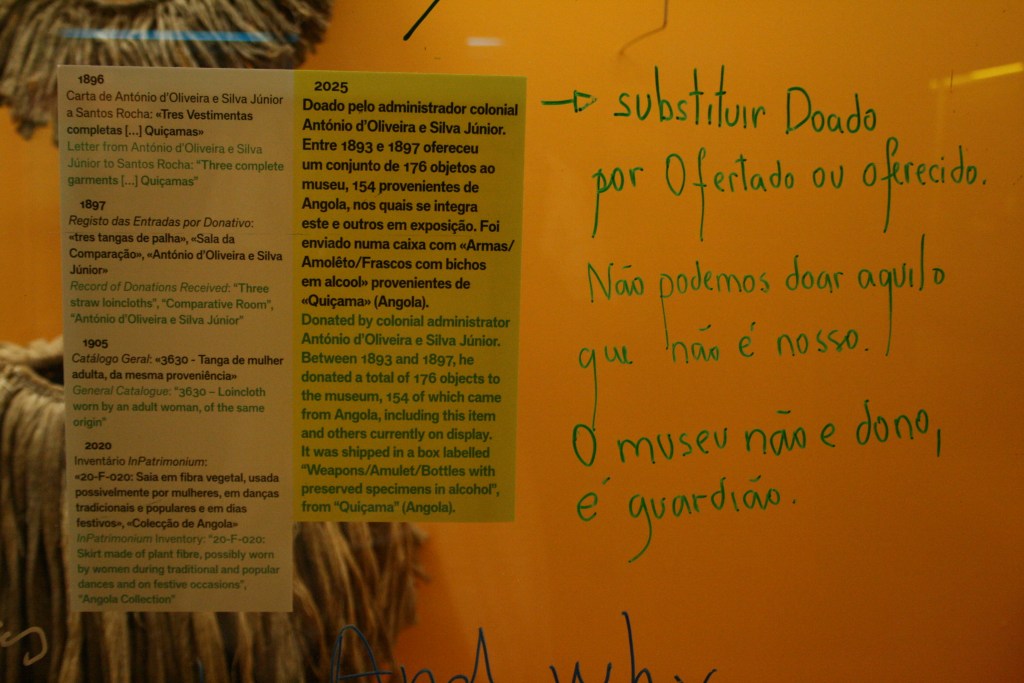
The third set of labels featured black and green text on white and yellow backgrounds and presented visitors with a chronology of the museum’s registration of objects that illustrated how the language surrounding these collections has evolved over time (fig. 4). Visitors highlighted and conjugated verbs from past to present and interrogated acquisition methods. Beside an Angolan skirt “donated” by d’Oliveira, someone wrote:
Substitute Donated with Offered or presented. We cannot donate something that does not belong to us. The museum is not the owner, it is the guardian.[xxv]
Concerning Timorese drums, they questioned, “Obtained how?”[xxvi] “Stolen? Bought? Traded?” “Probably stolen or given.” Aware of d’Oliveira’s and Jardim’s roles in colonizing Timor, Angola, and the DRC, visitors demanded greater transparency and honesty.
Not everyone responded positively. Pedro Santana Lopes, mayor of Figueira da Foz, disapproved of Confrontar’s portrayal of colonial histories, noting in public statements that the show had been approved by the previous administration. He also emphasized that Figueira da Foz is proud of its history and museum collections and that no council members were to attend the exhibit.[xxvii] Lopes’s reaction concerned me, as I feared it might motivate offensive comments. On the opening night, I asked a designer how the team would handle such issues; they answered it would be the museum’s decision.
When I revisited in August and October for public talks, I was interested to see how the conversations had evolved. By October, the glass cases were covered with writings and doodles—one visitor wrote, “Give back our stuff!” to which another replied, “womp womp :).”
Visitors’ comments were mostly positive—ranging from critiques of colonialism to personal reflections about the objects. Marking the glass with green, red, white, and blue pens to circle, cross out, underline, and add notes facilitated immediate, personal interactions through handwritten remarks, which are more direct than digital comments or QR codes. Many visitors contributed: two young children wrote that some Timorese textiles should be returned home; others wrote lengthy sentences or shyly noted “cool weapons” in small script. A parent shared, “my daughter really loved these figures, especially the little animal at the end :).” In a discreet corner, a comment urged the museum to make the design permanent. Thanks to the floor-to-ceiling glass, a place for sharing was always available.
Confrontar o Legado Colonial no Museu exemplified a flexible approach to engaging the public with historic collections, fostering real-time conversations, feedback, debate, critique, and learning. By confessing knowledge gaps and transparently explaining how this occurred, Confrontar deconstructed deceptive colonial narratives and the museum’s authoritative voice, creating space for visitors to challenge one another’s beliefs. This sparked dynamic dialogues that yearned for accountability, historical truth, and for the recognition of living cultures. Decolonization involves adopting democratic knowledge-sharing and nurturing dialogue between experts, the public, and collections. As Confrontar demonstrated, such exchanges do not depend on cutting-edge technology or expensive exhibition design, but on the cultivation of critical thinking that deepens understandings of how these centuries-old belongings continue to live with us in our present lives.
All images by Sol Rego.
[i] Maria Figueira, Quintino Lopes, and Elisabete Pereira, “Coleções coloniais em Portugal e suas invisibilidades: João Jardim e o Museu Municipal da Figueira da Foz [Colonial collections in Portugal and their invisibilities: João Jardim and the Municipal Museum of Figueira da Foz],” Historia, Ciências, Saude – Manguinhos 23, no. 1 (August 2025).
[ii] Njabulo Chipangura et al., “Truth-telling as a form of decolonial care: stories from a collaborative object biography research with the Ndau community of Eastern Zimbabwe,” Museums & Social Issues 19, no. 1 (2025).
[iii] Figueira, Lopes, and Pereira, “Coleções coloniais em Portugal.”
[iv] For more information about museum object repatriation in Portugal, see, “Colonial collections and restitution: The case of Portugal (interim report),” RM* [restitution matters], updated July 11, 2025; “Sociedade de Geografia de Lisboa: not 1, but 76 Benin objects,” RM*, updated August 18, 2023; and “Em Portugal ‘não há listagens’ de obras de arte a devolver às ex-colónias, diz investigador,” RTP noticias_, updated November 23, 2018.
[v] Elsa Peralta, “Insurgent memory, post-imperial governance, and change: reassessing the truth about Portugal’s colonial history,” Rethinking History (2025): 3; Cristiano Gianolla, Giuseppina Raggi, and Lorena Sancho Querol, “Decolonizing the narrative of Portuguese Empire: Life stories of African presence, heritage and memory,” in Decolonizing Colonial Heritage: New Agendas, Actors and Practices in and beyond Europe, ed. Britta Timm Knudsen et al. (Routledge, 2021), 81; Fernando Arenas, “Migrations and the Rise of African Lisbon: Time-Space of Portuguese (Post)coloniality,” Postcolonial Studies 18, no. 4 (2015): 353; and James H. Sweet, “The Iberian Roots of American Racist Thought,” The William and Mary Quarterly 54, Constructing Race, no. 1 (January 1997): 156.
[vi] Arlindo Caldeira, “Portuguese Slave Trade,” in Oxford Research Encyclopedia of African History (2024), 2.
[vii] Ibid., 11–12.
[viii] The TRANSMAT project researches the histories and stories of transnational archaeological, ethnographic, and anthropological collections in Lisbon’s Museu Nacional de Arqueologia, and Figueira da Foz’s Museu Municipal Santos Rocha. For more information see, “IN2PAST: Associate Laboratory for research and innovation in heritage, arts, sustainability and territory,” accessed November 24, 2025; and “TRANSMAT – Transnational Materialities (1850–1930): Reconstituting Collections and Connecting Histories,” 2021, accessed November 24, 2025.
[ix] All translations of visitor comments provided by the author. “‘Feiticeiro’ é um nome redutor.” Fifteenth-century Portuguese explorers and merchants labelled the religious belongings of African coastal communities as “feitiço(s),” a term encompassing forms of magical practice, as such, “feiticeiro,” which derogatorily refers to a “witch-doctor” or “sorcerer.” Sónia Silva, “Art and Fetish in the Anthropology Museum,” Material Religion 13, no. 1 (2017): 80–82.
[x] “Sempre foram reduzidos, sempre foram conotados como inferiores, ‘feitiço’ este nome sempre será pejorativo, não é o nome certo e nunca será . . .”
[xi] “Não me parece depreciativo, é nome comum de uma prática, a eventual conotação negativo é a de quem lê ‘feitiços’ e ‘feiticeiros’ como entidades malévolas, condição que as lhes é intrínseca”
[xii] “Quantas vidas? Quantos sonhos? Quantos futoros?”
[xiii] “Vejo muito reclamação ao colonialismo, com razão, naturalmente. Não podemos mudar o passado, ticou escrito na história, mas PORTUGAL ainda hoje, mais do que nunca é o abrigo de muitos cidadãos de todas mundo”
[xiv] “Sim, concordo que não podem mudar o passado porém esse passado de grandes tragédias ainda é gravemente exaltado! Especialmente por livros de história que se recusam in contar a triste verdade em nome da faunos o ‘patriotismo’ portugueses”
[xv] Lovisa Brown et al., “Desegregating Conversations about Race and Identity in Culturally Specific Museums,” The Journal of Museum Education 42, no. 2 (June 2017): 123–25.
[xvi] Salwa Mikadi Nashashibi, “Visitor Voices in Art Museums: The Visitor-Written Label,” The Journal of Museum Education 28, no. 3 (Fall, 2003): 24.
[xvii] Ibid.
[xviii] For further information (open access), see Figueira, Lopes, and Pereira, “Coleções coloniais em Portugal.”
[xix] “Se pertencia aos ‘principais’ (chefes, lideres) que sentido tem aqui?”
[xx] “Perdeu todo o seu sentido!”
[xxi] Writer and critic Susan Sontag explains how the emotional distance created by viewing photographs can hinder a full understanding of another person’s pain. Expecting images to fully convey the depth of human suffering is an overestimation of their capacity. Susan Sontag, Regarding the Pain of Others (Picador, 2003).
[xxii] “Como seria o seu som? Podemos dar a vida de volta e este instrumento?”
[xxiii] “O que aconteceu ás princesas do Ambrizete que usarem estas ‘manilhas’?”
[xxiv] “Forma de comunicação entre irmãos se parados fisicamente”
[xxv] “Substituir Doado por Ofertado ou oferecido. Não podemos doar aquilo que não é nosso. O museu não e dono, é guardião”
[xxvi] “Obtido como?”
[xxvii] Agência Lusa, “Câmara da Figueira autorizou, apoia debate, mas demarca-se de instalação sobre obras coloniais,” Expresso (Expresso Online), March 14, 2025.
Tamara Newton is a PhD candidate in History of Art at the University of Birmingham, England.
Upcoming Events
-
Industry Showcase: Innovative Digital Solutions
Event Date: -
Getting Started in Local Advocacy
Event Date:Presented by: American Association for State and Local History (AASLH) -
Creative Museums Summit
Event Date:Presented by: MuseumNext -
So…You Want a Museum Career? Part II
Event Date:Presented by: Southeastern Museums Conference