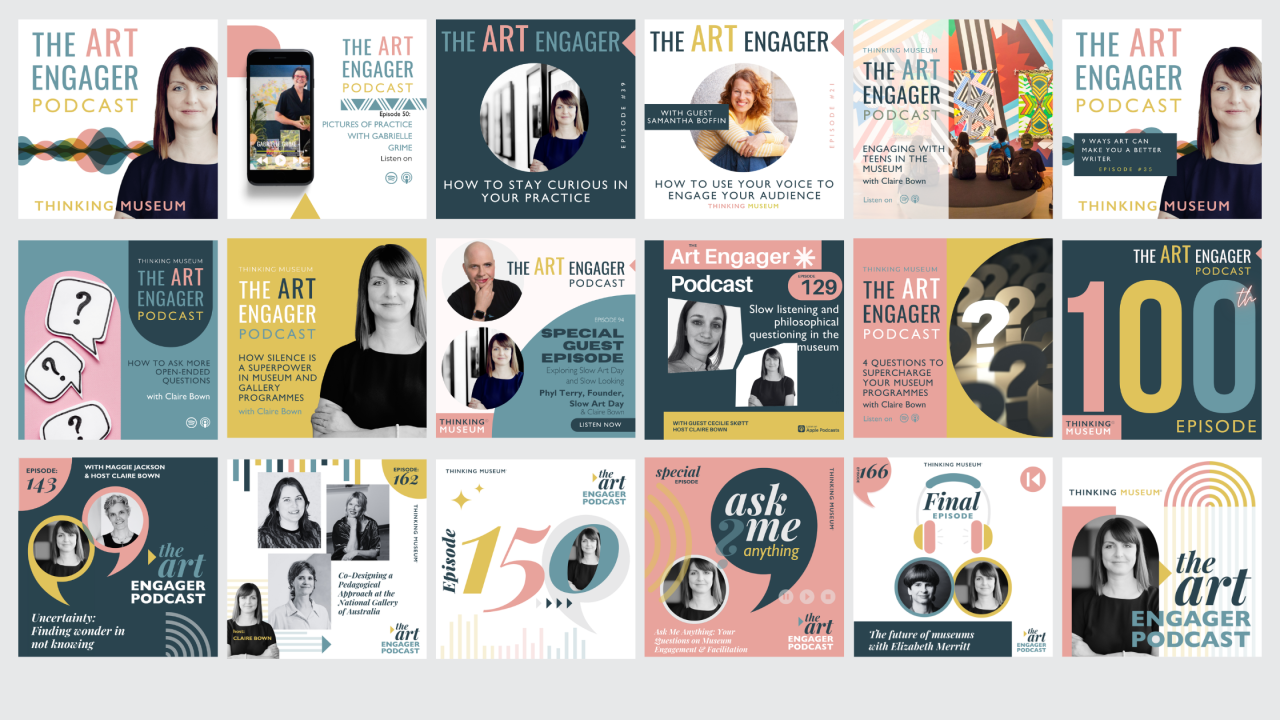
Last fall I had the pleasure of meeting Claire Bown in Horsens, Denmark, where she was recording an episode of her podcast, The Art Engager, at the Network of European Museum Organizations Conference. Having quickly become a fan—binge listening to episodes from extensive back catalog of the podcast—I was honored when Claire asked me to be her guest for what might prove to be the final episode of this five-year endeavor. Today on the blog, she returns the favor, answering my questions about her work, suggesting some favorite episodes of the podcast, and recommending other resources about designing meaningful museum experiences.
Warmest regards from the future,
Elizabeth
Elizabeth Merritt, Vice President Strategic Foresight and Founding Director, Center for the Future of Museums, American Alliance of Museums
Claire, tell our readers a bit about yourself, your work, and what led you to start the Art Engager podcast.
I’m a museum educator, facilitator and author. I teach museum and cultural professionals how to design experiences that invite people to slow down, look closely, and connect with art and objects, and with each other. I founded Thinking Museum® in 2013, and the Thinking Museum® Approach, which I developed over years of practice, sits at the heart of everything I do. I work with cultural organizations worldwide, from national galleries to regional museums, and with the wide range of people who shape visitor experience within them, from educators and guides to curators, managers and whole teams.
The Art Engager podcast started in 2021. I’d been writing and teaching about engagement for a while by that point, and I was on the lookout for a different way to share the ideas, tools and conversations I was finding most useful. I was – and still am – an avid podcast listener. I love the way a podcast can build a sense of connection over time, between host and listener, and between a show and its community.
There were museum podcasts out there at the time, but most spoke about museums, or were produced by museums themselves. I wanted to make something different: a podcast rooted in practice, that shared the joy and good work already happening in museums and looked closely at how engagement actually works.
It began almost entirely as solo episodes. Interviewing people was a new skill I wanted to develop, and starting with solo episodes gave me the space to find my voice behind the microphone before bringing other people in. My first guest, on Episode 24, was Louise Thompson, on using art and objects to learn wellbeing skills and improve mental health, and from there the show gradually opened out into the mix of solo and guest episodes it’s been ever since.
What are some of the most important or surprising things you learned in the course of producing 165 episodes of the podcast?
Having spent five years in conversation with the field, both with guests and in my own thinking out loud, what I’ve learned from all of that is a bigger question than I can answer fully here, but a few things stand out.
The first is how much the podcast has expanded my own practice. That wasn’t really what I set out to do, but it’s turned out to be one of the most valuable things about hosting the show. Every conversation brings someone new into my thinking. Guests have introduced me to books, ideas, frameworks and fields I would almost certainly never have encountered on my own, and many of those have now filtered down into how I teach and write. The podcast has also opened doors I didn’t expect – a host’s invitation is a surprisingly generous thing to be able to offer, and it has meant I’ve been able to sit down with people whose work I’d admired for years. Some of those conversations have changed how I think about engagement, and a few have changed how I think about my own practice.
The second is how much the show has expanded my sense of what museums can be. I came into the podcast already thinking about museums as places of connection, inquiry and meaning-making, and that hasn’t changed. But five years of conversations have added a lot of layers to what I thought I knew. I’ve talked to colleagues whose museums are sites of wellbeing, belonging and community, of care, of social connection, and of closer, slower ways of looking. Each of those conversations has made the question ‘what can a museum be?’ feel larger and more interesting, and it has made me more curious, not less, about the possibilities of the field.
I’ve learned other things too. How generous the field is, and how willing people are to share their work honestly when you give them the time and space to do it. How much the conversation around engagement itself has widened, with more people across the museum thinking about what it means and how their own work shapes it. And, not least, how much work a podcast actually takes. Every episode is a research project, a writing project and a production project, and is not for the faint-hearted!
More than anything, the podcast has introduced me to people and ideas I’d never have encountered otherwise, and I’ve been so fortunate to have had that chance.
In 2024, you published The Art Engager: Reimagining Guided Experiences in Museums. How does that book expand on and complement the topics you explored in the podcast?
The Art Engager: Reimagining Guided Experiences in Museums is a practical guide for anyone who designs or facilitates guided experiences in museums, galleries and heritage settings. It sets out the Thinking Museum® Approach, a flexible structure for leading inquiry-based discussions around art and objects, and gives readers the tools, techniques and frameworks to use it in their own practice. The Approach itself grew out of something I’d noticed back in 2011. Museum educators were struggling to lead inquiry-based guided experiences with confidence, and at the same time teachers were telling me they wanted museum programmes with more depth, more observation, more dialogue and, in their words, ‘less telling.’ Both pointed to the same underlying issue: an engagement deficit. The Thinking Museum® Approach grew directly out of that.
The book and the podcast cover overlapping territory, but they do different things. The podcast is a conversation with the field. It looks outward – it’s where you hear how other practitioners think, how museums around the world are engaging and connecting with their audiences, and what the wider field is thinking about. The book gives you a way to work with the practices, tools and techniques you need to apply it in your own practice, across your team, or right through your organisation.
Can you recommend two or three of your favorite episodes as an entry point for people wanting to explore the archives of the podcast?
This is such a difficult question after five years! I’ve chosen one long-form guest conversation, one solo episode and a recent episode where I’ve been exploring a new format.
First of all, I’d highly recommend listening to Uncertainty: Finding Wonder in Not Knowing with Maggie Jackson. I loved this conversation because it challenged some of our assumptions about expertise, confidence and certainty. Maggie’s ideas about uncertainty, attention and learning have so much relevance for museums, particularly for anyone facilitating discussion or working with multiple perspectives. It is the sort of episode I really enjoy making, where ideas from outside the museum field suddenly illuminate our own practice in new ways.
Secondly, I’d choose episode 150: How to Create Meaningful Museum Engagement: 10 Best Practices. This was a milestone podcast which gave me the chance to step back and reflect on everything the podcast had explored up to that point. I revisited the backcatalogue, relistened to old episodes and tried to distil the principles that kept coming across conversations and solo episodes. I’m really proud of this episode because it turns 5 years of thinking and talking into something practical and immediately useful for listeners.
And finally, episode 165, How Can Museums Build Meaningful Social Connection?, recorded after attending the National Convening on Art and Social Connection at the High Museum of Art in Atlanta. It explores the role museums can play in combatting loneliness and social isolation, drawing on two days of conversation with colleagues from across the field. I went to Atlanta carrying three questions about what it takes to do this work well, how we build evidence for it, and how we make sure others hear about it. I care about this work. And I think it’s going to matter more and more for museums in the years ahead
Do you have any other recommendations for reading, listening, watching that museum people can use to learn more about designing meaningful museum experiences?
I’d encourage people to look both inside and outside the museum sector. Some of the most useful ideas about meaningful experiences come from psychology, community-building, public health, facilitation and the arts, as well as from museums themselves.
For museum-specific reading, I’d recommend The Empathy-Building Toolkit for Museums, published by American Alliance of Museums and Bloomsbury Publishing. It brings together a range of contributors exploring how museums can foster empathy, perspective-taking and human connection. I was pleased to contribute a chapter on slow looking as a practice for seeing differently and building connection.
Outside the museum field, I often recommend Community: The Structure of Belonging by Peter Block. It offers deep insight into how we create spaces where people feel connected, welcomed and able to contribute, which is highly relevant to museum programmes and public engagement.
I’d also recommend The Power of Strangers by Joe Keohane, which explores how conversations with people we don’t know can build confidence, trust and connection. There is a lot in it for anyone thinking about museums as social spaces.
And The Art Cure by Daisy Fancourt is an excellent resource on how engagement with the arts can support health and wellbeing, drawing on a growing body of research about the wider impact of cultural participation.
For listening and watching, I’d suggest looking widely beyond the sector. Observe great facilitators, teachers, interviewers, performers and hosts. Notice how they welcome people, build trust, ask thoughtful questions and create participation. Those human skills sit at the heart of meaningful museum experiences. I often find inspiration in podcasts such as The Science of Happiness, Choiceology and Choose to Be Curious. I also love A Long Look, which shows how much can emerge when we spend real time with a single artwork.
And finally, spend time being a visitor yourself. Pay attention to how experiences make you feel, where connection happens, and what stays with you afterwards. Some of the best professional development comes from noticing your own experience more carefully.
What’s next for The Art Engager podcast?
Episode 166—in which I interviewed you, was released on the podcast’s fifth anniversary, which feels like a fitting moment to pause. After that, the podcast will be taking a sabbatical for a while. Five years like a good time to take a break.
The podcast has brought so many interesting people, great conversations and unexpected opportunities into my life. It has also shaped my own thinking far more than I ever imagined when I recorded those first solo episodes (under a blanket!) in 2021. Let’s see what comes next….
To see what’s next, connect with Claire on LinkedIn and Instagram.
Upcoming Events
-
Creative Museums Summit
Event Date:Presented by: MuseumNext -
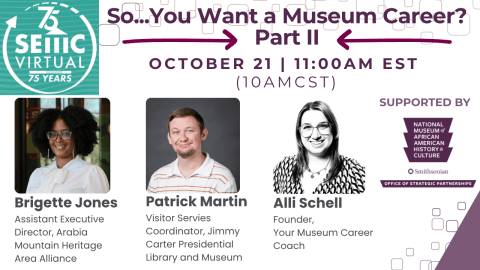
So…You Want a Museum Career? Part II
Event Date:Presented by: Southeastern Museums Conference -
-
Doing History in Polarized Times
Event Date:Presented by: American Association for State and Local History (AASLH)