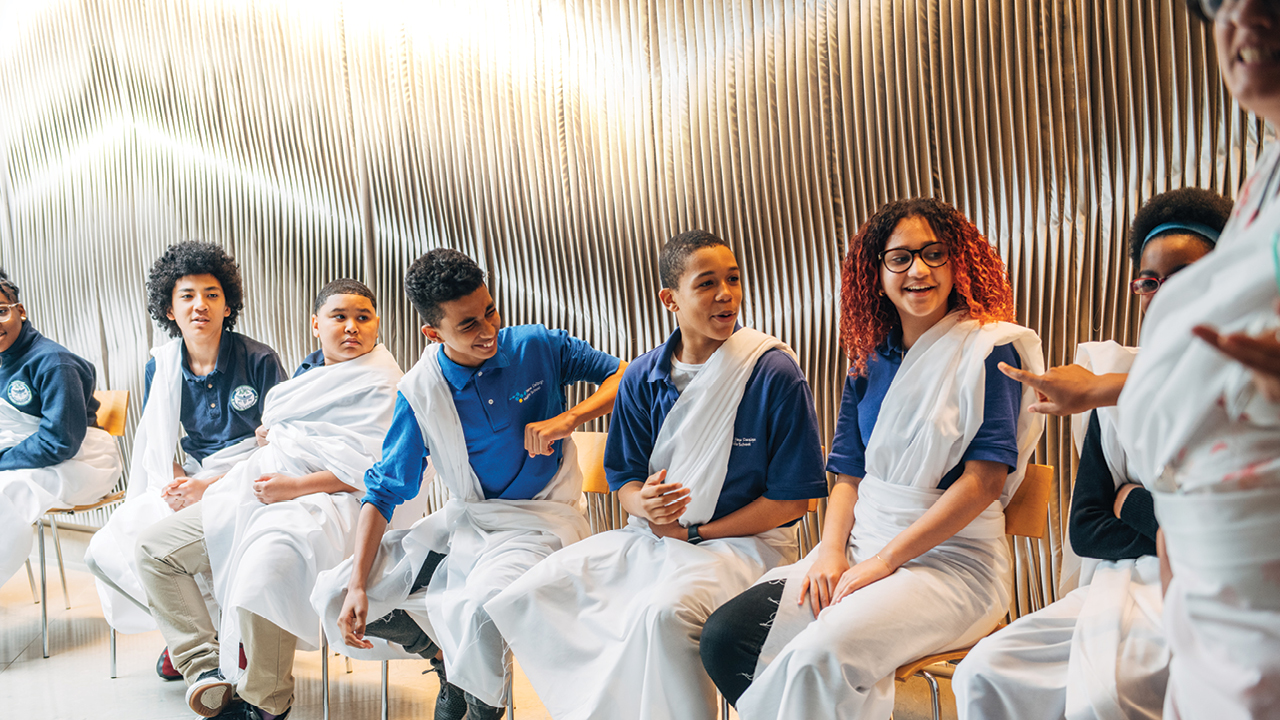
The New York Historical offers New York City sixth graders four full days of museum-based learning.
If you visit my place of work between 9 a.m. and 2 p.m. on a weekday, you are likely to hear some remarkable sounds: restrained yelling during an ice-breaking game of rock-paper-scissors; chanting as a class call-and-response gathers everyone’s attention; whispered discussions related to a close reading of historical texts; dramatic readings of classical theater productions; enthusiastic debate during a voting simulation; laughter over a lunch period.
This article originally appeared in the May/June 2026 issue of Museum magazine, a benefit of AAM membership.
» Read Museum.
If I worked in a school, these sounds would not be remarkable. But I don’t work in a school. I work in a museum, one of the nation’s earliest, which has spent more time as a space for quiet contemplation than as a place designed for full-day student activities. The sounds I am describing reflect the new commitment my institution, The New York Historical, has made to reimagining museum-based learning.
In 2018, The New York Historical was approached by New York City education leaders concerned about sixth graders, many of whom struggle academically as they simultaneously endure a significant developmental phase and enter the unfamiliar environment of middle school. Research has shown that those who lean into learning in sixth grade are more likely to graduate from high school.
These partners, who included a former chancellor and two superintendents of New York City Public Schools, wanted to find new ways to push sixth graders to embrace their education and were curious how museums might help. Our area of expertise is American history and civics, and they felt that inspiring sixth graders to care about democracy was important in this moment. We all agreed that a mere field trip was not going to move the needle on strengthening civic knowledge, academic engagement, and students’ sense of belonging in school.
Transformative support required a transformative solution. We often said we were committed to education, but how far were we truly willing to go? We had classrooms and an Education Division made up of 20 staff and nearly 40 part-time educators. What if we leveraged those resources to specifically address this challenge in our public schools? And if we did, could we convince schools to rearrange their busy schedules to make time for us? Could we create a program that felt strategically necessary to school principals and teachers? What would it take to make this available to all schools, not just the privileged few who usually benefit from such high-profile endeavors?
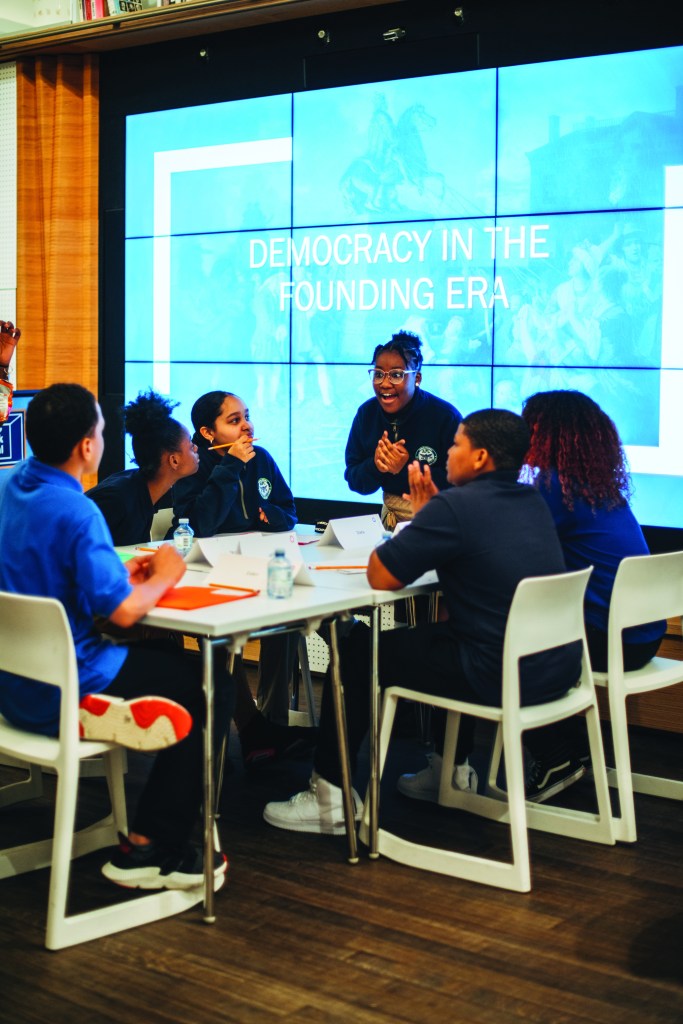
What eventually took shape was The Academy for American Democracy, a museum-based residency where entire classes of sixth graders attend school at The New York Historical for four consecutive days. For this period, students go to school, immediately travel as a class to the museum, spend the entire day learning about the history and evolution of democracy, and return to school in time for dismissal. What started as a pilot for three classes in 2019 has grown to a full operation serving more than 1,000 students a year in the in-museum residency.
What We Offer Students
Programmatically, The Academy for American Democracy is an authentic museum learning experience from start to finish. Almost everything is inquiry- based and learner-led. Students analyze primary source documents and artifacts, generate their own interpretations, and debate their conclusions before hearing additional historical context. Each class is assigned two museum educators as well as a classroom that serves as their “homeroom away from homeroom.”
Over four days, the classroom walls are covered in charts, artwork, and other ephemera students and their facilitators create. Our goal is simple yet ambitious: we know we cannot cover all of American civics in four days, so we see our role as planting the seed of curiosity and enthusiasm. We want students to understand what democracy is, how it works, and how and why they must play a role in it, now and in adulthood.
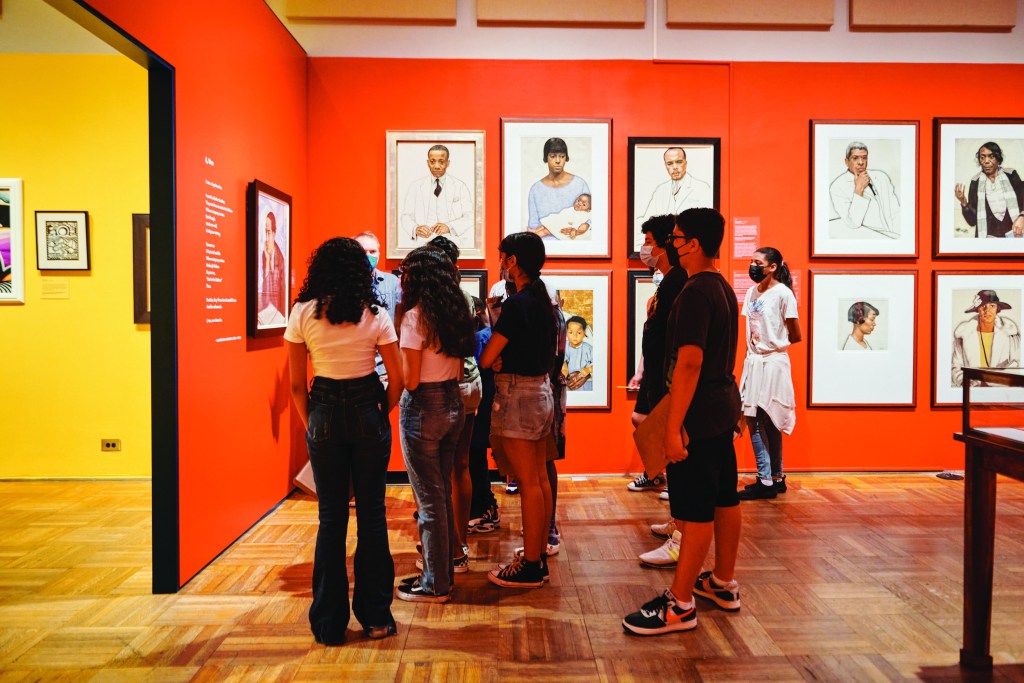
Students engage with the museum spaces during tours, gallery-based activities, and even free exploration time (instead of recess). Learning activities include document and artifact analysis, interactive tours, simulations and role playing, and artmaking. None of these activities are novel for museum educators. What is unusual is the volume and intensity—four days of nonstop museum learning within our building, taking place almost every week of the school year as sixth graders from throughout the New York City public school system rotate through the program.
At every step in the design process, we worked to balance the needs and interests of the school system with our strengths as a museum and education provider. We wanted to create something that was compelling and conducive to all New York City middle schools, which are part of the most segregated public school system in the country, according to national studies. The content we teach is relevant to the sixth-grade curriculum and includes opportunities to build the critical thinking and social-emotional skills all preteens need.
To break down logistical barriers, we made the program free, even covering the cost of transportation to and from the museum. While we are fortunate to have several key foundations and individuals who have committed to multiyear support, we still must raise the necessary funds and fill gaps each year. It is a significant lift, but it ensures that no school is excluded for financial reasons. In return, we just ask that schools not only bring their students but also enthusiasm for the learning adventure we offer.
The Effect on the Institution
The Academy has not only transformed student learning—it has reshaped our institution. On one hand, The New York Historical has been offering high-quality education to New York City public schools for more than 20 years, and The Academy was a natural evolution of that work. On the other hand, we struggled to find a similar model and were forced to make major decisions at every turn. Did we need new staff? Part-time or full-time? In the end, we promoted our field trip manager to a new Academy-specific role, and she trained our preexisting educator pool to team teach the program. We simultaneously felt as if we had all the answers and struggled with infinite, seemingly impossible questions.
What we developed doubled down on our education mission, and its success required a commitment from most departments in the institution. While the vast majority of the work takes place within the Education Division, bringing 30–90 students into the building each day for up to five hours means we need our operations staff to keep spaces running, AV and IT to support tech needs, communications to help promote the program and maintain our web presence, development to recruit financial supporters, and more.
Bringing the staff together was an exciting opportunity to collectively declare our commitment to thoughtful, strategic learning that addresses a clear need within our community. Even our recent capital campaign was informed by The Academy. In June 2026, The New York Historical will open the Tang Wing for American Democracy, which includes two additional classrooms specifically designed for The Academy.
Much like running a school, embracing in-museum learning brings unexpected hurdles almost every day. On the micro level, we weather the usual storms of program management: educators call out, buses get stuck in traffic, supplies break, and fire alarms go off. We serve one of the largest and most diverse public school systems in the country, so every class feels unique.
We are fortunate to have a cohort of nearly 40 part-time educators who lead most of the programs in our building. Leading The Academy is an opportunity presented to them once they master our core field trip programs. By relying on our seasoned staff, we can ensure each Academy educator is well-versed in our teaching approach and our building. But they also need additional support and ongoing training to practice tools and strategies. We can’t meet every need, but we do our best to accommodate student and class needs as much as possible without compromising quality.
On the macro level, operating a program that impacts almost every corner of the building is a big shift. A large part of my work is continually and politely reminding my colleagues across the museum about the program’s needs. Our lessons are affected when galleries change or items go out on loan. Even though the museum is closed to the public on Mondays, our program usually starts then, so we need security and AV staff on hand. Our classrooms are now in use four days a week for The Academy, which is prioritized over other programs’ space needs.
Donors are excited to see the program in action, but we need to stagger their visits so students and staff do not feel as though they are constantly being watched. As a leader of this program, I have learned that patience, proactivity, and gratitude are key. Even on the days when I need to remind folks about the program’s needs, I am grateful to work at an institution that is willing to support not just the Education Division, but the needs of young people, many of whom have never been to our museum before.
Evolving Museum Education
Through this work, The New York Historical is making a difference on many fronts. We are offering a transformative learning experience to New York City public school students who desperately need an educational experience that inspires them to be civic leaders. The program is also connecting students to cultural institutions, which they might perceive as intimidating and unwelcoming spaces.
Demand for the program is growing, and we are working to expand thoughtfully. Returning schools are given priority because we want the program to be a part of a school’s annual curriculum. All other public schools are welcome to apply, but we make a concerted effort to recruit schools from Manhattan and the Bronx, given their proximity to our building.
We collect surveys from students to gauge their enthusiasm for the program, their perceived increase in content knowledge, and their self-assessed understanding of democracy. An external study in 2023 found that students displayed strong growth in content acquisition about democratic models and skills around civic engagement. Students were most engaged when they could connect the content with their own lived experiences through inquiry and discussion.
I believe we are also actively shaping the future of museums, and I hope our work inspires others to join us on this journey. The scale of The Academy is tremendous, and I am grateful to work at an institution with the capacity to offer such a program. Not every museum can do what we do, but programs smaller in scale can also be successful.
When we piloted The Academy in 2019, we served just three classes. To those students, the impact was real. When we visited those same students in seventh grade, we were impressed with what they could recall. There was a palpable enthusiasm for their Academy residency that spoke to the unique nature of the program. Even if we still only held three residencies each year, our contribution to the lives of those young people would be substantial.
We can and should reimagine our spaces for innovative in-museum learning. Every museum and community is different, so our efforts will be equally varied. Most museums do not have the ability, space, or staff to sustain more than 1,000 students in four-day residencies each year. But most museums can provide some type of in-museum learning that extends beyond typical field trips. If we can commit to opening our doors to schools in more creative, intensive, and equitable ways, we can fully realize the potential of our field.
Questions to Consider in Reimagining In-Museum Learning
- What K–12 audiences in your community would benefit most from a transformative learning experience?
- What content area(s) are unique to your institution? Where might there be strategic alignment with the education system?
- Do you have classroom, gallery, or outdoor spaces conducive to learning?
- How many students/classes/schools can you reasonably serve?
- Who from the museum needs to be involved? How can staff from education, operations, development, communications, curatorial, visitor services, and more play a part?
- What might the one-, three-, and five-year plans be for this program?
- How do you ensure you reach those who will benefit the most? Can you lower barriers to entry or create incentives for the audience you want to serve?
All photos by Christian Rodriguez/The New York Historical
Leslie Hayes is Vice President for Education at The New York Historical in New York City.
Upcoming Events
-
AASLH-NCPH Joint Conference
Event Date:Presented by: American Association for State and Local History (AASLH)Providence, RI -
All You Need to Know to Drive Success for Your Museum Store Sunday!
Event Date:Presented by: Museum Store Association -
Transit Insurance in Practice for Traveling & Co‑Organized Exhibitions
Event Date:Presented by: American Alliance of Museums -
Digital Collections Summit
Event Date:Presented by: MuseumNext