This article first appeared in the journal Exhibition (Fall 2026) Vol. 45 No. 2 and is reproduced with permission.
To announce the 1942 opening of the new Hall of North American Mammals at the American Museum of Natural History (AMNH), curator Harold Anthony explained his philosophy behind habitat group dioramas. These detailed re-creations of nature were more than big game trophies behind glass. They were halls of geology and ecology in a broad sense, teaching about erosion and climate. The labels were supposed to be small and unobtrusive; explicit lessons would scare people away, but beautiful illusions of reality would engage visitors from all backgrounds. Writing during the height of World War II, Anthony was less concerned about teaching facts than about creating an immersive space for visitors to find respite in the sublime. He felt that this was “especially important during this period of world-wide turmoil, when the daily press and the radio continually impress one with man’s destructive powers and when there are so few releases from the war psychology.” He went on, “even in a war-mad world,” city dwellers could visit the dioramas to “find the sun still shining, the plants and trees still green or budded with promise, and the animal life still pursuing the same pattern of life as during times of peace. . . . For a while at least, the visitor can lose himself in communion with Nature.”1
Anthony’s words could easily have been written today. Ongoing wars and catastrophes constantly flood our screens. In the space of a year, the community around the Natural History Museum of Los Angeles County (NHM) has endured disastrous wildfires, military occupation, and masked agents raiding schools and churches. Perhaps more than ever, we need quiet opportunities to unplug, decompress, and lose ourselves “in communion with nature.” Across cultures, being in nature is one of the most common ways we experience awe, an emotion triggered by encountering vast mysteries that transcend our current understanding of the world. Feeling awe lowers stress, reduces ego, and promotes prosocial behavior.2 Even though dioramas are detailed re-creations of nature—not the real thing—evaluation we performed in 2024 in our diorama halls at NHM showed that about 70 percent of visitors still found them relaxing and awe-inspiring (n=300 visitors surveyed). When asked why, one visitor wrote, “Just seeing the animals in their habitat made me think about the wonders of nature and how vast and amazing it is.”
Occasionally, a museum visitor will post a snapshot of one of our dioramas on the r/LosAngeles subreddit, launching a lively discussion. “I love the old exhibits, and I especially love the hall that they’re in. The atmosphere in there is just sublime,” wrote one respondent under a picture of our Watering Hole group. Many responses were nostalgic: “These remind me of my childhood. I’m so grateful they have kept them the same.” Others were not as fond: “All of these old school dioramas always creeped me out for some reason.” Visitors are understandably confused by the inherent paradox of dioramas: “They’re beautiful but sad that they hunted the animals for the dioramas,” read another post. Why would a museum that promotes conservation kill an animal and put it behind glass?
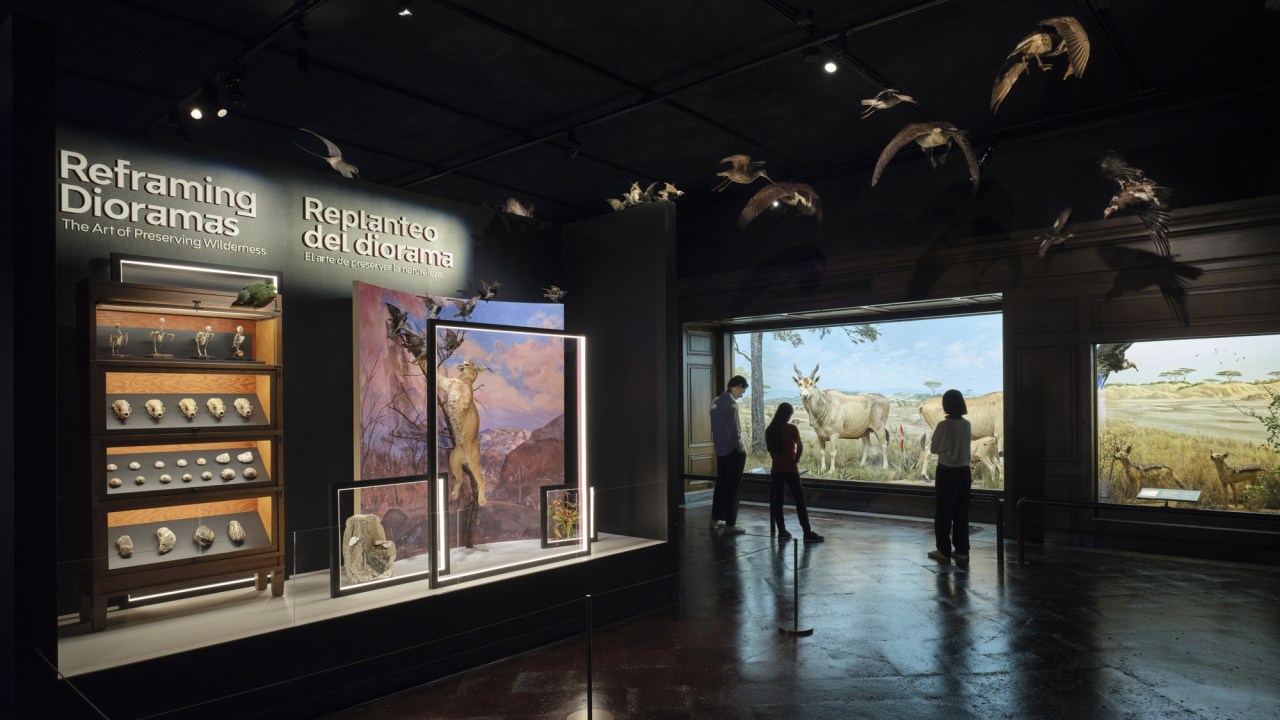
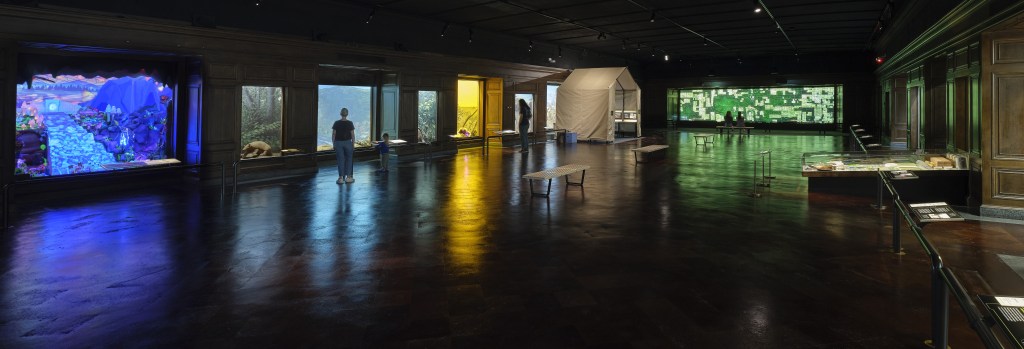
Dioramas are a prime example of something many museums struggle with: “historic exhibits,” old halls or displays that, while beloved by many, contain challenging content. Even when made with noble intent, many old exhibitions surface troubling reminders of our field’s colonialist past. Visitors may once have been captivated by the swashbuckling adventures of rich donors hunting “exotic” wild animals for dioramas, but a 2015 Marist poll found that 86 percent of Americans now oppose big game hunting.3 Can we intentionally create awe-inspiring spaces like diorama halls that offer reprieve from the demoralizing noise of a “war-mad world” while also encouraging visitors to process challenging content? Based on the success of a recent renovation project, our answer is a resounding, Yes! We’ll show how we did this with our own century-old diorama halls by using extensive evaluation to engage visitors with the complex legacy of dioramas (intro image).
The Complicated History of Dioramas
Part of the problem with historic exhibits is that we have moved far past the original cultural context in which visitors would have seen these displays. Pioneering taxidermist William T. Hornaday laid the foundation for diorama halls when he built the first bison diorama for the Smithsonian Institution in 1888 (fig. 1). On a collecting trip two years prior, Hornaday was horrified to find the Great Plains devoid of bison. It had taken less than 20 years for state-sanctioned slaughter to completely destroy the thundering herds once 10 to 15 million strong. With some remorse Hornaday shot the few stragglers he could find and returned East to sound the alarm. His bison diorama became a powerful, if fatalistic, rallying call for conservation: better to shoot the last bison and place it behind glass among its natural vegetation than to let our progeny forget the entire habitat we had so carelessly destroyed.
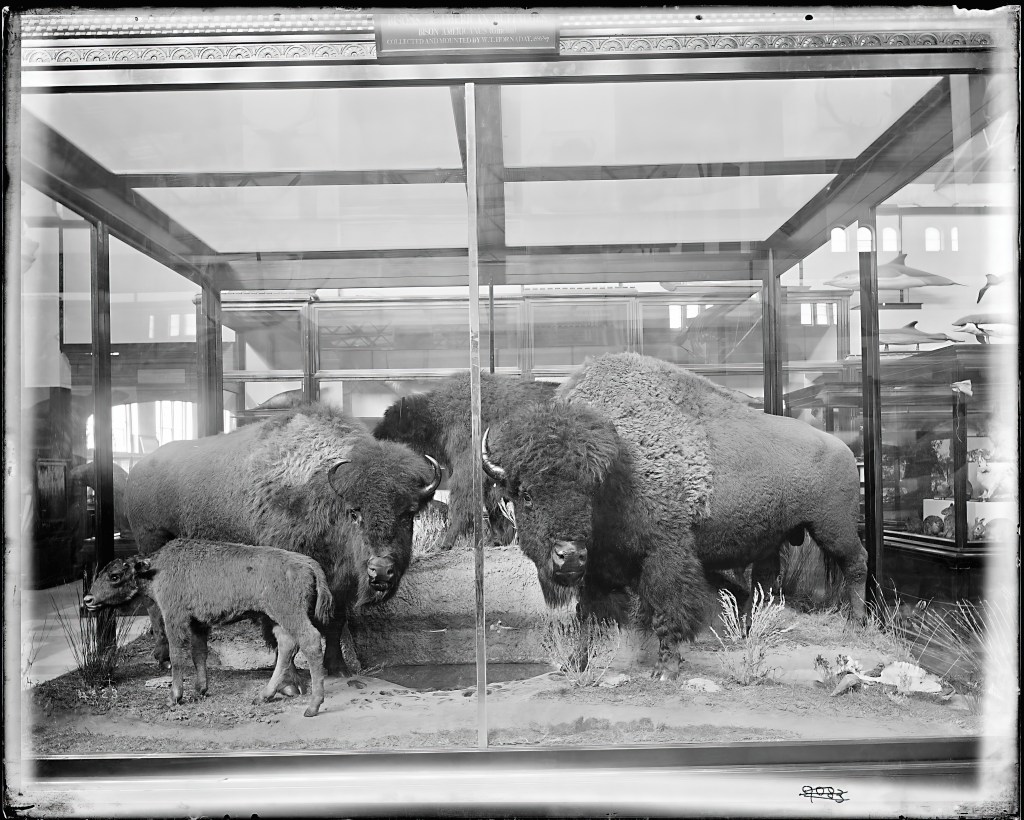
But Hornaday didn’t stop there. He tried breeding bison on the Smithsonian’s lawn, starting what would become the National Zoo. He wrote a popular book and founded the American Bison Society to promote conservation laws and reintroductions. Hornaday transformed the bison into a symbol for America. It was only after the Smithsonian’s exhibit that we got the bison on the $10 bill, the buffalo nickel, and the seal of the Department of the Interior. Without Hornaday and his diorama, the American bison would likely have gone extinct.4
Other museums followed Hornaday’s lead. Early dioramas were directly responsible for creating the first US federal bird reserve, Africa’s first national park, and important marine mammal protection laws.5 Dioramas worked. There are more bison, tule elk, and mule deer alive now than when they were first placed behind glass at NHM a century ago. With their dramatic scenery and minimal text, dioramas were also more inclusive than traditional displays, which had long, didactic labels meant only for the highly educated. At the 10th Annual Meeting of the American Association of Museums in 1915, taxidermist Homer Dill excitedly told attendees how the new diorama at the University of Iowa Museum had brought in an incredibly diverse audience: “Here are all kinds of people! Students, men of science, and people who would never read a book or go to a lecture are here learning something.”6 After reviewing the country’s first mammal diorama hall at the California Academy of Sciences in 1917, Scientific American proclaimed, “It is not venturesome to prophesy that the museum of the future will be planned almost exclusively for habitat groups.”7 The old way of displaying bones in cabinets with long, boring labels was out. Natural history museums had discovered the awe-inspiring powerof dioramas.
Today, the laudable origins of dioramas are unfamiliar to many. What appears clearer in hindsight is the more troublesome legacy of habitat groups. Hornaday and his bison diorama may have helped launch the modern conservation movement that saved many species from extinction, but this crusade was driven in part by frustrations among wealthy white East Coast men. They needed “wilderness” to prove their vigor and wanted to preserve it for themselves.[8]8 Hornaday had personally hunted and killed hundreds of species from elephants to orangutans. Still, he lambasted what he saw as the wanton destruction perpetrated by non-white “pot hunters” (e.g., poor Italian American laborers who shot small game to support their meagre diets). Even Hornaday’s contemporaries accused him of racism. In 1906, he infamously displayed a young Congolese man named Mbye Ota Benga in the chimpanzee cage at the Bronx Zoo as a “missing link.”9 Despite unruly crowds, protests by African American clergy, and increasingly bad press, it took Hornaday 20 days to release Benga. An editorial in William Randolph Hearst’s New York Evening Journal opined that the display was “an absolutely shameful disgrace to every man in any way connected with it.”10 Although habitat groups of deer and skunks were a far cry from racist exhibitions of humans like Benga, they were still beholden to the biases of their time. Many dioramas purposely created false scenes of virgin wilderness, erasing humans from African savannahs and habitats in North America where Indigenous Peoples, and even European Americans, had been living for generations.
Updating Dioramas
Dioramas were designed to be unchanging time capsules, a conceptual and aesthetic choice which has long frustrated museum leaders struggling to keep their halls up to date with current technology, educational trends, and the public’s everchanging views on nature and hunting. In the 1980s and ’90s, many museums tried to revitalize their now dusty and outdated dioramas by making them more immersive. In L.A., we added touchable fur and pulled dioramas out from behind the glass, breaking the fourth wall. We installed animatronics, sound effects, and real running water (fig. 2). On a looping audio track, Michael Landon, star of Little House on the Prairie, waxed forlornly about the near extinction of bison.
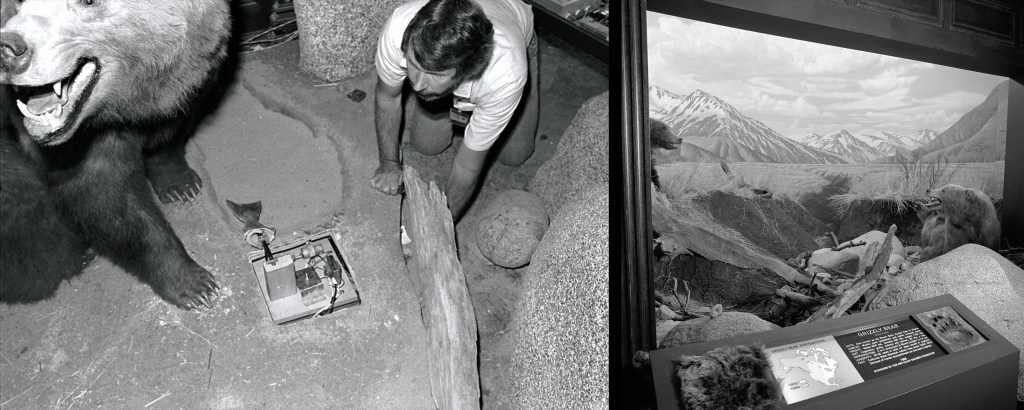
While these Disneyesque interventions might have increased visitors’ sense of awe, they only obfuscated the challenging history of dioramas. It’s doubtful they made the halls any more relaxing either. If taxidermy already unnerved someone, turning an aardvark into an animatronic cyborg by stretching its real skin over a robotic skeleton did not improve the situation. It didn’t improve costs either. Unlike their motionless counterparts in sealed dioramas, the animatronics required frequent and expensive maintenance. Touchability and immersion also came at the expense of biodiversity. Small insects, plants, and birds were too fragile to withstand the surge of unauthorized hands (and feet!) entering the now open scenes. By 2006, we had turned off all the theatrics and pushed the dioramas back into their bays, restoring the halls to their traditional aesthetic and repopulating the habitats with a realistic diversity of plants and small species.
As part of recent surges of interest in taxidermy11 and decolonization, museums have begun intervening in ways that do encourage visitors to process challenging content and think about dioramas as historical artifacts rather than true reflections of nature. Both the Carnegie Museum (2016) and Field Museum (2020) opened exhibits that showcased the artistry behind dioramas. For Climate Week NYC 2025, AMNH overlaid eight dioramas with labels and interactives showing how climate change was affecting the habitats on display. Half of the bison diorama was covered to show that half of the Great Plains has been ploughed into farmland.
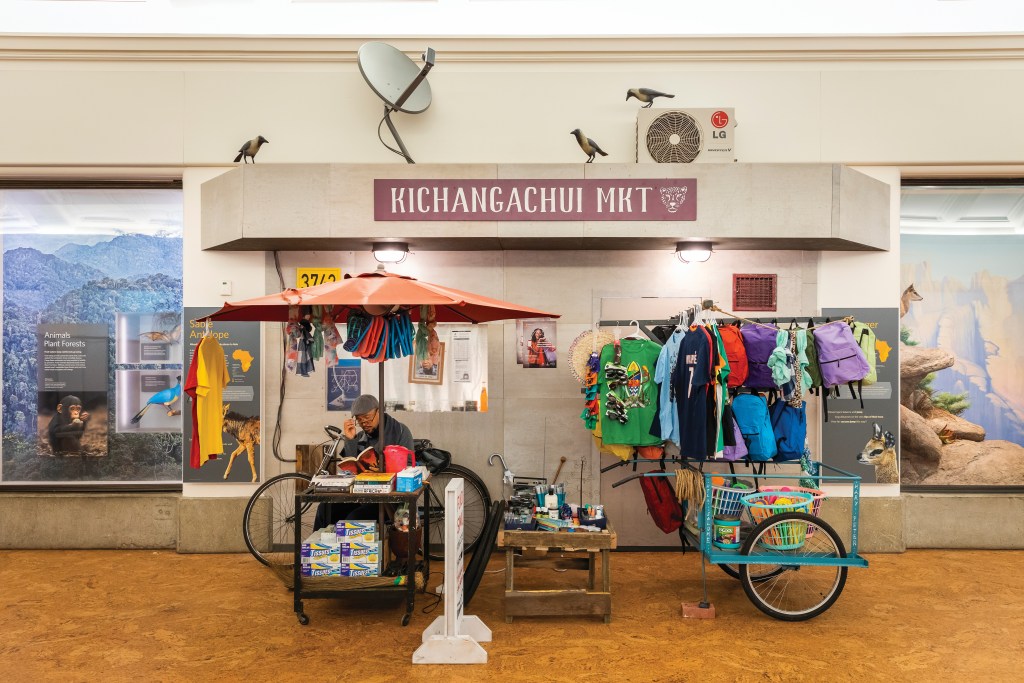
The California Academy of Sciences’ “Thinker-in-residence” Walter Kitundu went further, temporarily replacing an entire diorama with a storefront from Dar es Salaam, Tanzania, in 2023 (fig. 3). The museum also added pictures of African cities to the hall’s intro label. Dioramas have been so effective at erasing Africans that it was provocative to point out that more than a billion people live on the continent.
Reframing Dioramas in Los Angeles
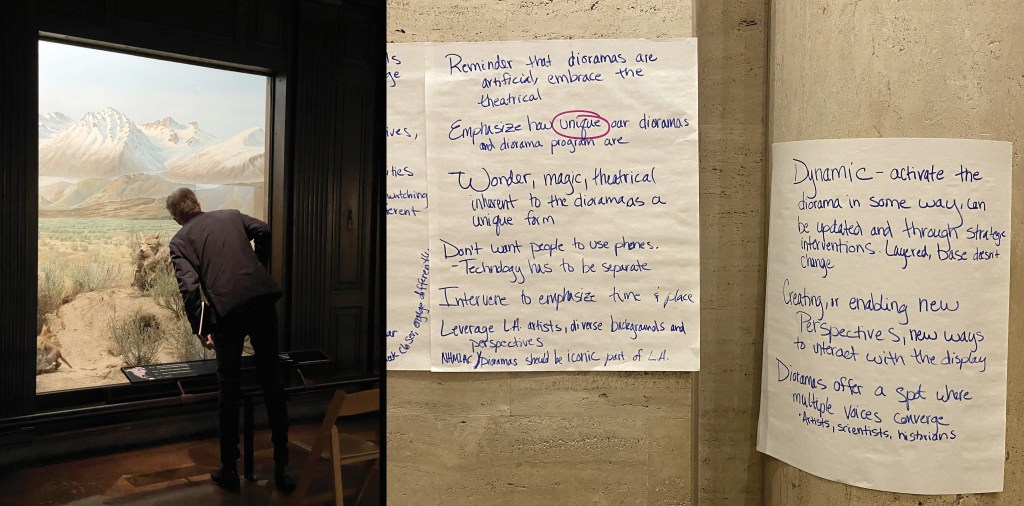
With funding from Getty’s PST ART: Art & Science Collide initiative in 2020 and the centennial of our first diorama (1925) approaching, we completely reevaluated NHM’s four diorama halls. We began this exploration with a large incubator (fig. 4) that included a diverse cross section of staff, academics, artists, conservationists, Tribal Elders, educators, and government officials. After sharing a history and tour of our halls, we asked participants, “How can our dioramas best support the values and vision of the museum and our communities today—as well as through the next 100 years?” Their feedback was wide ranging, but could be synthesized into several broad goals:
- Go big! Whatever we do, do it loud and proud.
- Celebrate the amazing works of art that dioramas are—but be critical and open about their history.
- Allow outsiders to help tell the story.
- Trust in our visitors.
- Defend collections and how important they are for research and education.
All this could be wrapped up in one overarching theme: Help everyone see dioramas from new perspectives.
Setting the Baseline with Formative Evaluation
Emboldened by the support of our community, we embarked on a two-year evaluation process in 2022 that included staff focus groups, visitor tracking and timing, build-your-own label activities, and multiple prototyping sprints. This gave us a much better understanding of staff and visitor needs. Anecdotally, floor staff said that visitors’ most asked question was, “Are they real?” To many, it was inconceivable that the museum would have purposely hunted animals for the dioramas.
We were aghast to find that some staff had the opposite misconception; they thought all the animals were illegally poached by pith-helmeted colonialists. We needed radical transparency. Many diorama animals were hunted by wealthy donors. However, these were legal hunts under special scientific research permits and often part of large, museum-led biodiversity surveys funded by those same donors. Other animals were collected after death—donated by zoos or as part of government-sanctioned culls.
In 2022, we gave 34 visitor groups the chance to create their ideal diorama label from a wide set of content modules featuring information frequently found on species labels in museums and zoos. Each module was an individual label piece such as a range map, a description of diet, or a seemingly weird fact. Given that our general visitors seem very interested in whether the animals in our dioramas are real, we were surprised that only half of the groups in the activity included such information on their labels. Fewer than a quarter added modules about the history or artists of the dioramas. Groups prioritized information about the life habits of the focal species and pictures of the other animals hiding in the scene.
These findings led us to split our exhibition refresh strategy in two. For the first part of this strategy, we would revamp the labels for dioramas in our African and two North American Halls, focusing on the ecology displayed in each scene. However, we would not alter the general aesthetic or experience of the dioramas; these “traditional” halls would maintain the nostalgic, awe-inspiring atmosphere that visitors cherished. Importantly, we were able to assess visitors’ emotional experiences in these three traditional halls (before their refresh) using the revised Dimensions of Visitor Experience (DoVE) adjective checklist developed by Jan Packer.12 This survey tool allows visitors to choose from 50 emotional descriptions, which map to 10 overarching dimensions of visitor experience, including engagement, awe, and concern. These surveys (n=300) would serve as a baseline for any interventions done in our halls, enabling us to evaluate their effectiveness.
Sharing Challenging Content Through a New Exhibition on Dioramas
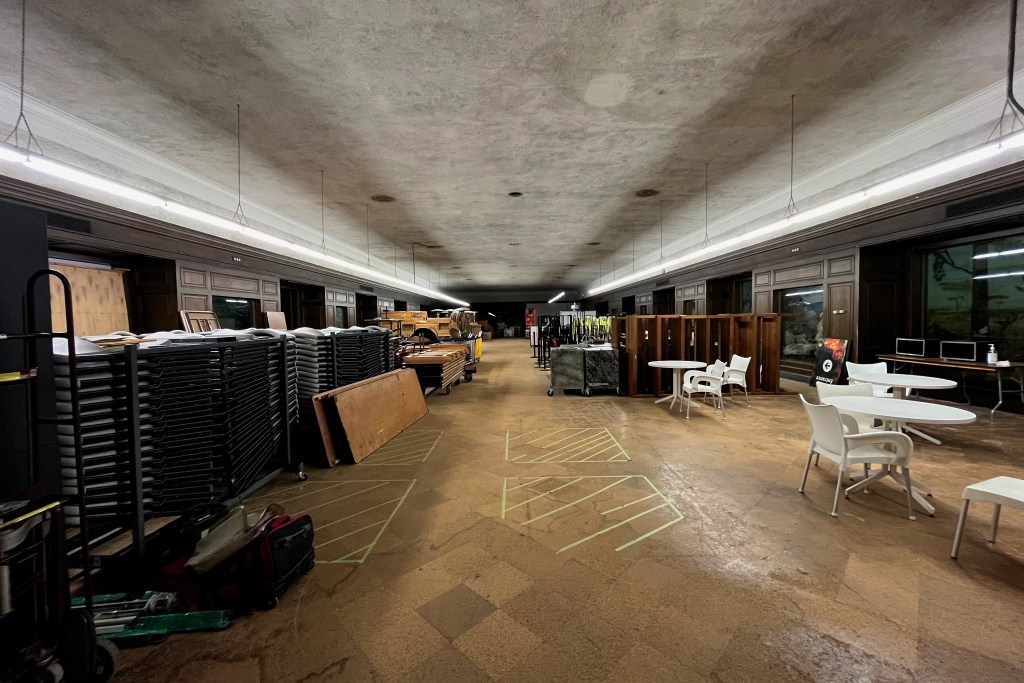
Our fourth diorama hall (featuring species from Australia, Asia, Africa, and South America) was actually never finished and had been closed to the public for decades (fig. 5). As the second part of our refresh strategy, we decided to restore this hall and reopen it not as an exhibition of dioramas, but rather as an exhibition on dioramas (fig. 6). We wanted visitors to understand that dioramas were works of art and that their creators had—and have—complex motivations. There are still many species that need our help, which is why we continue to collect specimens in an ethical way for crucial biodiversity research.
For the reopened hall, which would become our new temporary exhibition Reframing Dioramas: The Art of Preserving Wilderness, we drew inspiration from early diorama creators (intro image). They had revolutionized natural history museums by using art and drama to communicate ecology and conservation. We wanted our design to focus on artistic interventions that evoke visitors’ own emotions rather than didactic displays that transmit facts. It was crucial to develop a somber yet hopeful emotional tone because the underlying content was often horrific. On a biological survey to a tiny Hawaiian island in 1911, the second president of our museum discovered the carcasses of over 300,000 albatrosses left to starve to death by feather poachers. It was scenes like these that made museum leaders think they were losing the war against extinction. They wanted to preserve memories of habitats in dioramas before they disappeared forever.
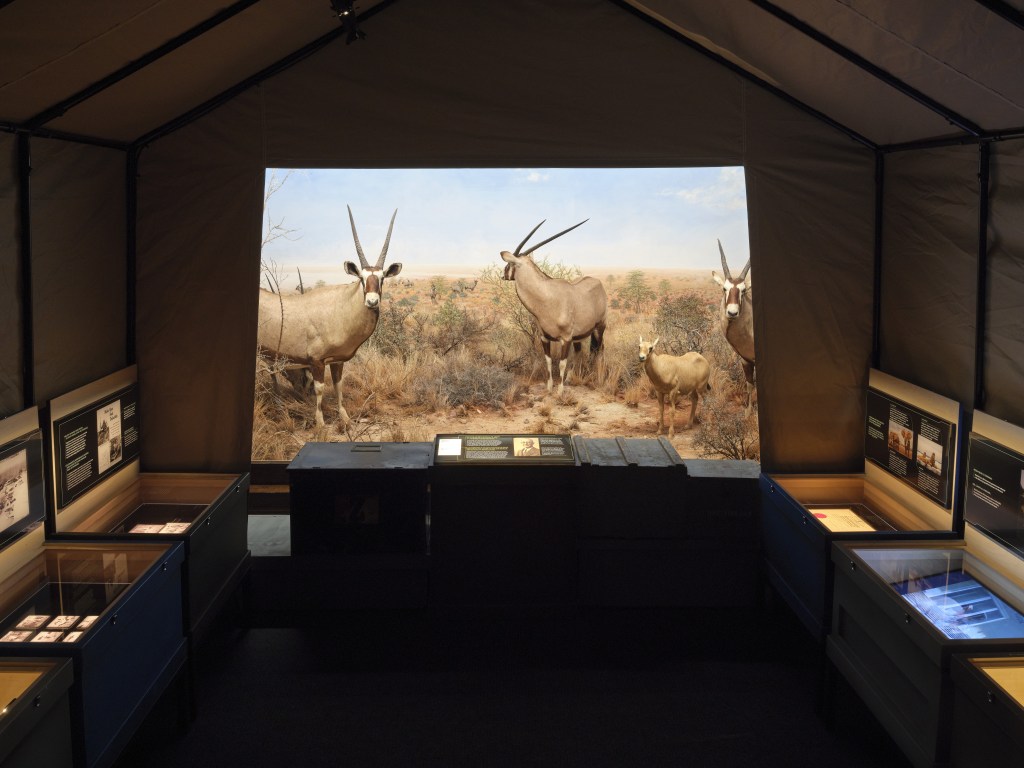
As a museum with over 160,000 student field trip visitors a year, we needed to take care in displaying and communicating stories like these. Particularly graphic content, like photos of donors posing with their bloodied kills, was placed in crates and put inside an expedition tent display (fig. 7). This field camp allows for an opt-in experience while also evoking early 20th-century colonialism. The donors who shot animals for the museum’s dioramas truly did care about education and conservation. Beyond their sweat equity, they spent fortunes to fund research expeditions, exhibitions, and wildlife conservation programs. However, they were also part of a colonialist system that favored rich, foreign trophy hunters like themselves over locals who needed to hunt for food or to protect their crops and livestock. Under the auspices of the museum’s research permits, donors could bag impressive game like elephants and muskoxen unavailable to normal hunters—all while getting a tax write-off.
Photograph by Elon Schoenholz ©NHMLAC
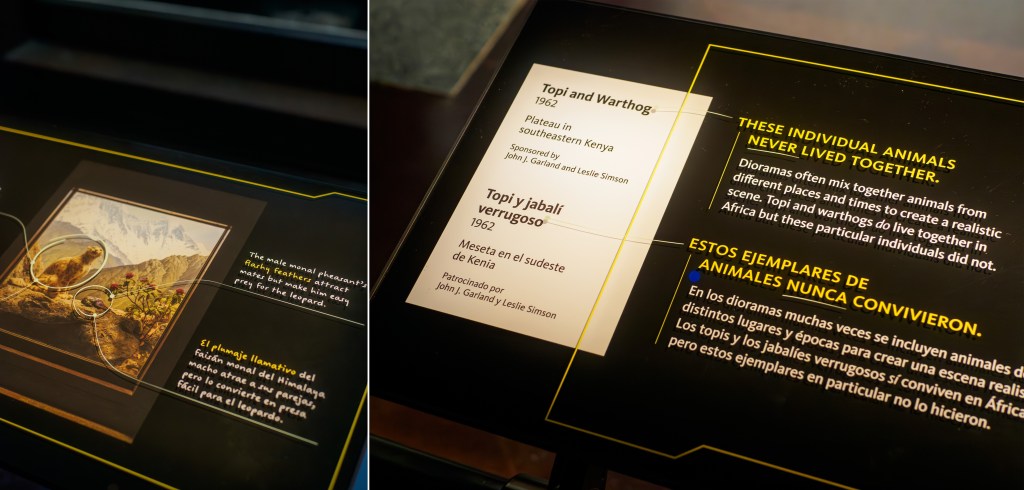
Viewing the gemsbok diorama through the field tent flaps is one way the exhibition design team interpreted the title Reframing literally. Another display helps visitors recognize the artificiality of the habitats by deconstructing one diorama into each meticulously handcrafted leaf. We presented dioramas as art and gave them labels more typical of paintings than rainforests (fig. 8). We printed these labels as two separate layers so that we could superimpose self-critical annotations over the traditional museum voice. These interventions were designed to complement the traditional wood-paneled aesthetics of the hall. The goal was to use emotional cues to encourage new perspectives, not to assault visitors with overly aggressive confrontations.
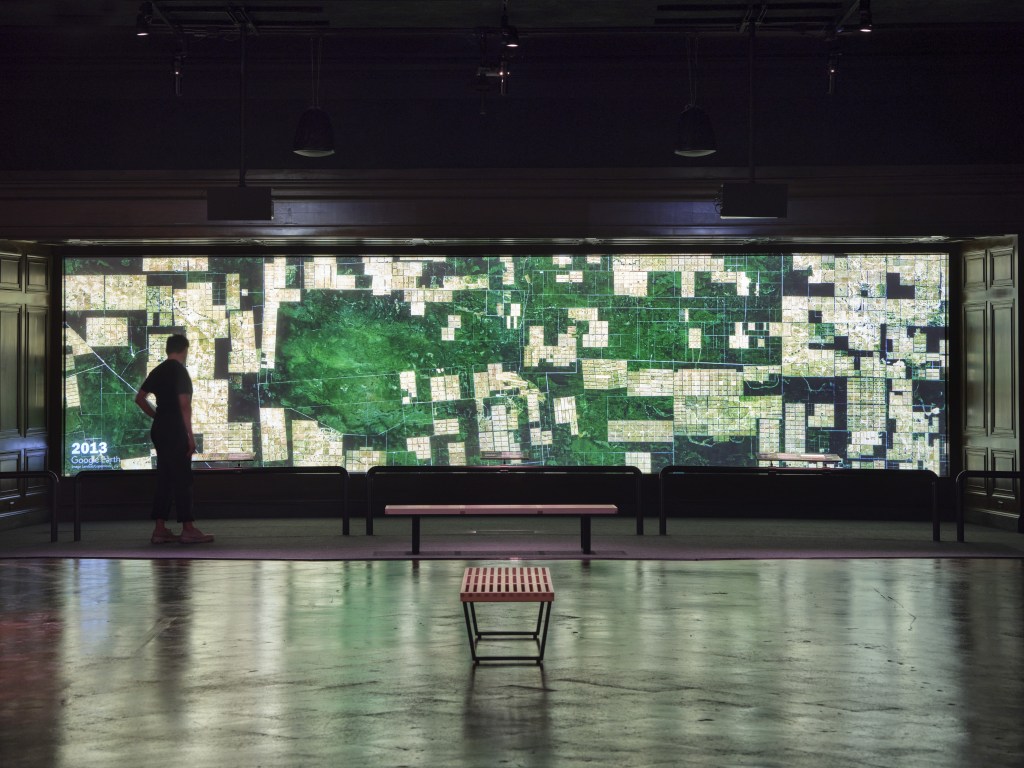
Despite this contemplative atmosphere, we did not prioritize relaxation. Visitors should feel concerned. They may scorn khaki-clad hunters of the past, but the extractive economic system we currently live in would put any historical colonialist to shame. Two dioramas in the hall display species from the Gran Chaco region of South America. Between 2009 and 2019, this habitat lost 52,690 km2 of native woodland, mostly to farms and pastures producing beef for richer foreign countries.13 Imagine clearcutting a forest larger than Vermont and New Hampshire combined in less than a decade and you approach the scale of this destruction. Rather than write these facts on a label, we projected time-lapse satellite views of Gran Chaco’s rapid habitat loss on one panoramic diorama, encouraging visitors to reflect on how their own diets contribute to extinctions (fig. 9). It’s not trophy hunters or poachers that are threatening most animals, it’s our appetite for beef.
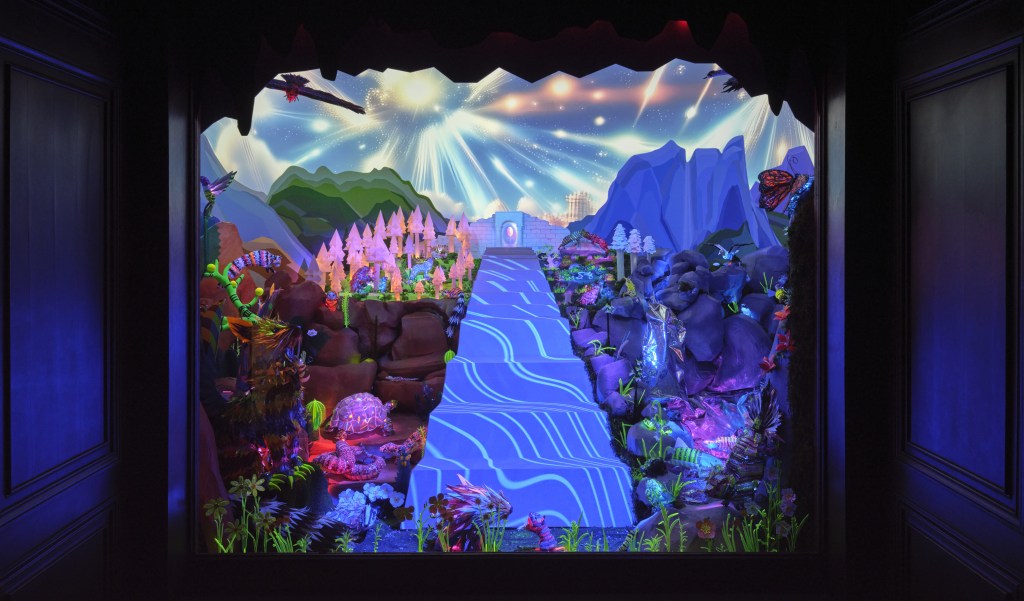
To include more outside perspectives in our story, we also selected five artists to develop their own interventions in three empty diorama bays. Seattle-based painter and sculptor Saul Becker crafted an eerily beautiful post-apocalyptic landscape of orange skies and metallic plants. Local multimedia artist Lauren Schoth used digital backgrounds to show the evolution of the L.A. River over hundreds of years and on to a hopeful, sustainable future. L.A. artist collective RFX1 (Yesenia Prieto, Joel Fernando, and Jason Chang) combined expertise in piñatas, digital multimedia, and street art to transport visitors to a fantastical spirit realm where California’s threatened species thrive (fig. 10).
Measuring our Effectiveness with Summative Evaluation
Was this design effective? In 2025, we randomly surveyed 112 visitors exiting Reframing Dioramas using the same DoVE tool and compared their responses to our baseline from the three traditional diorama halls before any refreshing in 2024 (fig. 11). The DoVE questionnaire gives a quantitative measure of emotional response, but we were also curious why visitors might feel certain emotions. At the suggestion of the tool’s author, we added a series of open-ended questions to the end of the DoVE checklist, asking visitors to explain the drivers of specific emotions that they had selected. We were especially interested in which aspects of the exhibits caused concern or compelled visitors to consider changes they could make in their own lives. This qualitative data provided insight that could inform the design of future exhibits with similar cognitive and affective goals.
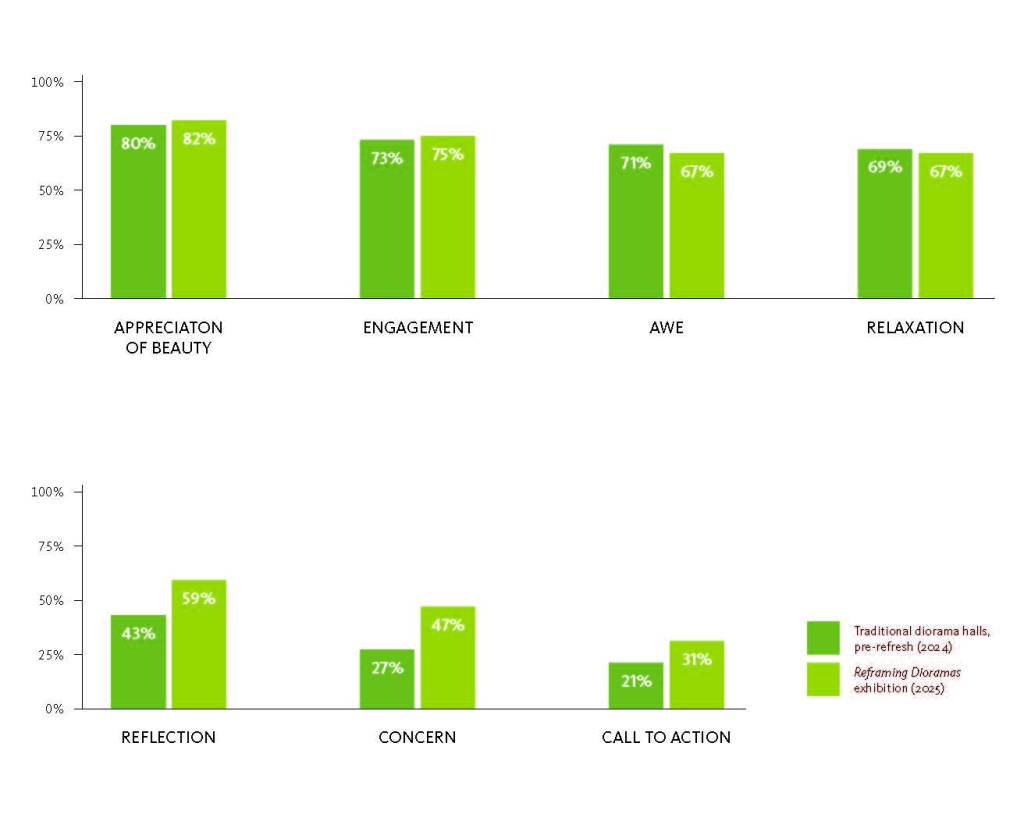
Responses demonstrated that the design and complicated content of the new exhibition did not detract from the appreciation of beauty, engagement, or sense of awe that visitors felt in our traditional dioramas. Appreciation of beauty was still the most reported dimension in Reframing Dioramas (82 percent), while over two thirds of visitors still felt awed and relaxed in the hall. That visitors found the exhibition relaxing was a surprise, as we were willing to sacrifice some relaxation to prioritize increased concern. However, this was not necessary. Reframing Dioramas greatly increased feelings of concern, reflection, and being called to action without losing any of the strengths of traditional diorama halls. Compared to these traditional halls, visitors leaving Reframing Dioramas were twice as likely to report being “worried about the state of the world.” More encouragingly, they were also twice as likely to report that they “felt moved to take action” and “wanted to do something to help.” This suggests that difficult truths can lead to positive takeaways. As one visitor wrote, “The fact that some species went from endangered to stable due to the dioramas made [me] feel inspired that the world could still be saved.”
Self-reflection and sharing are also built into Reframing Dioramas. Using an interactive kiosk, visitors can complete the DoVE checklist themselves and compare their own responses to the results of our scientific survey. While a nonrandom sample, this kiosk data does provide an important measure of ongoing visitor sentiment. For example, the habitat loss projection (fig. 9) has proven particularly impactful. Visitors have written comments like, “the back wall display of disappearing forest gave me chills and a consideration to eat less meat,” and, “the livestock mass data and satellite images compel me to turn vegan.” On several occasions, we have personally witnessed visitors weeping in front of the display.
Creating Awe-inspiring Spaces for Reflection
Our dioramas inspire an appreciation of beauty and a sense of awe, but also offer a space where visitors confront misconceptions and reflect on challenging content. This leaves many concerned and even sad but also inspired to take action in their own lives to conserve wildlife and habitats. But what about other types of historic exhibits? How can museums grappling with challenging content cut through the noise? We offer the following guidelines, based on our own experience successfully updating our historic halls.
- Use existing tools like the DoVE checklist to quickly create a baseline and measure the effectiveness of your interventions. Without comparable data, you will never know whether the changes you make to your historic exhibits are working as intended.
- Embrace the sublime. Experiencing awe makes people feel like they are part of something larger, increasing their open-mindedness. This attitude helps visitors process challenging content and new ideas. When asked why they felt inspired, one visitor in our 2024 baseline survey wrote that it was “a humbling experience to know that I am small, not in a negative or sad way but rather that there is so much out there outside myself, and to not focus on things I can’t change, and [instead] use my energy to change what I can for the better.” Nature and the cycle of life and death are two strong sources of awe found in dioramas, but any exhibit can connect visitors with the sublime. Art, music, discovery, the mystical, collective action, and moral beauty are all proven to inspire awe.14
- Provide context for why historic exhibits are the way they are. There is no neutral voice. Explaining the “why” behind a display helps visitors place it into a larger historical context. One visitor to Reframing Dioramas thanked us for this explanation, writing, “It is important to understand our difficult history in research and science to truly appreciate the artistry and preservation presented in this exhibit.”
- Separate nostalgia from colonialism. Despite their problematic content, there’s a permanence in historic exhibits that many visitors find comforting. One visitor to our refurbished African diorama hall wrote emotionally about her turbulent childhood and how seeing the antelope diorama unlocked a healing memory of visiting the same display with her mother decades earlier. When a Redditor commented that they loved our African diorama hall because, “The atmosphere in there is just sublime,” they were probably talking about the dark wood paneling, not embracing the colonization of Africa. Can you replace or contextualize problematic content without destroying the nostalgic character of the space? Or is the architecture itself so problematic that it needs reframing?
- Connect emotionally through the power of real objects. While creating immersive, awe-inspiring spaces, don’t forget the power that real objects hold. “Seeing life-like wildlife in front of me made it seem more real than seeing them through the internet,” wrote one visitor to our refurbished North American diorama hall.
- It’s OK to have beautiful spaces meant for relaxation. Not every display needs to confront visitors with some hard-hitting truth. Navigating mazelike museum exhibits is overwhelming enough without heavy themes. Give visitors the space and time they need to relax and reflect on challenging content. Use design cues like comfortable seating to signal that it’s alright just to be here and enjoy the scenery. One visitor to our refurbished African diorama hall praised, “The simple fact that I was able to just enjoy the beautiful scenic view. . . . Allowing such imagination flow was surprisingly very calming and having that, and sharing that, with my child and husband is something I will never forget.”
- Solicit and trust visitors’ feedback early and often, and don’t be afraid to take risks with difficult content. We do our communities a disservice by hiding the brutality of nature and our own history; honesty and transparency can gain visitors’ trust. Evaluation gave us the confidence that visitors appreciate candor and the opportunity to contemplate challenging content. One comment from our 2024 baseline survey proved particularly inspiring, “Wildlife [diorama] halls remind me of my mortality and the mortality of everything around me. They do cause me to reflect, but I’m not upset about that. I think that’s healthy.”
It is possible to create relaxing and awe-inspiring spaces in today’s “war-mad world” that still challenge visitors and leave them empowered.
- Harold E. Anthony, “Tour of North America,” Natural History 49, no. 4 (1942): 189–93. ↩︎
- Dacher Keltner, Awe: The New Science of Everyday Wonder and How It Can Transform Your Life (Penguin Press, 2023). ↩︎
- “Americans Oppose Big Game Hunting . . . More than Six in Ten Favor Legal Ban,” HBO Real Sports/Marist Poll, archived November 24, 2015. ↩︎
- Steven Rinella, American Buffalo: In Search of a Lost Icon (Spiegel & Grau, 2008). ↩︎
- Matt Davis, “Introducing Dioramas,” in Fabricating Wilderness: The Habitat Dioramas of the Natural History Museum of Los Angeles County, ed. Matt Davis (Natural History Museum of Los Angeles County, 2024), 19–25. ↩︎
- Homer Dill, “Building an Educational Museum as a Function of the University,” in Tenth Annual Meeting of the American Association of Museums, ed. Paul M. Rea (Waverly Press, 1915), 84. ↩︎
- Samuel Hubbard, “Where Science Joins Hands with Art: The Modern Taxidermy as Revealed in San Francisco’s Great New Museum,” Scientific American 116, no. 6 (1917): 154–57. ↩︎
- Miles Powell, Vanishing America: Species Extinction, Racial Peril, and the Origins of Conservation (Harvard University Press, 2016). ↩︎
- Pamela Newkirk, Spectacle: The Astonishing Life of Ota Benga (Amistad, 2015). ↩︎
- The Editorial Board, “The Black Pygmy in the Monkey Cage,” New York Evening Journal, September 17, 1906, GenealogyBank. ↩︎
- Matt Blitz, “Why Taxidermy Is Being Revived for the 21st Century,” Smithsonian, June 19, 2015; Caroline Galambosova, “From Specimen to Contemporary Taxidermy,” Daily Art, August 4, 2025. ↩︎
- Jan Packer, “Issues in Measuring Visitor Experiences: Refining the DoVE Adjective Checklist,” Visitor Studies 28, no. 2 (2025): 245–71. ↩︎
- María Jesús Mosciaro et al., “Future scenarios of land use change in the Gran Chaco: how far is zero-deforestation?” Regional Environmental Change 22, no. 115 (2022): 2–17. ↩︎
- Keltner, Awe. ↩︎
Matt Davis is Exhibition Developer at the Natural History Museum of Los Angeles County (NHM) in Los Angeles, California.
Beth Katz is Director of Evaluation and Museum Impact at NHM.
David Pullido is Exhibition Designer at NHM. Andrea Mode Andrews is Director of Exhibitions at NHM.
Upcoming Events
-
From Informational Interview to Real Connection
Event Date:Presented by: American Alliance of Museums and National Emerging Museum Professionals Network -
Understanding the U.S. History Workforce
Event Date:Presented by: American Association for State and Local History (AASLH) -
TrendsWatching: To Live or Die in AI Webinar
Event Date:Presented by: American Alliance of Museums -