This article originally appeared in the May/June 2016 issue of Museum magazine.
Exploring the social justice role of museums in the preservation and presentation of history and culture.
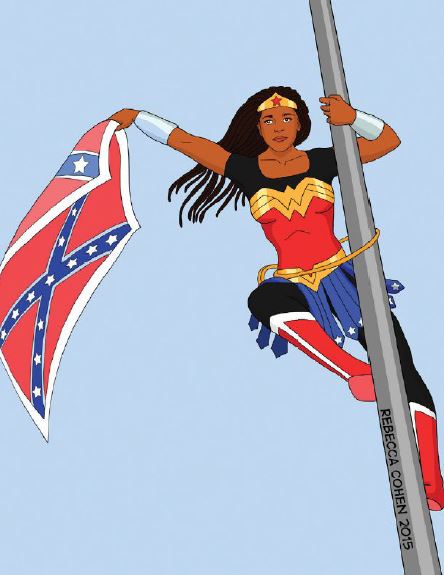
“Take down the flag. Take it down now. Put it in a museum. Inscribe beneath it the years 1861–2015.”
The past year has been marked by protests across the globe as communities grapple with issues of race, identity, culture, history, and symbolism. People are climbing out of the boxes long used to define and control society— male/female; straight/gay; white/black/yellow—demanding control over their identities and how these identities are represented. These issues have dogged the US since the nation’s founding, but now activists are using the power of social media to ensure they are heard. Objects—powerful symbols of individuals, groups, history, and society as a whole—have become explosive points of contention. And museums, as public stewards of our collective history, find themselves enmeshed in the struggle over representation, identity, and material culture.
Western society is beginning to acknowledge the complexities of human identity—including race, sexual orientation, and gender. Government notoriously lags behind social change, with the US Census perpetually playing catch-up, changing how it collects data to support the way people categorize (or resist categorizing) themselves. The Census Bureau first allowed people to identify as more than one race in the year 2000. In the following decade, the number of people choosing this option doubled, reaching 1.8 million by 2010. New parents are more likely to identify their babies as belonging to more than one race, and grown children are more likely to change the identity assigned to them and self-identify as multiracial.
We are also beginning to accept, once we stop forcing people into binary categories, that sexual orientation and gender are both continuums. Sixteen percent of Americans identify themselves as neither fully hetero- nor homosexual but somewhere in between. And some people are able to recognize that their gender doesn’t synch with their genes or morphology as early as age three. Our social and legal systems, as well as our built environment, are slowly adapting to reflect these complexities. (In 2014, Facebook presented new ways for users to identify themselves, including 58 gender options as well as three pronouns.) While many universities struggle with how to accommodate students who transition in college (particularly at single-sex universities), the University of Vermont has officially recognized a third gender: neutral.
But accepting fluid boundaries can heighten concerns over representation and control. Are there limits to the right to claim one’s own identity? Rachel Dolezal, former president of a chapter of the National Association for the Advancement of Colored People, was pilloried in social media and the press for self-identifying as black when her parents and peers experienced her originally as white. Dolezal has repeatedly expressed that she acted on a deeply felt sense of internal identity. But critics accuse her—and other whites presenting themselves as black—of dabbling in an identity they can abandon if it becomes inconvenient.
The landscape is no less fraught when it comes to groups rather than individuals. Who has standing to speak on behalf of a community? While supporters of the “Change the Mascot” campaign pressure the National Football League team based in Washington, DC to stop using a racial slur (“Redskins”) as its name, some Native Americans rallied in support of the team’s moniker. Further complicating matters, culture isn’t just a matter of parentage; it is also a matter of heritage. Does an individual have to be raised in a culture in order to represent it? The Navajo Nation recently wrestled with whether to allow a tribal member not fluent in Navajo to hold public office, and eventually decided to amend the election requirements.
Issues of identity and representation not only play out on the individual and corporate levels, but also in the public sphere, as we grapple with tangible reminders of a painful past. In the US, calls to #TakeDownTheFlag led to the removal of the Confederate battle flag, first from the grounds of the South Carolina Courthouse, and then in a cascade from Capitol Hill in Montgomery, Alabama, to the University of Mississippi and even St. Paul’s Episcopal Church (known as the “Cathedral of the Confederacy”) in Richmond, Virginia. South Africa is confronting similar issues in response to calls that statues of (former Prime Minister Cecil) #RhodesMustFall, and former Soviet bloc countries wrestle with the choice of saving or destroying statues of Lenin.
Now the question becomes not whether to take down a flag or a statue, but where to draw boundaries. Do public monuments perpetuate oppression or remind us of the history we need to redress? The person or people who defaced the monument to John C. Calhoun in Charleston, South Carolina were drawing a line—geographically and intellectually—from his racist views (Calhoun was a strong advocate of slavery and a supporter of the South’s succession from the Union) across Marion Square, to the recent murders of nine worshipers at the Emanuel African Methodist Episcopal Church. But as many commentators are pointing out, if we erase tangible reminders of our past, how will we understand how we got where we are today?
What This Means for Society
If our communities proactively address social justice issues, we may negotiate cultural/social transformation in productive and equitable ways. Conversely, if society resists change until an explosive tipping point is reached, the resulting violence often ends up damaging the very neighborhoods that seek legitimate redress. For example, research suggests that cities damaged by riots following Dr. Martin Luther King Jr.’s assassination witnessed a nearly 10 percent decrease in the income of black families and higher unemployment among young men.
As a society, we need to create an environment (physical and regulatory) that treats people with respect, which includes not presuming they fit into neat categories. As with the civil rights and disability rights movements, restrooms are once again on the front line of social change. While many cities and schools negotiate the reinvention of the restroom (how many, who gets to use them, signage), opponents of Houston’s Equal Rights Ordinance (which would have banned discrimination based on sexual orientation and gender identity) sank the initiative in fall 2015 by inflaming fears of sexual predators lurking in the public loo. By contrast, cities at the forefront of equal access have passed ordinances requiring all-gender restrooms.
What This Means for Museums
Whether they seek an active role or not, museums are being called on to act as cultural hazmat teams. In story after story about taking down Confederate battle flags or removing statues and commemorative plaques, the writer or speaker concludes with a call to “put it in a museum.” What does this signify? Do people want museums to serve as explosion-proof vaults for volatile social issues? Or do they want museums to bury offensive objects in collections storage, out of sight and out of mind? Or (optimistically), do people trust museums to foster productive debate, dialogue, and reconciliation?
With regard to a museum’s own collections, what does “cultural appropriation” mean (beyond the legal issues of cultural patrimony)? When is it wise, necessary or desirable to tell the backstory of colonialism and oppression that lies behind so many collections (whether fine art, decorative art, historic artifacts or natural history specimens), and when is it okay to have a less-fraught point of access?
Are there subjects that can only be appropriately addressed by people or groups that represent, genetically and historically, the topic in question? In December 2015, John Cummings opened the Whitney Plantation in Wallace, Louisiana as what he characterizes as America’s first museum dedicated to telling the story of slavery. Cummings is white, and some (even before the opening of the museum) slammed the project as “an example of continued profiteering off the suffering of black people,” while others hailed him as a modern-day John Brown—a white man battling racism and oppression.
In recent decades, museums have tried to compensate for the overall lack of racial and cultural diversity among their own staff through the use of advisors and advisory boards. Given the contested nature of identity, it may be increasingly challenging to choose groups and individuals to “represent” the interests of whole cultures, races, etc. Can any individual or group speak for the whole? What validates the approval such groups offer the museum, and who has standing to challenge their input?
Museums Might Want to…
- Take a fresh look at our own built environment and the overt and subtle signals we send about the categories we impose on our visitors, signaling who is welcome and not welcome. Adopting the philosophy that “everyone deserves to pee in peace” may be as simple as altering signage, or it may require modifying, adapting or renovating available facilities—and not just the restrooms.
- Create productive ways to navigate controversy within the museum’s own sphere—anticipating and welcoming hard conversations—before the need arises. Recognize that no group is homogeneous and no one person or set of people inoculates the museum against criticism. There will probably be a diversity of opinion within any given group, and all it takes is a Twitter hashtag to launch a small protest into the national news.
- Realize that people will experience the museum in the context of their own identity and concerns. Guided by its mission, a museum may focus on the aesthetic or scientific meaning of an object—but others may view these collections through the lens of culture and history. How can museums validate and acknowledge these perspectives?
- Decide whether and how to play a role in decommissioning or relocating culturally explosive icons in their states/cities/communities. This may include confronting offensive symbols in a museum’s own historic properties and sites, and memorials recognizing a museum’s founder or donors. In some communities, it may mean wading into issues that have the potential to alienate segments of the museum’s visitors and supporters.
- Consider the opportunity (many consider it an obligation) to play a role in community dialogue: defusing, healing, rebuilding. This might take the form of the museum’s usual core activities: collecting and exhibiting artifacts and oral histories that document conflict and calls for social change. It may extend to being intermediaries, bringing together people of goodwill to find common ground on contentious issues.
Museum Examples
In 2014, the Minnesota Historical Society (MNHS) created a Department of Inclusion and Community Engagement (DICE) to “guide internal and external strategies across all historic sites and museums to embed inclusive practices in our work to ensure the diversity of the state is reflected in all MNHS activities, including collections, programs, staffing, volunteers, historic preservation, and governance.” As Chris Taylor, director, inclusion and community engagement, explained in a series of posts on the Incluseum blog, one of the goals of the department is to “recognize the expertise within our various diverse communities and use our resources to amplify voices of diverse communities through collaboration and co-creation.” While the society had a long history of reaching out to diverse constituencies, it created DICE to integrate and elevate these efforts.
As it prepared to move to lower Manhattan, the Whitney Museum of American Art hosted a discussion about what it means for a museum to be a “safe and welcoming space,” including the provision of gender-neutral restrooms. Signage in the new building now reads “All Gender Restroom.” The American Folk Art Museum in New York and the Utah Museum of Fine Arts in Salt Lake City, provide all-gender (or gender-neutral) restrooms for visitors as well.

Additional Resources
Museum Hue (www.facebook.com/museumhue, @museumhue) is a community dedicated to “tackling issues at the intersection of identity, culture, art and community” and “champions equity, agency, diversity and inclusion within cultural institutions.”
The Incluseum (http://incluseum.com) is dedicated to the vision that “inclusion become an integral priority for all museums and flourish through supportive community relationships.” Its resources include an essay by Nikhil Trivedi, web developer, composer and activist, on defining oppression in museums. Another resource from Trivedi is a presentation from Museum Computer Network 2015—“Towards an Anti-Oppression Museum”—in which he offers some suggestions for beginning hard conversations.
This article is an adaptation from one chapter of TrendsWatch 2016, the Alliance’s annual deep dive into the future via the Center for the Future of Museums. The report explores five trends of significance to museums and their communities. It is available as a free PDF from the Alliance website and in print from the AAM Bookstore.

Upcoming Events
-
AASLH-NCPH Joint Conference
Event Date:Presented by: American Association for State and Local History (AASLH)Providence, RI -
Transit Insurance in Practice for Traveling & Co‑Organized Exhibitions
Event Date:Presented by: American Alliance of Museums -
Digital Collections Summit
Event Date:Presented by: MuseumNext -
The Federal Grant Landscape: What Museums Need to Know
Event Date:Presented by: Ohio Museums Association