This article first appeared in the journal Exhibition (Spring 2026) Vol. 45 No. 1 and is reproduced with permission.
In 2019, an 11th-grader from the District of Columbia talked with exhibition development and education staff members at the National Museum of Natural History (NMNH) about her cellphone use. She felt frustrated by adults who assumed her cellphone use was both mindless and mind-numbing: “[This] isn’t true to my experience with my phone,” she said. “I’ve never seen any media that tries to engage with me where I am, that doesn’t scold me for how I use my phone, and that encourages me to look deeper at my phone usage.”
NMNH staffers were intrigued. They were beginning to develop a long-term exhibition about the natural history and anthropology of cellphones—what’s in them, how we use them, and how they connect us to the natural world. But the team members, who ranged in age from mid-30s to mid-50s, recognized that their experiences with cellphones were likely quite different from those of “digital denizens” who had grown up using these devices. So, the team convened a group of youth advisers to consult on exhibition- and programming-content development.
This convening was noteworthy. Museums often implicitly ask visitors to participate in trust relationships that are unidirectional: We (the museum) will show you objects and tell you about them or present public programs to you, and you (the visitor) will trust and absorb our expertise and walk away enriched and informed. But these didactic, unidirectional relationships exclude the richness, insights, and lived experiences our visitors bring with them. By decentering the museum’s expertise, we can make room for a broader, deeper, more enlightening informal education experience.[i]
Starting with Cellphones
NMNH’s mission is to understand the natural world and our place in it. Part of that mission is a commitment to examining big questions in nature, science, and society with our visitors, as they seek to make sense of our rapidly changing world. In the past, that commitment was explored through Genome: Unlocking Life’s Code (2013) and Outbreak: Epidemics in a Connected World (2018), two exhibitions that embraced uncertainty, change, and science as an ongoing process.
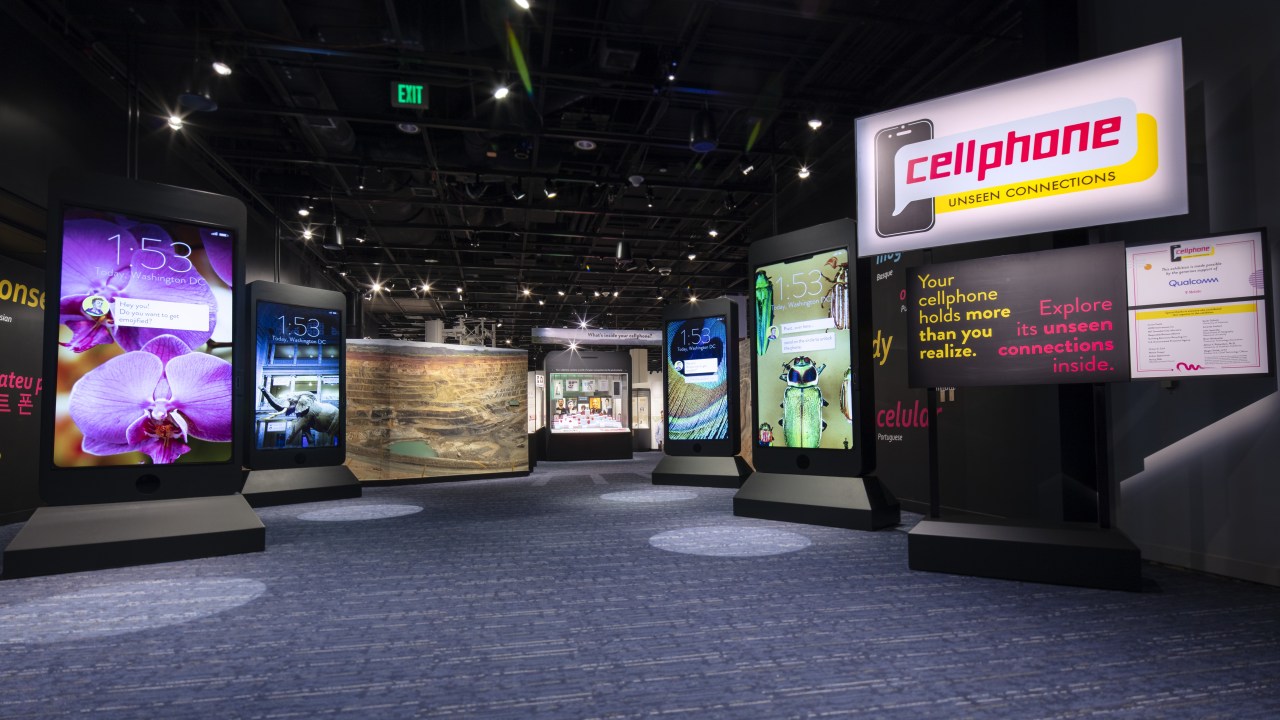
Cellphone: Unseen Connections, a 2023 exhibition, aimed to embrace the “gray areas” to an even greater degree. Cellphones are one of the fastest-growing technologies in human history,[ii] and each of us is navigating a world profoundly changed by these devices while that world continues to develop. There is no “end of story”; no neat conclusion with which to tie up an exhibition. Indeed, the exhibition curator, NMNH cultural anthropologist Dr. Joshua Bell, centers his research on such ever-changing and expanding questions of human experience. Dr. Bell’s studies of material culture and globalization include more than a decade of collaborative fieldwork with teens in Washington, DC, related to cellphone use and repair.[iii]
The team and curator felt strongly that to remain relevant and meet visitors where they are, a cellphone exhibition would have to balance its authority and “museum voice” with a strong willingness to listen and to share the space of “not knowing” with our visitors.
A vast unseen network of people, places, and resources makes our cellphones function and connects us to other cellphone users. The team used four approaches within the exhibition and its related public programming to center this network and its expertise alongside the museum’s:
- Object-based learning
- Co-creation with the target audience
- Personal perspective storytelling
- In-exhibit conversation and reflection
Object-Based Learning
Object-based learning is not a novel museum strategy; for many museums, it is a foundation of their approach to visitor engagement. At NMNH, we know that visitors come to see our “real stuff”: from dinosaur fossils to a giant squid to the Hope Diamond. But using an incredibly personal, truly ubiquitous object like a cellphone for visitor engagement, especially at a natural history museum, is novel.
Cellphones are a natural entry point for museum visitors: nearly every visitor enters with this object already in their pocket or handbag, and many have never considered what’s in their phones, how they work, who made them, and what might happen to those phones when they’re done using them. These questions provide high-interest, often unexpected connections to traditional natural history topics like anthropology, mineral sciences, and environmental sciences. Cellphone examines these connections through sections that focus on the minerals inside our phones, the built environment that makes them work, the culturally driven ways we use our phones, and how repairing and recycling our phones connects us to the natural world.
Centering cellphones in an object-based learning experience also allows visitors to contribute their own experiences and knowledge in ways they often can’t in natural history exhibitions about, say, extinct plants or rare gems. They are the experts in the ways they use their phones, in what their phones allow them to do, and in how their phones make them feel. These cellphone-related emotions are rarely clear-cut and often more complicated than just “good” or “bad,” providing starting points for introspection and discussion: How do we trade off convenience with privacy? How do we feel about being constantly connected? How do we balance the environmental demands of new technology with responsible stewardship of our planet’s resources?
While museum experts and curators provide science-backed cellphone content, visitors bring their lived experiences with their devices and their nuanced perspectives on how to grapple with big questions that have multiple answers.
Co-Creation with Target Audience Members
Cellphone, on view through 2028, is NMNH’s first exhibition intentionally developed for youth aged 13 to 24. While most of our exhibitions target the broad, multigenerational audiences that make up the bulk of Smithsonian visitors, with Cellphone, the team hoped to better reach the youth audience. Research shows that two important things happen by the age of 13:
- Most students receive their first cellphone—more than half by age 11 or 12.[iv]
- Many students lose interest in STEM topics, particularly during their middle-school years.[v]
Within the United States, 95 percent of teenagers report having access to a smartphone, and 46 percent report using it on a “near constant” basis.[vi]
The team felt it was critical to work directly with youth[vii]—both to gain insight from those who had only known a world with cellphones, and to center and emphasize the deep, creative, and innovative ways young people mediate their lives through their phones.
The team assembled its co-creation cohort from a larger existing pool of youth associated with the museum: a diverse group of high-school and college-age students from the greater DC metro area participating in the museum’s “youth engagement in science” volunteer and internship programs. Nineteen of these students composed the exhibition’s youth advisory board.
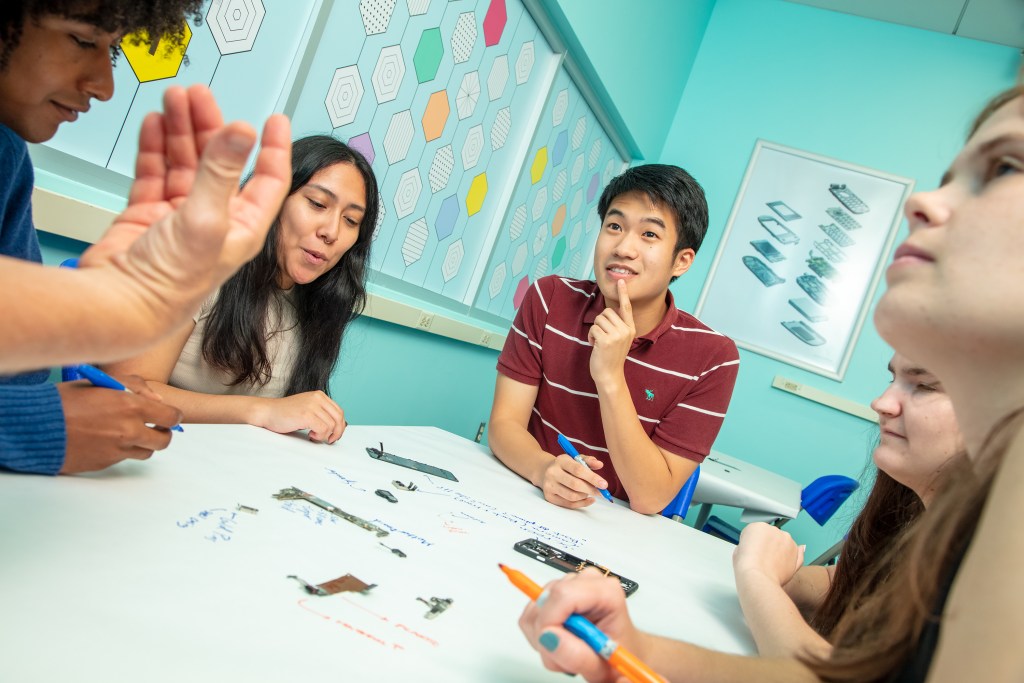
To reduce attrition and sustain engagement over the 18-month commitment, the team leaned into hybrid or entirely online sessions that enabled multiple modalities for feedback and engagement. We provided food when students were on-site and treated the students with the same level of respect and access we gave our adult subject-area specialists. Project development began in late 2019. When the world went virtual during the coronavirus pandemic, our cohort was already well-versed in online engagement—and cognizant of how critical our phones were for connection!
The students on our Cellphone youth advisory board were given active, progressively responsible roles in helping shape the exhibition and programming content, guided by the core development team (fig. 1). One of their first tasks was to run focus groups for their peers, exploring what other teens already knew about cellphone materials, infrastructure, and cultural practices, and what topics most stirred their interest. The students accomplished this task almost entirely on their own, with NMNH staffers serving only as notetakers. They found that their peers were already generally aware that their phones often contained minerals from conflict areas, although they didn’t know specifics. The students were also well-versed on the topics of constant connectivity and cellphones and mental health—and eager to talk about these subjects. These insights helped the core team refine exhibition themes before a single word of the exhibition script had been written.
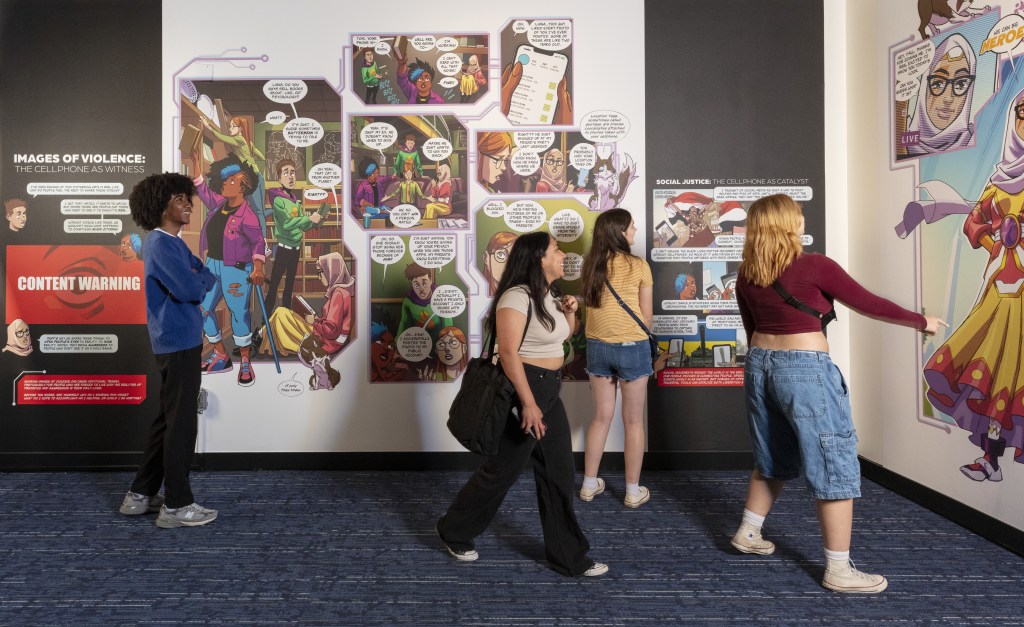
Later, the students reviewed the script and advised the team on our interactive Group Chat and large-scale comic experiences. These two exhibition elements were created specifically to appeal to our target audience, and the team knew their success rested on their authenticity. The Group Chat interactive invites visitors to chat (on their own devices or via in-gallery kiosks) with fictional young-adult characters about topics ranging from the minerals in our phones to how we feel about constant connectivity. The comic, created with professional artist-and-writer team Khary Randolph and Joanne Starer, features the same fictional characters as the Group Chat in large-scale illustrated scenarios drawn from the curator’s decade of research and fieldwork on cellphone culture with teens in DC. These scenarios include cellphones and online images of violence; cellphones and self-image; and “doomscrolling” and mental health (fig. 2).
Often, the student advisers were kind but direct with the team: Our memes were outdated. The clothing the comic characters were wearing was totally wrong. And our slang? Maybe just don’t.
But rather than simply critiquing, the students provided helpful suggestions, reality checks, and ideas the core team hadn’t even considered. They told us, for example, that we were on the right track having a comic character with a disability—but the disability shouldn’t figure into the storyline at all. Representation is what mattered. Similarly, we had to keep the cat: a snarky, omniscient outside-the-frame commentator who had raised some eyebrows among museum leadership when they reviewed the comic. Thanks to our advisers, the cat got to stay.
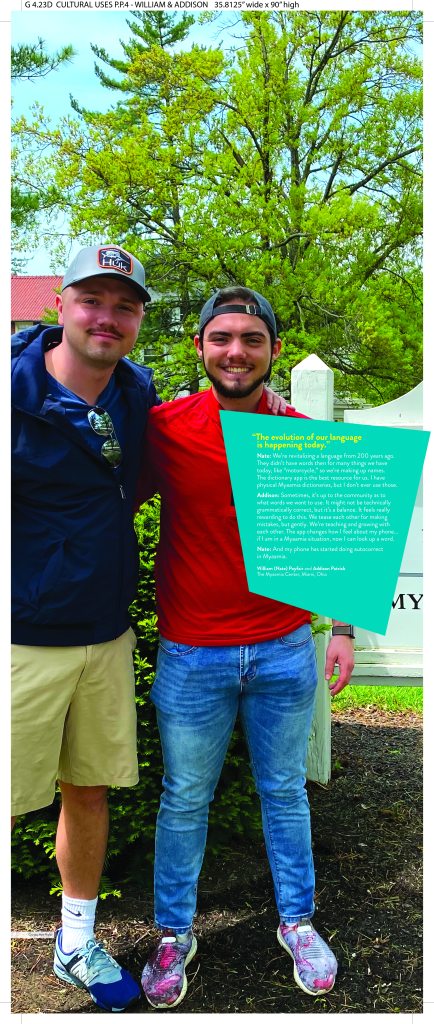
Based on anecdotal feedback, the co-creation experience was strongly positive for the students as well as the museum team. The students reported that they appreciated being trusted and felt respected and valued when the team made concrete changes based on their feedback. “I’m proud that [our cohort] was able to [review the exhibition script] and transform that feedback into something useful for the exhibit development team,” one student wrote.
The students also expressed pride in their sustained engagement, which led to the creation of something special. “[Being part of] the overall family of the museum . . . was the best part,” another student wrote. “I gained confidence and showed myself I can do big things.”
Personal Perspective Storytelling
An important part of revealing the unseen connections in our cellphones was to highlight the cellphone supply chain. This meant featuring the people who extract the materials used in our phones, who process those materials, who design, manufacture, or engineer our devices, and who disassemble, recycle, repair, or resell our phones. The content team did this work with personal perspective storytelling.
Personal Perspectives are a storytelling method that the museum refined in Outbreak: Epidemics in a Connected World. In summative evaluation for that show, this approach was specifically mentioned by visitors as “fresh,” “different,” and “unexpected.”[viii] Cellphone features 22 individuals in the Personal Perspective format. Each panel is roughly 100 words long and written in the first person by an expert in a particular area of the supply chain. A large, often life-size, casual photograph of each speaker completes each panel.
Personal Perspectives perform several important functions:
- First, they fill in gaps in the museum’s subject-area specialists’ expertise. While the museum can confidently present content on anthropology and mineral sciences, for example, we don’t have in-house experts in electronics recycling, mobile money applications, or undersea telecommunications cables.
- Second, Personal Perspectives elevate the often-unseen work that researchers, laborers, and nonprofits are doing. A concept like “the cellphone supply chain” is quite abstract. Putting real faces—a materials scientist, an e-waste recycler, a community liaison in a mining community—on that supply chain humanizes its scale and invites moments of emotional connection.
- Third, this type of storytelling provides authenticity, a value that is critically important to youth in our target audience. Personal Perspective labels elevate diverse voices with varied backgrounds and perspectives not frequently heard within natural history museum exhibitions.[ix] The collaborative, iterative manner by which we created the labels allowed the subjects to tell their own stories, in their own words, and to choose photos that present them as they wish to be seen (fig. 3). This co-creation process also helps the museum team, and ultimately our visitors, more deeply understand the complexities of emotionally charged issues like conflict mining or spectrum licensing.
The wide variety of human faces and stories present in Cellphone is by design: it communicates immediately that the “museum voice” is not the central expert. It also invites our target audience to see themselves in the stories told and imagine their own future contributions to science, natural and cultural history, or the cellphone supply chain.
In-Exhibition Audience Conversation and Reflection
It was important to the team that discussion and exploration around fast-changing cellphone-related topics weren’t limited by or to the words on the exhibition panels. So, a team of museum educators and youth interns developed an ongoing suite of in-gallery public programs to deepen engagement around the “gray areas” of our relationships with our cellphones. These programs included:
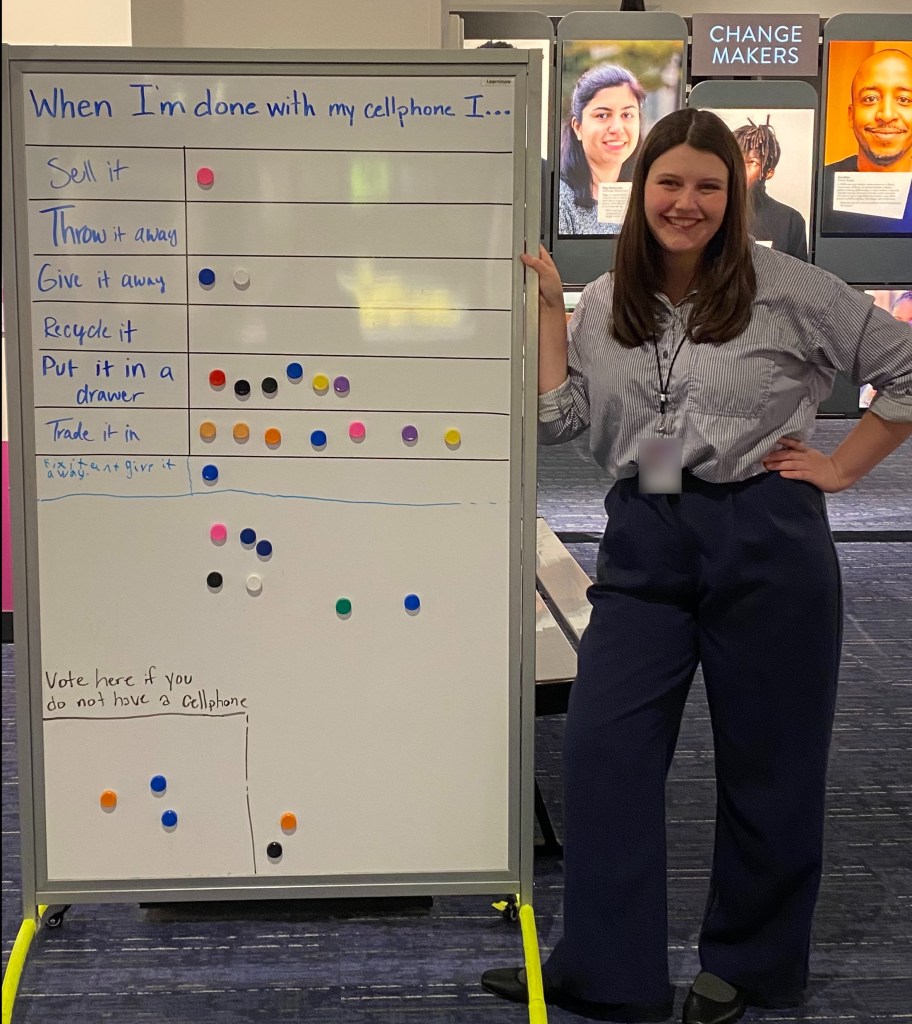
- Talkback Stations. These proved to be a simple, low-budget, and effective method of encouraging visitors to engage both with a museum educator and with whoever they are visiting with. A facilitator brings a large whiteboard onto the gallery floor. A handwritten prompt invites visitors to answer a multiple-choice question by placing a colored magnet next to their answer. For instance, the prompt “Cellphones: At what age?” generates rich conversations in multigenerational groups. Another talkback station prompt invites visitors to reflect on what they do with their old phones (fig. 4).
- In-Exhibit Programming. In “The Expert Is In,” for example, experts—some of whom are featured on Personal Perspective panels—come to the museum and lead drop-in, “ask me anything” discussions with visitors. These informal programs keep the exhibition content evergreen and fresh (an important consideration for an exhibition about a constantly evolving topic that will be open for at least five years). It also allows for more in-depth, nuanced discussion of challenging topics than can’t necessarily be covered in a text label.
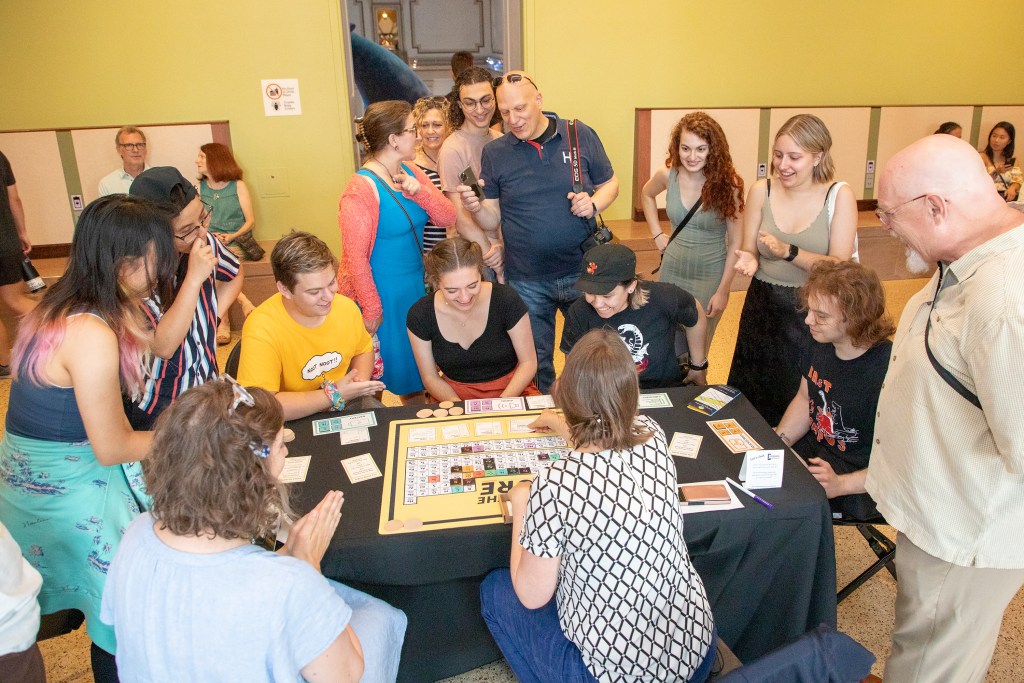
- The Cellphone Studio. This separate education space provides registered groups and drop-in visitors with more in-depth discussion opportunities through hands-on programming. Participants may take apart, or “explode,” a cellphone to interrogate the origins of its components or play an original cooperative board game where they must collaborate to build a smarter, greener future phone (fig. 5).
What We’ve Learned and Areas for Improvement
One of the biggest benefits of a long-running exhibition at a museum with more than 4 million annual visitors is the chance to watch, evaluate, and learn what’s working and what could be improved. A formal summative evaluation of Cellphone will begin in 2026, but ongoing informal assessments of the exhibition’s effectiveness, as well as the informal evaluation of the co-creation process with our youth advisers, also provide insight.
Anecdotal evidence from visitors has been mainly positive. Among the target audience of 13 to 24-year-olds, responses have routinely indicated that this age group feels seen: one young woman said she related to the “doomscrolling” panel in the comic wall, sharing that when she was waiting for news on her college applications, she sat up all night on her cellphone, obsessively refreshing her screen. Other young adults reported that they felt they’d received their own cellphones at too young an age, and that they had concerns about the amount of time they spend on their phones. Participants in a registered group discussion program expressed gratitude that educators in the exhibit listened to their thoughts about cellphones and their role in mental health. Still, some youth visitors have reported that the Group Chat text feels outdated already—cellphone-related slang changes constantly—and that high school kids “just don’t talk like that.”
Sustaining commitment from the same set of youth advisers over the course of the project was sometimes challenging. While many students maintained their engagement, others moved away for college, took on paid work, or simply lost interest. The team strove to respect students’ time and to approach them for feedback in ways that allowed varying degrees of involvement. Sometimes, this meant that sample sizes at a particular project phase were quite small or not widely representative.
Co-creating with audiences is incredibly staff- and resource-intensive. While Cellphone was fortunate to have funding from corporate donors and enough staff bandwidth to pursue this work, many museums will face limitations in scaling up and formalizing the process. Without early commitment of resources and senior-level buy-in on the benefits of co-creating with audiences, it often becomes too easy to justify jettisoning co-creation for time and budgetary reasons. At NMNH, we recognize a need to formalize the co-creation process for future projects. And, ideally, co-creation projects would reach students who more closely represent our actual youth audiences—everyone from the superfans to those being dragged in by parents or teachers—rather than exclusively drawing on youth already engaged in existing museum programs.
Finally, if monetary and human resources allow, including formal evaluations throughout the project would strengthen both exhibition and program development. Without resources to pursue formal evaluation throughout project development, our team had to rely mostly on subjective or anecdotal observations. Nonetheless, the feedback we’ve collected from visitors reveals a richness of opinion as well as the expected mixed feelings toward our phones. We believe that visitors’ willingness to chat and share their opinions demonstrates success in the creation of a safe, nonjudgemental, open space for audience members to be vulnerable and share their perspectives.
Takeaways for Future Projects
In summary, Cellphone provided the team with some important takeaways that may be broadly applicable:
- Be willing to try methods that are new to your institution.
- Be open to new perspectives; check your “museum person” ego at the door.
- Ensure content is grounded in science, research, and/or best practices—while broadening who the speaker or messenger is.
- Extend the rigor of the exhibition and programming development process to include the audience. Open the circle and invite them in.
- Adopt a “Yes, and . . . ” mindset: the museum and its expertise are credible and valuable. Insights from audiences and co-creators are equally critical.
To remain “present tense” and relevant to a young, diverse, global audience, museum exhibitions cannot center museum voices and expertise at the expense of all others. Our exhibitions and our public programming benefit from our audiences’ input, and our impact is strengthened by embracing unfinished stories, actively building trust, and becoming comfortable with uncertainty whenever possible.
Acknowledgments
The Cellphone: Unseen Connections exhibition and public programming were generously supported by Qualcomm and T-Mobile.
[i] See, for example, S. Cairns, “Mutualizing Museum Knowledge: Folksonomies and the Changing Shape of Expertise” Curator 56, (2013): 107–19; Torhild Skåtun, “Engaging through Co-Design in the Science Museum,” Museum & Society 23, 1(March 2025): 20–37; and C. Lashaw and E. Orantes, “Sharing Authority: Creating Content and Experiences,” in Museums as Sites for Social Action Toolkit, ed. J. White (2017), 105–24.
[ii] See, for example, Michael DeGusta, “Are Smart Phones Spreading Faster than Any Technology in Human History?” MIT Technology Review, May 9, 2012; and Jonathan Comer and Thomas Winkle, “Worldwide Diffusion of the Cellular Telephone, 1995–2005,” The Professional Geographer 60 (2008): 252–69.
[iii] Alexander S. Dent, Joshua A. Bell, and Joel C. Kuipers, “Cellular Ambivalence in a Digital Age,” Anthropology Today 38, 1 (2022): 18–20; J.A. Bell, J. Kuipers, J. Hazen, A. Kemble, and B. Kobak, “The Materiality of Cell Phones Repair: Re-making Commodities in Washington, D.C.,” Anthropological Quarterly 91, 2 (2018): 603–33.
[iv] “How Parents Manage Screen Time for Kids,” Pew Research Center, October 2025.
[v] P. Potvin and A. Hasni, “Interest, motivation and attitude towards science and technology at K-12 levels: a systematic review of 12 years of educational research,” Studies in Science Education 50, no. 1 (2014): 85–129; Per Anderhag, Per-Olof Wickman, Kerstin Bergqvist, Britt Jakobson, Karim Mikael Hamza, and Roger Säljö, “Why Do Secondary School Students Lose Their Interest in Science? Or Does it Never Emerge? A Possible and Overlooked Explanation,” Science Education 100, (2016): 791–813.
[vi] “Teens and Internet, Device Access Fact Sheet,” Pew Research Center, last modified July 2025.
[vii] P. Barnes, and G. McPherson, “Co-Creating, Co-producing and Connecting: Museum Practice Today,” Curator 62 (2019): 257–67.
[viii] Smithsonian Organization and Audience Research, Outbreak: Epidemics in a Connected World: A Summary of Results from an Exhibition Study (2019), 18.
[ix] Katie Chandler, Jen Kretser, and Stephanie Ratcliffe, “Climate Solutions: How Audience Research Helped Us Support Visitors in Envisioning Alternate Climate Realities,” Exhibition 43, no. 1 (Spring 2024).
Laura Donnelly-Smith is Exhibit Writer/Editor at the Smithsonian National Museum of Natural History in Washington, DC.
Christyna Solhan is Exhibit Developer/Project Manager at the Smithsonian National Museum of Natural History.
Marion Le Voyer is Geology Education Specialist at the Smithsonian National Museum of Natural History.
Nicole Webster is Manager of School and Teacher Programs at the Smithsonian National Museum of Natural History.
Upcoming Events
-
Industry Showcase: Innovative Digital Solutions
Event Date: -
Getting Started in Local Advocacy
Event Date:Presented by: American Association for State and Local History (AASLH) -
Creative Museums Summit
Event Date:Presented by: MuseumNext -
So…You Want a Museum Career? Part II
Event Date:Presented by: Southeastern Museums Conference