This Q and A first appeared in the journal Exhibition (Fall 2026) Vol. 45 No. 2 and is reproduced with permission.
In this issue, editor Jeanne Normand Goswami sat down with Ian Kerrigan, SVP for Exhibitions at the 9/11 Memorial & Museum in New York City, to discuss this year’s 25th anniversary of the attacks and the museum’s approach to presenting emotionally and politically charged content in our present moment. Ian and Jeanne also had a chance to reflect on Ian’s six years serving as Exhibition’s managing editor—read on to discover some of his favorite issues.1
Ian Kerrigan is the Senior Vice President for Exhibitions at the 9/11 Memorial & Museum where he oversees interpretive planning and research, design and installation, media production and digital development, and exhibition project management for the institution. He completed his undergraduate studies in anthropology at Northwestern University and earned his master’s degree in anthropology at The George Washington University. Ian also teaches exhibition planning and design in the graduate Museum Studies Program at New York University. He and his family split their time between the metropolitan area of New York City and the rural Catskill mountains.
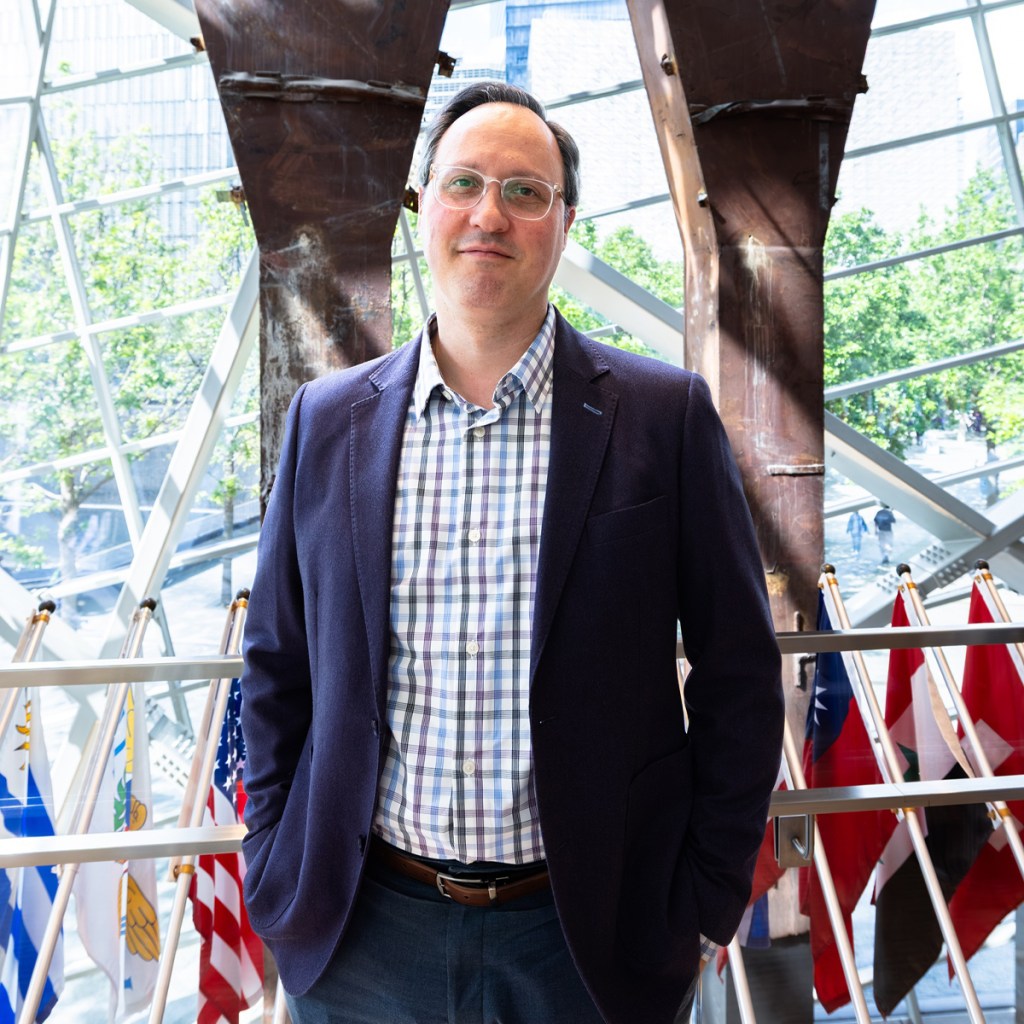
Ian, can you start by telling readers a bit about your role at the 9/11 Memorial & Museum? What does exhibition creation look like in a museum dedicated to such a traumatic event?
I am the Senior Vice President for Exhibitions at the 9/11 Memorial & Museum in New York City. I’ve been here for 19 years and was part of the initial team that worked on curating the inaugural exhibitions for the museum’s opening in 2014. I lead our exhibitions department, which is charged with interpretive planning and content development, design, fabrication, installation, media, and lighting, as well as project management, evaluation, and administration of all things exhibition-related.
Creating exhibitions here at the 9/11 Memorial & Museum is similar to how other museums engage in exhibition development. We do the same topic ideation and selection informed by research and visitor feedback that other museums do. We develop interpretation, write scripts, create designs—all of that good work.
Our core historical exhibition looks at the events of the day, its historical antecedents, and ongoing repercussions. We have a memorial exhibition gallery that focuses on remembering the lives of the people who were killed as a result of the terrorist attacks. Then we have this continuum of open gallery spaces that weave through the in-situ archaeological remnants of the World Trade Center site that include some exhibit installations. And, finally, we have a set of special exhibition galleries and changing installation spaces that rotate over time.
Our new installations are often motivated by the opportunity to dive deeper into a topic that our core exhibitions just don’t have the space—the actual physical real estate—to go into in that depth. And, the further we get from 2001, we are also always looking back to see what new themes are emerging that might be valuable in terms of collecting opportunities, the development of new educational resources that respond to what teachers and educators are asking for, and then developing new exhibitions that respond to those ideas.
We are speaking in July 2026, just a few months before the 25th anniversary of 9/11, and this issue will be published shortly after it. The anniversary falls in the same year our nation celebrates its 250th and amid a time of increased political polarization and misinformation. What is the role of commemoration in maintaining honest and nuanced understandings of historical events? Or are the two separate endeavors?
This is something that we think about every year and every day. How do we balance the history side of our mission and the commemorative side? I think commemorations are moments that can often command attention on a large scale. An anniversary provides a spotlight, be that the 250th of the United States in July or the 25th anniversary of the 9/11 attacks in September. Museums and our audiences are given an opportunity to consider the implications of past events when a commemoration comes up, to reflect on how far, or maybe not how far, we’ve come in the interim and to look ahead and imagine where we, as a particular community or society at large, want to go.
I don’t think that means that everyone should have the same interpretation of the past or a common agenda for the future, but I think museums as storytelling institutions can leverage those moments to acknowledge and reckon with multiple narratives. We can illustrate that different groups may have different associations with anniversaries. For some, they can be moments of grief; for some, they’re moments of celebration, and those can both coexist.
I think you’re right to point out this moment of misinformation and increased or perceived increased political polarization—I’m never sure what’s real and what’s just my social media feed. But there’s research that points out that the population, at least in this country, still overwhelmingly supports museums and regularly ranks museums among the most trusted institutions in our country. That’s not to gloss over the troubled histories of museums, needed decolonization and repatriation work, or restorative justice efforts. But I think it does mean that museums have to actively work to preserve and continue to earn our audience’s trust through the scholarship that undergirds our programs, and by sharing reliable and nuanced content.
I think it’s critically important to provide accurate information, to have a really rigorous fact-checking process in exhibition development. Where can our content in museums reduce editorializing? Where and how can we share the voices of the people whose stories our exhibitions are showcasing without adding those extra adjectives along the way? I think with that approach, museums can strive not to tell visitors what to think, but to suggest to visitors what issues to be thinking about. And outside of that, I don’t know that this commemoration for us at the 9/11 Memorial & Museum is any different than what we do any other day. We just know there is a spotlight on us.
Have you seen the public understanding of or emotional reaction to the events of 9/11 shift significantly over the lifespan of the museum? Has this affected the museum’s approach to its exhibitions and/or programming?
Since the museum opened in 2014, the public’s understanding and emotional reactions have remained pretty consistent. Here at the museum itself, our visitors’ visceral responses—to the space, to the artifacts on display, to the images being shown—remain potent.
I will say that we have a lot of visitors tell us they were pretty cautious on deciding whether to come here or not because they were concerned that the exhibitions might be too emotionally fraught. But after their visit, our visitors overwhelmingly report that they had a positive and meaningful experience. Many people use the word “therapeutic,” which is not a term that we use in our practice, but we hear from our visitors that they are finding that this place provides a space to encounter or re-encounter this history in a way that is supportive and constructive to them.
The passing of time is certainly part of the equation, too. The change in demographics alone means that with each passing year, a greater percentage of our visitors were too young to have a direct memory or weren’t even born yet. And we know that is going to affect our exhibitions in some ways. We have teachers now who were too young to have a lived memory of 9/11, and they’re now in the front of the classroom. It was textbook history for them, and it is continuing to be textbook history for the next generation. That’s one thing that my colleagues in our education department are actively working on.
What we have observed so far is that different visitor segments are deriving distinct, yet notable, meanings from the same installations. For example, we have a media piece near the beginning of our visitor journey, where visitors encounter the voices of people recounting where they were on 9/11 and what were they doing. Older visitors who have a direct memory are motivated to recall where they were. They’re actually inserting themselves in the exhibition narrative at that moment. Many visitors even share their stories with others in their party or even with the strangers next to them.
For younger visitors who don’t have that lived memory, they’re reporting that this installation helps them realize that 9/11 wasn’t just a New York or a DC story. This was a national and a global event. Everybody was tuning in; it’s believed that about one third of the world’s population was watching it in real time on the television or internet or listening to it on the radio. So, for these younger visitors, they’re gaining this sense of 9/11 as this unprecedented worldwide collective experience and thus understanding why it is such a huge memory for older generations. So, it’s interesting to see the same exhibit elicit such different reactions for different demographics. I’ll add that historical hindsight always offers us a view about how certain stories could be narratively related or thematically grouped. And what our visitors’ interests are and how they’re changing. So, for example, we have a much greater interest now, and we know more about ongoing health effects of World Trade Center dust that has sickened and even killed emergency responders, rescue recovery workers, relief workers, survivors, and local Manhattan residents. There is also a growing curiosity about the military response—9/11 marked the start of two decades of wars in Afghanistan and Iraq and then other areas of the world. So, we’re always thinking about how our existing exhibitions and the creation of new ones can best align with those audience needs and what they’re interested in.
Do you have any advice for colleagues attempting to center politically and/or emotionally charged narratives in their own exhibitions for the first time or at an institution that is less used to approaching these types of histories and events?
I remember during the early planning years of the 9/11 Memorial & Museum, we had an advisor, the scholar Barbara Kirshenblatt-Gimblett, who talked to us about the concept of what she called, “hot topic, cool treatment.” And that has stuck with me all these years. The idea is that when you are dealing with content that is so emotionally charged, presenting it in a cooler, more straightforward manner without theatricality, is a way for visitors to better engage and not be overcome by the emotions that they’re feeling or by the narrative. I think many of our design choices here at the museum follow that idea, as does our label copy.
We worked really hard to scrub editorial adjectives from our text. You know, how do we present the facts as they are? How, do we have more of a journalistic tone to our label copy? And how do we elevate the voices of those people who directly experienced these events? They’re telling the story in their own words on our labels, or on quotes on the wall, or in media pieces that we produced. Do we show a still image or a moving one? Do we render a quotation in text because if you are hearing the audio and someone is in significant distress that could feel emotionally manipulative in some way?
We can still get the point across, and a visitor can still understand what’s happening. It isn’t a desire to whitewash history, but a way to allow visitors to engage without becoming emotionally distraught themselves.
Another important piece to this is staff care: making sure that everyone—from those dealing directly with curating the content, to the security guards who are on the floor in constant proximity to the content, to educators and tour guides and docents who are directly interacting with the public—has the resources to handle this material and to engage in a safe and productive dialogue around these topics. That’s a really important piece of the puzzle.
There’s really no way to segue from that, but I do want to turn to your role here at Exhibition, where you’ve served as Managing Editor for the past six years. Do you have a favorite issue that you’ve worked on or one that you’ve found particularly useful in your own exhibition work?
Serving as the Managing Editor of Exhibition has been a true privilege. It’s allowed me to get a glimpse into the creative and meaningful work that museums across the country and around the world are engaged in and to amplify the voices of our colleagues who are doing that work to create better, more meaningful, more memorable experiences for our audiences and communities. I loved every issue I worked on, but I have two that I will call out in particular:
The fall 2022 issue, “Effective Exhibitions Should [Fill in the Blank],” offered so many ways to measure the success of exhibitions. Do you do it by impact? Do you do it by community engagement? Do you do it by how accessible your content is? And so many other ideas. For me, that issue was a reminder that we—and the institutions we work for—have to figure out how we want to define success early in the process. We can course correct along the way if need be, but we need to define it so we can set out to achieve our goals with intention and then figure out how to assess and evaluate our level of success.
And, another one that was just fun was the Fall 2020 issue, “Making Space for Fun in Museum Exhibitions.” It was my first issue, so it holds a special place in my heart for that reason, but the articles were also a reminder that fun is not the antithesis of the serious work that goes into exhibition development. Fun is actually difficult to achieve; it’s its own challenge. Moments of levity and amusement—whether that’s in terms of content or design or both—can offer real value to our visitors. To be surprised, to have a brief respite from heavy subject matter, to create a meaningful memory or an emotional response. That’s what they’re going to remember days or weeks or even years later.
I’m sorry to make you pick your favorite children, but I’m very glad you did. And so, to close, I wonder if you have any parting advice for practitioners based on the topics and issues you’ve seen surface in the journal or in your day job over the years? What are some guiding principles for exhibition makers today?
I think it’s really important to find your why. Why do you do this work? How can you cut through the noise of external politics, internal bureaucracies, and the workflow obstacles that are inevitable in any museum?
My office is located across the street from the museum, so when I’m in the museum for work, it’s usually before or after public hours. Because of this, I try to carve out some time, like 15 minutes, just to walk through while there are visitors there.
After a while, I came to understand that I was subconsciously seeking out an adult interacting with a kid—someone reading a label to a child, explaining a story about an artifact or an image to a student in their group, sharing with their teenager where they were on 9/11 and how they reacted and what was it like to be alive at that time. I had been looking for these moments of intergenerational knowledge transfer and personal storytelling and bonding. That is my why, my reminder of the importance and value of this type of work. And that’s what cuts through the noise and motivates me every day.
- This interview took place over Zoom in July 2026. The transcript has been edited for length and legibility. ↩︎

Upcoming Events
-
From Informational Interview to Real Connection
Event Date:Presented by: American Alliance of Museums and National Emerging Museum Professionals Network -
Understanding the U.S. History Workforce
Event Date:Presented by: American Association for State and Local History (AASLH) -
TrendsWatching: To Live or Die in AI Webinar
Event Date:Presented by: American Alliance of Museums -