This article first appeared in the journal Exhibition (Spring 2026) Vol. 45 No. 1 and is reproduced with permission. If you don’t read the journal, become a member to receive your digital copy of the full upcoming issues.
As a museum dedicated to sharing human rights stories to inspire reflection, dialogue, and action, the Canadian Museum for Human Rights (the Museum; CMHR) regularly faces scrutiny over its content decisions—which issues we choose to feature, how narratives are framed, and what may be omitted. A specific subset of complaints we receive focuses not on the issues we cover, but on individuals we feature. Our exhibitions rely heavily on personal narratives to communicate complex topics in compelling and accessible ways. Human rights defenders, activists, survivors, and other individuals affected by human rights violations often serve as the focal point or entryway into our content. Their stories carry powerful emotional weight and educational value, and their inclusion in a national museum can lend them a degree of visibility and, for some, validation.
This article outlines our institutional approach when featured individuals become the subject of public criticism or scrutiny. We use the term “contested figures” to describe instances where the public has questioned—or we reasonably anticipate they may question—the inclusion of a particular individual in our exhibitions or programs. These situations may arise through our own research, from visitor feedback or community engagement, or in response to current or emerging events that call into question the legacy, actions, credibility, and/or perceived moral authority of individuals we have included. Engaging in consistent and transparent decision-making ensures that we do not default to omitting or removing important human rights concepts, events, and persons from our galleries and programming. We will outline our framework and decision-making process, along with several key examples for carefully determining when it is no longer responsible to feature a person in a national museum for human rights who has been accused of wrongdoing.[i]
A Museum for Human Rights
The CMHR opened its doors to the public in September 2014. Established as a museum for human rights (rather than of human rights), our mandate is not to be encyclopedic, but to be impactful—to select and present stories that both illuminate human rights principles and motivate visitors to engage with them in their own lives.
Our museum practice is grounded in a desire to bring about individual and collective transformation. Engaging with complex, contested, and sometimes uncomfortable issues is both inescapable in our role as a museum for human rights and a critical part of the personal transformation that can happen in this work. This is because human rights are not principles that exist in a vacuum—they play out in real-world social and political contexts where power, privilege, and lived experiences shape how rights are understood, claimed, and denied. We cannot avoid difficult or controversial topics if we want to remain a relevant and trustworthy institution to the public.[ii]
Our approach to contested figures acknowledges and embraces the messy and complex nature of human rights. Understandings and applications of human rights are ever-evolving, constantly being negotiated and renegotiated. Rights can come into conflict with one another; they can be full of contradictions; and they are rendered meaningless if citizens and governments alike do not act to advance and uphold them. Similarly, people are flawed and full of complexities and contradictions. Knowing this, we do not expect an impossible or idealized standard of perfection from the human rights defenders and victims of violations that we feature.
Engaging in this practice means accepting that risk and disagreement are part of our work. We have a responsibility to approach conflict thoughtfully, always guided by our commitment to human rights. At the same time, we are intentional about the type of dialogue we invite. Some accounts of wrongdoing present meaningful opportunities for ethical reflection, learning, and public engagement. Others may exacerbate harm or trauma to affected communities. Assessing both the harms committed or being alleged and the potential for meaningful engagement on controversial topics is incredibly nuanced and context dependent. With the support of our leadership team and the Board of Trustees, we have developed institutional guidelines to support consistent and transparent decision-making related to our inclusion of contested figures.
Curating with Complexity
In the context of human rights storytelling in museums, the question is not whether stories are complex, it is how that complexity is approached not only from a scholarly standpoint but more importantly from that of visitor experience. Curating such narratives requires historical depth, political and social contextualization, and a readiness to work directly with the tensions and contradictions they contain in past and present moments. Exhibitions are, at their core, interpretive constructs; in human rights museum practice, they serve as critical sites where current lived experiences of systemic oppression and violence, dynamics of political struggle, and the mechanisms of structural power are brought into sharp relief.
Our curatorial practice often begins with personal narratives drawn from our original collection of about 350 video-recorded oral history interviews related to historical and contemporary human rights experiences with a special focus on human rights defenders, champions, and upstanders.[iii] These accounts can cut through abstraction, engaging visitors with a sense of immediacy—creating moments of recognition alongside the discomfort of confronting difficult histories.[iv] Yet individual stories cannot stand apart from the historical and political forces, social movements, and communities that shaped them. This approach counters mythmaking, resists simplification or romanticizing, and keeps the collective nature of human rights struggles at the center of interpretation.
Our exhibition, Mandela: Struggle for Freedom (June 8, 2018–August 25, 2019), developed in partnership with the Apartheid Museum in Johannesburg and later presented at venues across Canada and the United States from 2019 to 2021, exemplified this approach.[v] Nelson Mandela is one of the most recognized figures of the 20th century—an emblem of South Africa’s negotiated end to apartheid and pursuit of national reconciliation. His story is compelling, but we resist framing it as a self-contained biography. Instead, it becomes an entry point into the decades-long collective struggle against an entrenched and violent regime.
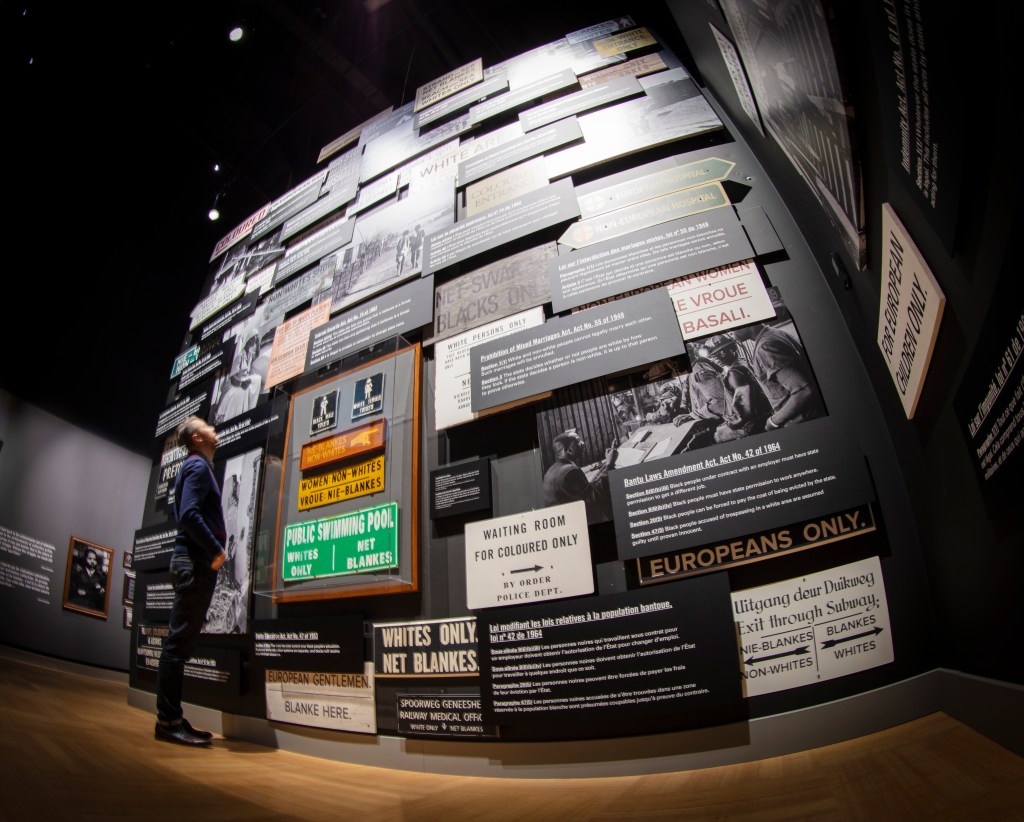
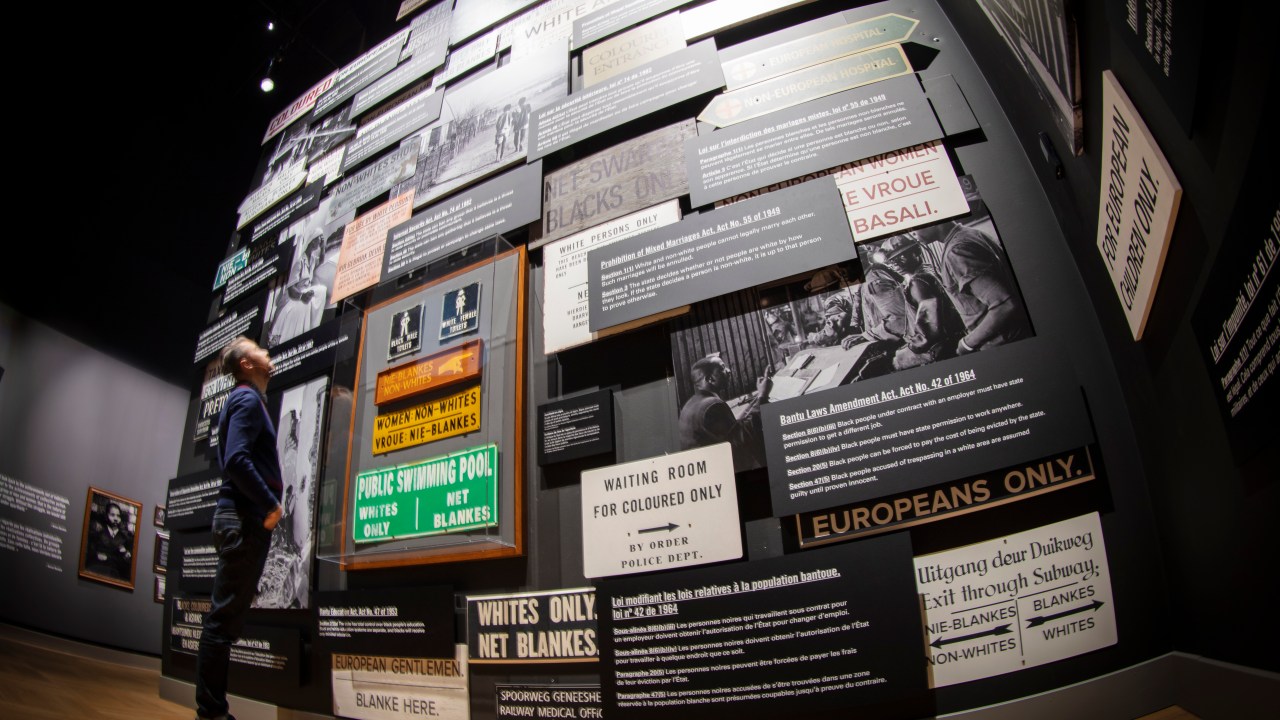
Spanning 5,000 square feet, the exhibition is organized into five zones:
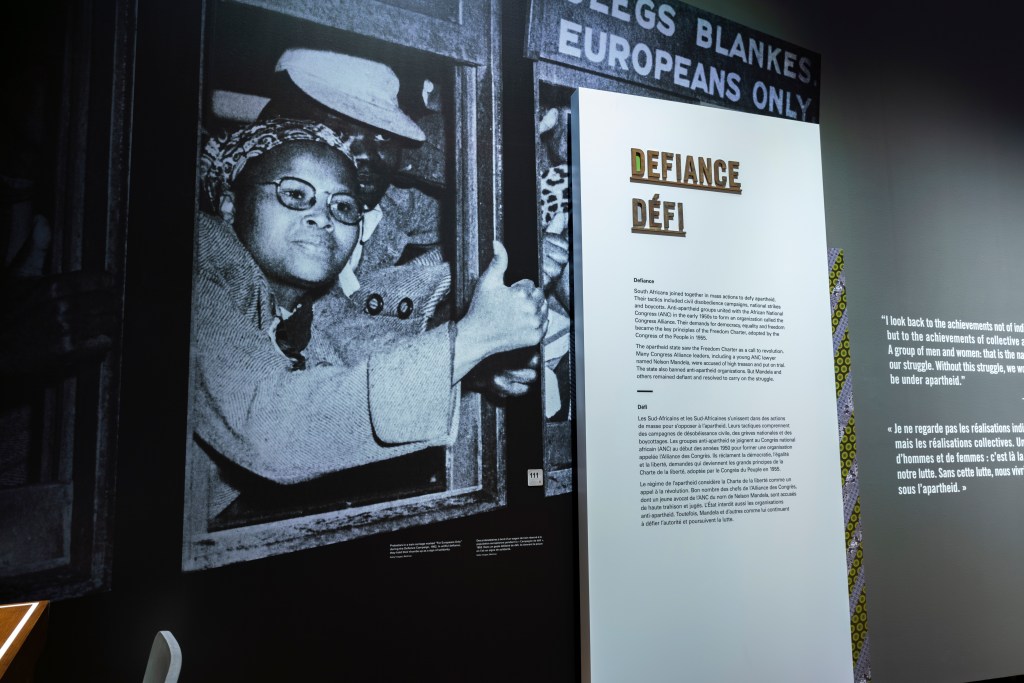
Apartheid,Defiance,Repression,Mobilization, and Freedom. Visitors first confront the mechanics of apartheid—its oppressive laws, institutions, and political and economic structures that permeated daily life—before moving into Defiance, a zone dedicated to the 1950s, a decade of organized, nonviolent resistance. Here, a young lawyer named Nelson Mandela stands alongside thousands in strikes, boycotts, mass protests, and civil disobedience campaigns (fig. 1).
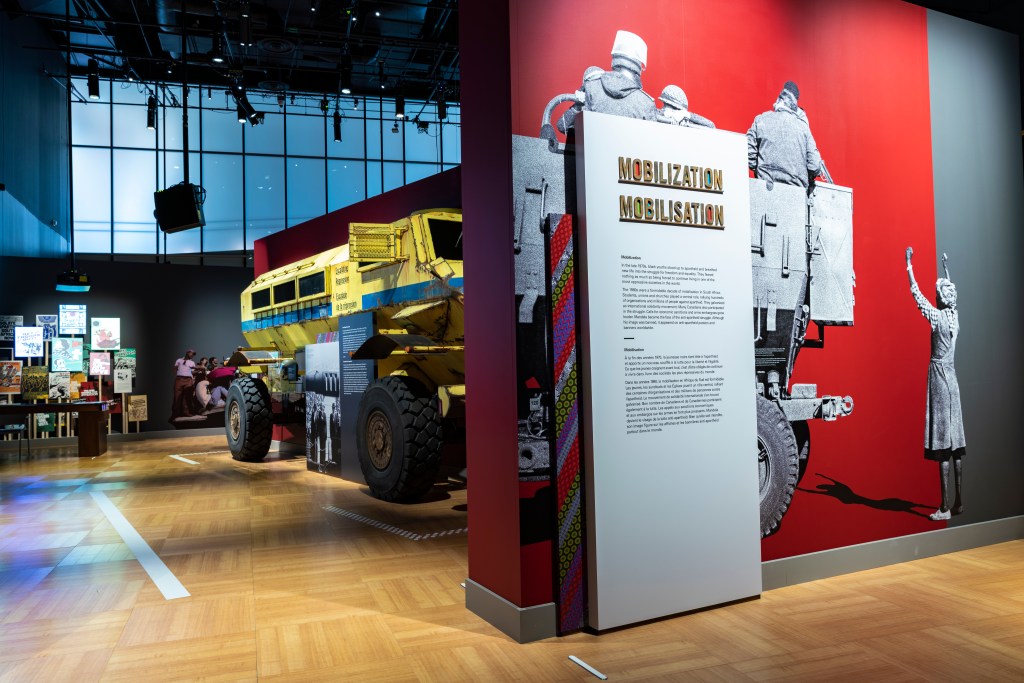
Defiance does not sidestep the turning point that the early 1960s represents. The Sharpeville massacre and the banning of the movement’s leading political organizations marked a sharp escalation in state repression against civilians by security forces, including mass arrests, detention without trial, and the use of lethal force. With peaceful avenues effectively closed, elements of the liberation struggle moved underground.[vi] It was during this time that Mandela cofounded Umkhonto we Sizwe (Spear of the Nation), the armed wing of the African National Congress (ANC), to sabotage government and military targets (fig. 2).
The decision to take up armed struggle made Mandela a contested figure. The apartheid regime, and several Western governments, labeled him a terrorist and accused him of communist ties. Rooted in Cold War geopolitics and amplified by apartheid propaganda, these labels shaped his international image for decades. We anticipated that some visitors would challenge Mandela’s human rights legacy on these grounds—and they have. Emails and social media posts raised unfounded claims of a “white genocide”—a term circulated in certain media and online communities to describe crimes against white farmers—alongside renewed Cold War–era accusations of terrorism and communism. These claims are often framed as challenges to Mandela’s legacy and to the broader struggle against apartheid.
The exhibition does not present a romanticized view of either Mandela or the liberation movement. Rather than sidestepping debates surrounding political violence, it leads visitors through immersive spaces where they can explore not only the political, social, and historical conditions in which the turn to armed struggle was made, but also how such choices are narrated—both by the oppressed and by those in power. This includes confronting the stark divergence between the movement’s framing of its members as freedom fighters and the apartheid state’s portrayal of them as terrorists. In doing so, the exhibition invites visitors to consider critically how language, propaganda, and ideology shape public memory and the interpretation of human rights struggles.
Inviting Difficult Conversations
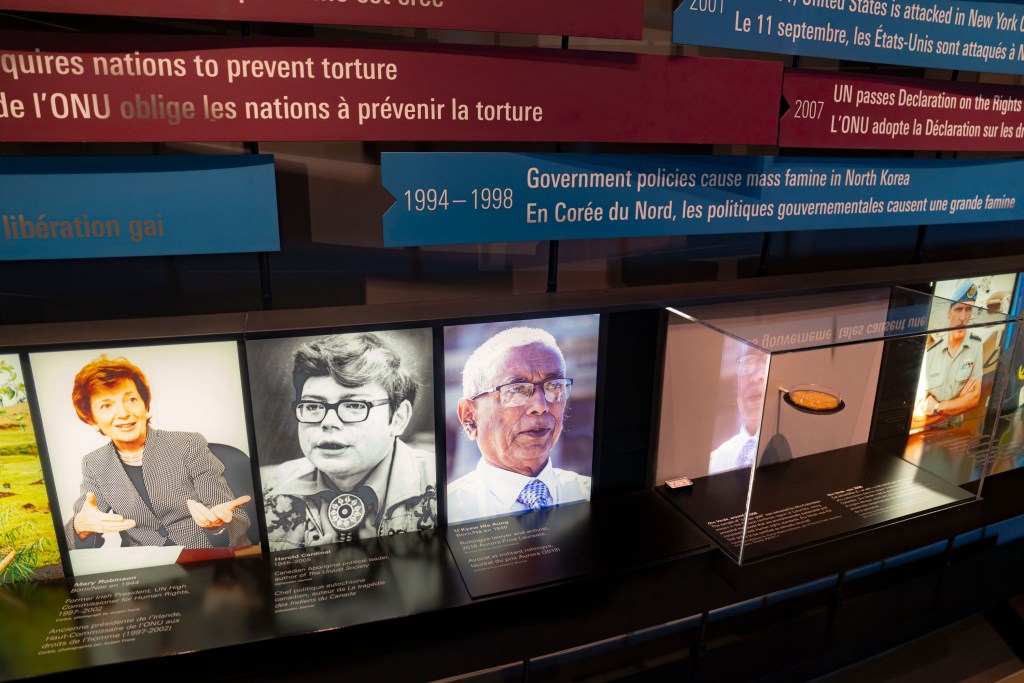
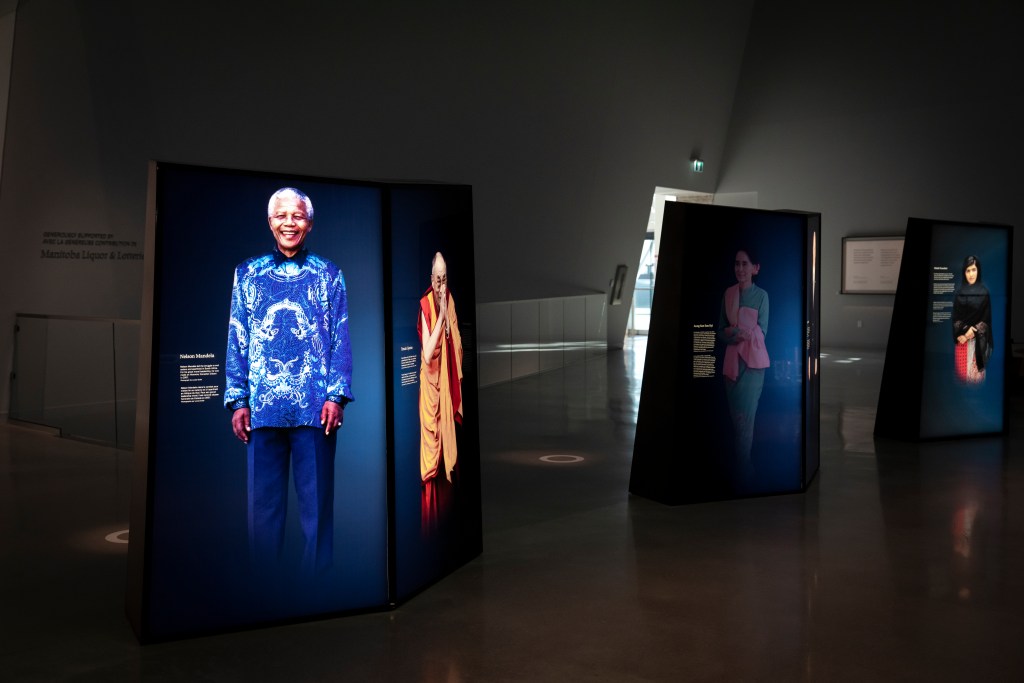
In 2017, concerns were raised regarding our representation of Aung San Suu Kyi, State Counselor of Myanmar. A 1991 Nobel Laureate and champion of peace and democracy, Suu Kyi has since been heavily criticized for her inaction in response to the atrocities Myanmar’s military has committed against the nation’s Rohingya Muslims.[vii] In response to the complaints, an internal review committee assessed two separate permanent gallery exhibitions featuring Suu Kyi. The first was a photograph alongside other human rights champions in Human Rights Through Time,part of our What Are Human Rights? gallery. The second was a backlit, life-size portrait of Suu Kyi in Honorary Canadian Citizens, an exhibit featuring individuals who have been granted honorary citizenship by the Canadian government that is part of our Turning Points for Humanity gallery.
In cases where unfolding events result in an individual becoming the subject of public contestation, we first consider whether this new information changes the intention, messaging, and objectives of the exhibit. We assess if the content is still factually accurate, along with whether the overall interpretation or tone of the exhibit might need to be adjusted. We also carefully consider if the situation presents an opportunity for visitors to engage in difficult but important conversations about human rights.[viii]
After undertaking its assessment, the committee first decided to remove Suu Kyi’s image in Human Rights Through Time. In the exhibit, Suu Kyi was presented in a very positive light and there was very little room to add interpretive information addressing the current crisis. Her image was replaced with one of a Rohingya human rights defender, which we selected in dialogue with Rohingya community members (fig. 3). We chose not to draw attention to this content change through any additional signage or explanation.
Honorary Canadian Citizens presented more of a challenge. While it was similarly a very positive and uncritical depiction of Suu Kyi, the overall exhibit still provided an accurate overview of the six individuals who had been designated as honorary Canadian citizens. The text panel, developed in 2013, did not include any context on the current atrocities. The glowing life-size image placed Suu Kyi on a pedestal as a shining example of a human rights defender. Given the triumphant interpretation of the exhibit, we undertook an immediate interim measure to set Suu Kyi apart from the other Honorary Canadians by dimming the light on her image and adding a temporary sign explaining the current criticisms (fig. 4).
Soon after, Canada’s Parliament stripped Suu Kyi of her honorary citizenship. Removing her from the exhibit may have made interpretive sense at this point, yet her complicity in the genocide and the revoking of her honorary citizenship were important pieces of information that we felt should not be hidden from public view. Instead, we expanded the text on her photo panel with additional information about the genocide and the stripping of her honorary citizenship. Her image remained dimmed to visually illustrate this aspect of the story in relation to the brighter surrounding images of other Honorary Canadians. We shared this resolution with concerned parties, and it became part of the engagement work the Museum did with the Rohingya community on the temporary exhibition Time to Act: Rohingya Voices (June 16, 2019–March 28, 2021).
In our gallery and online, we invited dialogue around Suu Kyi, asking how we should view previous human rights achievements in the face of present-day violations.[ix] We received wide-ranging responses on our Facebook and Twitter (now X) social media posts. Many commenters were very critical of her current actions and did not think she should continue to be honored in any way: “How can the Human Right Museum recognize a person who is involved in an ethnic genocide?!” Several comments expressed unquestioned support for Suu Kyi, for example, “Daw Aung San Suu Kyi is our . . . leader and (we) stand with her.” Another commenter shared reflections on the meaning and responsibilities behind bestowing such an honor:
We bestow honorary citizenship on those rare and exemplary people who seem to best represent what we profess to be Canadian values. We should, therefore, consider the shortcomings that any of them may, as mere human beings, fall prey to as a challenge to live up to our own chosen ideals as a nation. How we respond to this challenge at a time when an increasing number of Canadians (so we are told) are opposed to the resettlement of asylum seekers in our country may define Canada and its place in the world.
In the years since, we have received similarly positive responses to our decision to keep the dimmed image of Aung San Suu Kyi in our gallery. An educator recently shared with Museum staff that the installation had presented a valuable opportunity to grapple with complex questions about human rights with her visiting students. More recently though, we received a formal letter of concern from Amira Elghawaby, Canada’s Special Representative on Combatting Islamophobia, that the continued display of Suu Kyi in the Museum, while atrocities continue against the Rohingya Muslim minority in Myanmar, is harmful to the Rohingya community in Canada. Her colleague, a Rohingya community member, had a strong negative reaction to seeing Suu Kyi in our gallery and felt our interventions had not gone far enough. Based on this complaint, we have begun another internal review process, and we will continue to engage with community and explore new approaches to reduce potential harm that do not result in removing the content and learning opportunity.
Engaging with Community
Our commitment to trauma-informed museum practice requires us to engage ethically with impacted communities to determine what action to take.[x] We also consider the nature of the harm or controversy, whether the individual has taken accountability, and how staff and visitors, especially those from affected communities, might feel about the individual’s inclusion or removal from the exhibit. We also assess whether staff are supported to navigate these complex conversations with visitors, and what we might require internally and externally to be successful.
In October 2023, an in-depth investigation by the Canadian Broadcasting Corporation (CBC) questioned the Indigenous ancestry of acclaimed musician and activist Buffy Sainte-Marie.[xi] Throughout her career, Sainte-Marie identified as a Cree woman, born on Piapot First Nation, who also claimed Algonquin and Mi’kmaq ancestry. Soon after the report, Sainte-Marie released a statement defending her ancestry, noting that there had always been gaps in her own knowledge of her upbringing.[xii] Community discussion of the reporting and its meaning was widespread, and perspectives were widely divergent as the story evolved.
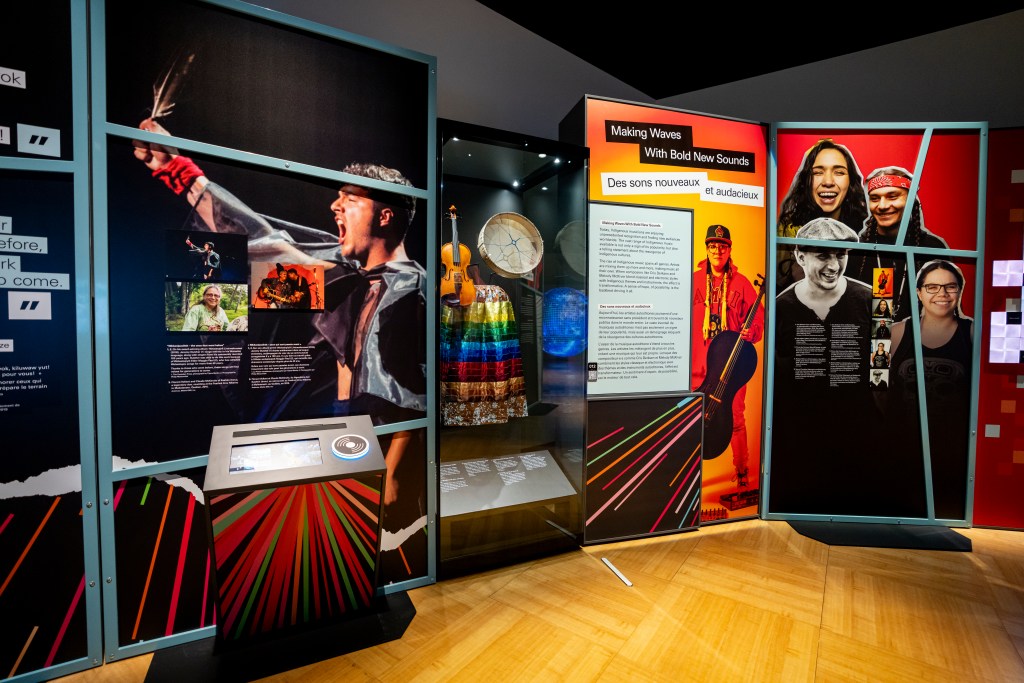
At the time, we were installing a temporary exhibition on popular music and human rights, Beyond the Beat: Music of Resistance and Change (February–September 2024) (fig. 5). Sainte-Marie was featured prominently in a section of the exhibition that highlighted Indigenous musicians and the many ways they have asserted their rights through music. By November, only one month after the CBC’s investigation went public, we made the decision to completely remove any reference to Sainte-Marie from Beyond the Beat. We made this decision carefully and in conversation with internal and external advisors, including our Elder-in-Residence[xiii] and the members of our Indigenous Music Advisory Committee (IMAC) who had supported the development of the exhibition over the past year.
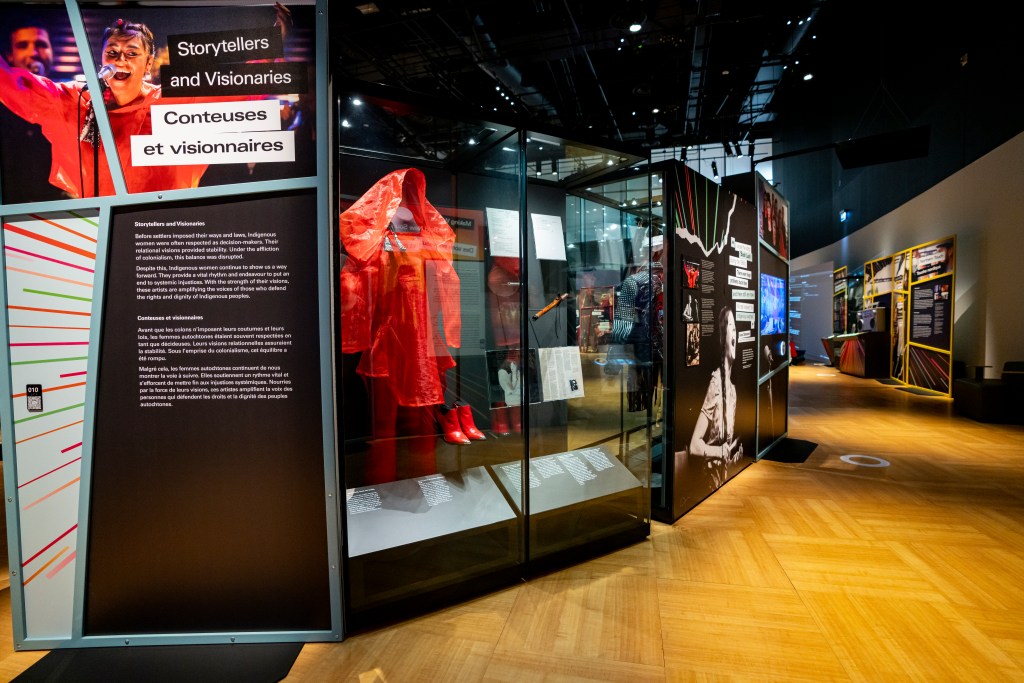
During our meeting with IMAC, members shared feelings of grief, betrayal, and anger. The revelation was still very fresh and painful. While some members felt this could be an opportunity to add an additional panel addressing the allegations, the committee eventually moved away from that approach. Completely removing Sainte-Marie from the exhibition felt like the solution least likely to cause additional harm to the community during a very painful time. Our advisors felt strongly that if the allegations were true, Sainte-Marie had already taken too many opportunities away from other Indigenous musicians and we could not let that continue within this exhibition. There are so many talented, exceptional Indigenous artists to choose from, it felt right for Beyond the Beat to elevate others in her place (fig. 6).
We also considered whether this topic was an appropriate learning and dialogue opportunity. Our visitor-facing staff (largely non-Indigenous) indicated they did not feel comfortable leading conversations with the public about false claims of Indigenous identity, and we additionally questioned whether a national museum was an appropriate setting to address these questions. The conversation with IMAC confirmed their preference not to invite Museum visitors into dialogue on the topic of defining and verifying Indigenous identities. It was agreed that these sensitive and fraught conversations should be led by Indigenous peoples and held within Indigenous communities and were not for the broader public to be weighing in on.
Conclusion
Many institutions are currently grappling with how to approach contested histories, contested objects, and contested figures. External pressures to alter or remove contentious content can feel immense. But rather than defaulting to removal, censorship, or avoidance, we center transparency in interpretative work and community engagement. This approach demands more complex work, but it is grounded in a sense of responsibility, both to the communities impacted and to the Museum’s role in fostering critical engagement with human rights. This work is inherently iterative, and clear guidelines help steer decision-making in moments when controversy arises or is anticipated. Rather than fixing individuals and their accomplishments in time or erasing them from museological narratives altogether, this curatorial practice engages with complexity and contradiction in the present tense with the explicit objective of creating space for critical thinking and dialogue.
[i] Prior to submission, the text was copyedited with the assistance of generative AI. All substantive content, analysis, and interpretation are the authors’ own.
[ii] Robert R. Janes and Richard Sandell, “Posterity Has Arrived: The Necessary Emergence of Museum Activism” in Museum Activism,ed. Robert R. Janes and Richard Sandell (Routledge, 2019), 5–6.
[iii] We use the term “upstander” throughout our museum programming to describe someone who recognizes injustice and uses their personal strengths to create change and become an “upstander” for human rights.
[iv] Jodi Giesbrecht and Clint Curle, “From Imagination to Inauguration,” in The Idea of a Human Rights Museum, ed. Karen Busby, Adam Muller, and Andrew Woolford (University of Manitoba Press, 2015), 322–32.
[v] Isabelle Masson, “The Exhibit,” in Mandela: Struggle for Freedom, exhibition catalogue (Canadian Museum for Human Rights, 2019), 14–83.
[vi] On March 21, 1960, South African police opened fire on a peaceful protest against the apartheid pass laws in the township of Sharpeville, killing 69 people and injuring more than 180. In 1966, the United Nations designated March 21 as the International Day for the Elimination of Racial Discrimination in direct response to the killings at Sharpeville. See, Tom Lodge, Sharpeville: An Apartheid Massacre and Its Consequences (Oxford University Press, 2011); “Resources,” Apartheid Museum, accessed November 30, 2025; and Masson, “The Exhibit.”
[vii] See, for example, Hannah Ellis-Petersen, “From peace icon to pariah: Aung San Suu Kyi’s fall from grace,” Guardian, November 23, 2018.
[viii] For more on conflict and dialogue in museums, see, Bernadette Lynch, “Disturbing the Peace: Museums, Democracy and Conflict,” in Heritage and Peacebuilding,ed. Diana Walters, Daniel Laven, and Peter Davis (Boydell Press, 2017); and Erica Lehrer and Cynthia E. Milton, “Introduction: Witnesses to Witnessing,” in Curating difficult knowledge: Violent pasts in public places, ed. Erica Lehrer, Cynthia E. Milton, and Monica Eileen Patterson (Palgrave Macmillan, 2011).
[ix] Canadian Museum for Human Rights, “If you’ve been to the Museum recently, you may have noticed a change in our display of Aung San Suu Kyi in our Turning Points for Humanity gallery…,” Facebook post, July 30, 2018.
[x] For more on trauma-informed museum practice, see Ross Laird, “Trauma-Informed Museum Practices: A Comprehensive Guide,” Ross Laird, accessed December 1, 2025; and Brenda Cowan, Ross Laird, and Jason McKeown, Museum Objects, Health, and Healing: The Relationship Between Exhibitions and Wellness (Routledge, 2021).
[xi] Geoff Leo, Roxanna Woloshyn, and Linda Guerriero, “Who is the Real Buffy Sainte-Marie?,” CBCNews, October 27, 2023.
[xii] Kelly Geraldine Malone, “Buffy Sainte-Marie pushes back against CBC investigation contradicting claims to Indigenous ancestry,” CBCNews, November 23, 2023.
[xiii] In 2021 the Museum developed an Elder-in-Residence program, welcoming an Indigenous Elder onsite to guide and support staff, lead ceremony, and to help ground our practices in Indigenous worldviews.
Julia Peristerakis] is Manager, Galleries and Exhibitions, at the Canadian Museum for Human Rights in Winnipeg, Manitoba.
Isabelle Masson is Curator at the Canadian Museum for Human Rights.
Upcoming Events
-
AAM Member Week
Event Date:Presented by: American Alliance of Museums -
AASLH History Hour: Is This Place Haunted?
Event Date:Presented by: American Association for State and Local History (AASLH) -
Disaster Preparedness for History Organizations
Event Date:Presented by: American Association for State and Local History (AASLH) -
From Informational Interview to Real Connection
Event Date:Presented by: American Alliance of Museums and National Emerging Museum Professionals Network


Name a person devoid of past, present or future (given more research) controversy.