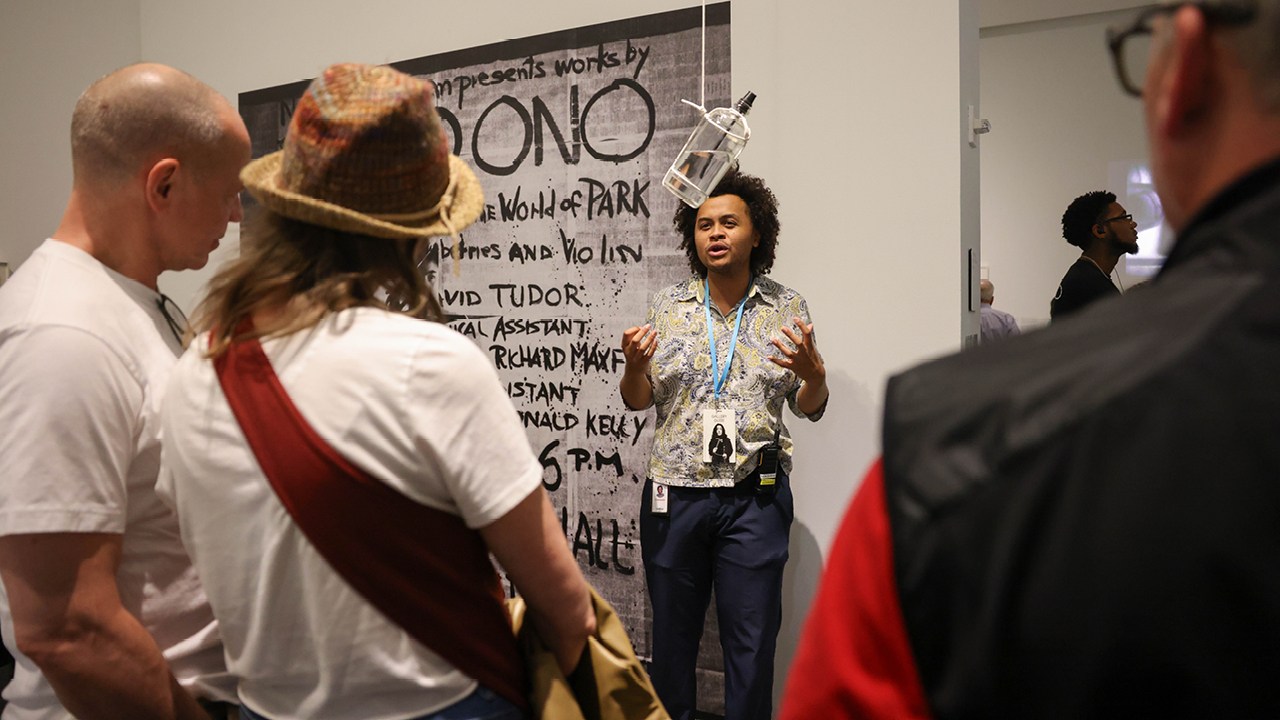
At the Museum of Contemporary Art Chicago, visitor services and interpretation share staff to provide free museum tours.
At the Museum of Contemporary Art Chicago (MCA), select entry-level staff from our Audience Experience division, including those in visitor services and retail, step away from the admissions desk to deliver our free public tours. How did that happen?
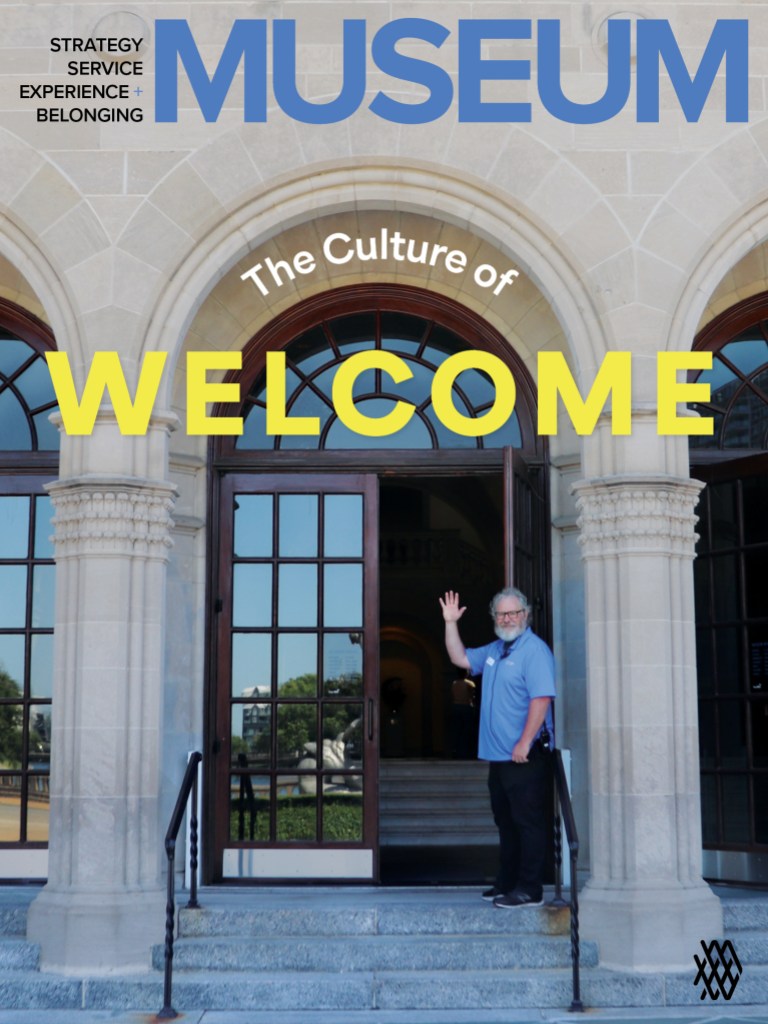
This article originally appeared in the Sept/Oct 2026 issue of Museum magazine, a benefit of AAM membership.
» Read Museum.
Allow me to set the scene. The year is 2021. Everyone still working in a museum is trying to remember how to work in a museum, which is to say a building with visitors rather than a concept on a screen. I am sitting in my office with a problem. Refreshingly, it is the predictable kind of problem museums have had before. I want to offer free public tours. Like many museums, the MCA relied for years on a stalwart cohort of close to 30 volunteer docents to give them twice daily. That program did not survive the shutdown. A confluence of factors left us without the infrastructure to recruit, maintain, and sustain a volunteer docent program at any scale.
Before your hackles rise—I know the winding down of docent programs became a fraught subject in museums—rest assured that I’m not going to get into that here. I’m interested in what comes next. That’s where this story begins.
The Solution Is Inside the Museum
I needed to build a free public tour program from scratch. If nothing else, constraints clarified the math. I wanted to offer high-quality educational experiences, for free, to the public twice weekly. At a contemporary art museum mounting three major exhibitions per year on very different subjects, a tour guide needs significant onboarding and then hours of further training per exhibition to become conversant with new artworks. That ongoing work should be compensated. How could we pay for a cohort of educators to give free tours when budgets were strained? For a while, we couldn’t and we didn’t.
Savvy institutionalists taught me that if I could not find the money, I should find the mission. See, providing free public tours was a nice perk. It made the museum more welcoming and engaging, but it really didn’t drive attendance in a way that would move the needle—at least not at the MCA.
On the other hand, the MCA was getting serious about professional development and career pathways. Creating career pathways for entry-level staff was workforce development, and professional development drove sustainability and employee satisfaction in positions that were sometimes unrewarding. How many people could move from an entry-level job into the next role, and the next, and ultimately the kind of senior role that takes a decade of experience to be considered for? In education, the answer was almost none. Entry-level education roles were scarce, often on contract, and demanded significant schedule flexibility alongside their time commitment.
The Visitor Services department, by contrast, was where many people—seeking proximity to what they care about—got a stable start. So, it came down to two questions. How do I offer public tours sustainably? How do I create career pathways in museum education?
Collaborating across the leadership of our Learning Department, our Audience Experience Division, and our People & Culture (HR) team, the MCA made a new program. In 2022, a new cohort of six Visitor Services employees began giving all our regular free public tours and many of our revenue-
generating private tours after a few months of planning. Since then, we’ve opened applications to join the cohort yearly.
How It Works
A point-of-view shift would be helpful here, I think. Imagine that a few weeks ago, you were hired to work at the admissions desk at MCA Chicago. Maybe you are preparing for your MFA or are a freelance designer. You could also be a mid-career theater actor or a retiree who’s returned to the workforce. In any case, a few weeks into your role, you spot an opportunity posted on the internal job board. Auditions are open to join the tour guide cohort.
Reading through the requirements, you see this is a real thing, with real expectations and rewards. Audience Experience division only. Supervisor approval required. Must be in good standing. If accepted, you must satisfactorily complete eight hours of onboarding, attend two hours of training monthly, and deliver weekly tours alongside your job duties. There is an elevated hourly pay rate for training and touring. It could go on your resume. That it’s paid work within your current work schedule means you can take it on without rearranging your life around it.
The audition is a 10-minute “tour” of a single artwork, your choice, with some baseline expectations. You get a couple of paid hours to prepare to describe and share context about the artwork based on in-gallery materials and your own research. It’s a bit nerve-wracking, as you stand there in the gallery waiting to begin. Your boss is there, and so are folks from the Learning Department. Looking down at your notes, you have two phrases underlined: be confident, be engaging.
You do it. I see your potential. You’re in.
A few weeks later, your onboarding begins with a group of your peers. The Learning Department leads several small workshops in sequence: what makes a good tour, how to structure a tour experience, object-based learning, designing a tour around a big idea, and techniques for facilitating dialogue. Each workshop lasts about 90 minutes and is part instruction, part hands-on practice.
It’s not lost on you that the very same skills that helped you achieve smooth, efficient interactions at the admissions desk or the retail counter can also be deployed to create the productive friction inherent in meaningful learning experiences. What happens in small interactions—clear instructions, active listening, empathetic communication—is elaborated, expanded, and facilitated in the galleries to create a meaningful encounter between visitors and art.
You’re excited to begin giving tours and join the monthly trainings led by the Learning Department. They alternate between content trainings, devoted to exhibition research, and technique trainings, meant to improve teaching skills. One obstacle remains. To complete the onboarding, you must deliver a full “graduation” tour. You scan through the information sheet, knowing that MCA staff will be evaluating your tour on explicit criteria: confidence and engagement.
Confidence is central to being an effective guide because it creates the feeling or belief among audiences that they can rely on you. Were you visible and audible? Did you communicate dynamically? Did you leverage your own interests? Were you sensitive to diverse identities and experiences?
Engagement is about balancing giving and receiving—knowing how to structure an experience, providing the right information about a work of art to meet the audience’s needs, and encouraging conversation. Did you offer welcoming invitations and directions? Did you share accurate information? Did you create opportunities for conversation?
As you begin welcoming peers and colleagues to your “graduation tour,” the itchy worry has returned. Unlike your audition though, this time around you know something you didn’t before. Your career is worth an investment, even when times are hard.
It’s difficult for museums to change anything at all. It’s difficult to collaborate across siloed teams. It’s also hard to imagine making investments in positions with low retention and high turnover. Job descriptions, workloads, and the real scheduling challenges of departments staffed by hourly part-time employees all must be respected. The logistical work is significant and ongoing.
I know all that. You know that. It’s still worth it.
In retrospect, the tours were never the only point. The real achievement was creating a structure that allowed staff to develop skills, gain experience, and imagine new possibilities for themselves within the museum field. Visitors receive a richer experience, the institution benefits from a more engaged workforce, and employees gain access to opportunities that might otherwise have remained out of reach. For a program born out of constraint, that feels like a remarkably expansive outcome.
Jeremy Kreusch is Director of Interpretation and In‑Gallery Learning at the Museum of Contemporary Art Chicago in Illinois and teaches a graduate course on arts integration at DePaul University’s College of Education.
Upcoming Events
-
-
Industry Showcase: Innovative Digital Solutions
Event Date: -
Getting Started in Local Advocacy
Event Date:Presented by: American Association for State and Local History (AASLH) -
Creative Museums Summit
Event Date:Presented by: MuseumNext