Museums hope to attract and support people who learn in many different ways, including those who are neurodivergent learners. But most museum activities aren’t designed with these potential participants in mind. What if they were?
The neurodiversity movement advocates for addressing societal barriers to allow full and equal participation for all neurodivergent people. This social justice goal is based on an understanding that diverse ways of thinking and learning are an integral part of people’s identities, and this variability is valuable to society and should be supported rather than minimized.
This article originally appeared in the Sept/Oct 2026 issue of Museum magazine, a benefit of AAM membership.
» Read Museum.
Many museums have begun responding to this movement by providing accommodations like sensory kits, quiet rooms, and specialized programming for neurodivergent learners. Such accommodations are important in many ways, building a sense of community among visitors who have similar identities and lived experiences, for example. But they can also isolate or call attention to neurodivergent people by limiting where, when, or how they can learn during their museum visits.
In an effort to design museum experiences for all learners, the Neurodiversity and Universal Design for Learning (NUDL) project was born. NUDL is a partnership among three museums—the New York Hall of Science in Queens, New York; Explora Science Center and Children’s Museum in Albuquerque, New Mexico; and the Children’s Museum of Pittsburgh in Pennsylvania—with research partners from Education Development Center and J. Sickler Consulting. Each museum had existing programs for autistic learners and active relationships with local autism communities. However, the museums wanted to make experiences more inviting and engaging for neurodivergent people.
Universal Design for Learning (UDL) argues that there is no such thing as an “average learner” and asks educators to proactively plan for variation in how people approach and navigate learning experiences. NUDL imagines a future where diverse ways of thinking are expected and normalized across all museum activities, exhibits, and programs, and where neurodivergent and neurotypical museum visitors can learn from and with one another without needing separate spaces or ad hoc accommodations.
The Co-Design Process
The museums participating in NUDL partnered with autistic youth as co-designers, with each museum working with between five and 15 teens at a time. Co-design is an important strategy within both UDL efforts and the disability rights movement, which adopted the motto “Nothing about us, without us.” Although neurodiversity includes more than autism, the experience of autism is incredibly varied and intersectional. The co-design teams, therefore, included the perspectives of people with many different support needs and learning preferences. Many of the museum staff involved in the project were also neurodivergent, bringing their own lived experiences to this work.
Co-design teams were tasked with redesigning engineering and maker activities across the partner sites to support neurodiverse ways of learning. These activities posed unique challenges: they frequently involve loose materials, potentially noisy or crowded environments, and tools that might be unfamiliar or intimidating. Even so, engineering and maker activities could be adjusted more easily than permanent exhibitions, giving co-design teams greater freedom to experiment and make changes to physical spaces, materials, and facilitation strategies.
The three museums held two-hour co-design sessions once or twice per month over two years. Each group spent the first few sessions building trust and adjusting meeting spaces to support co-designers’ sense of ownership and belonging as members of the project team. Early sessions also familiarized youth with existing museum activities, which provided opportunities to talk about experiential learning within museum environments and the qualities that can make activities engaging and meaningful (or confusing and frustrating).
Each team then chose an existing museum activity to critique and redesign together. Museum staff and youth moved through design cycles in a collaborative manner: testing activities themselves or with visitors, sharing feedback and observations, deciding on changes to improve the activity, and making adjustments as needed. Each team repeated multiple cycles of testing and revision to refine and strengthen their activities.
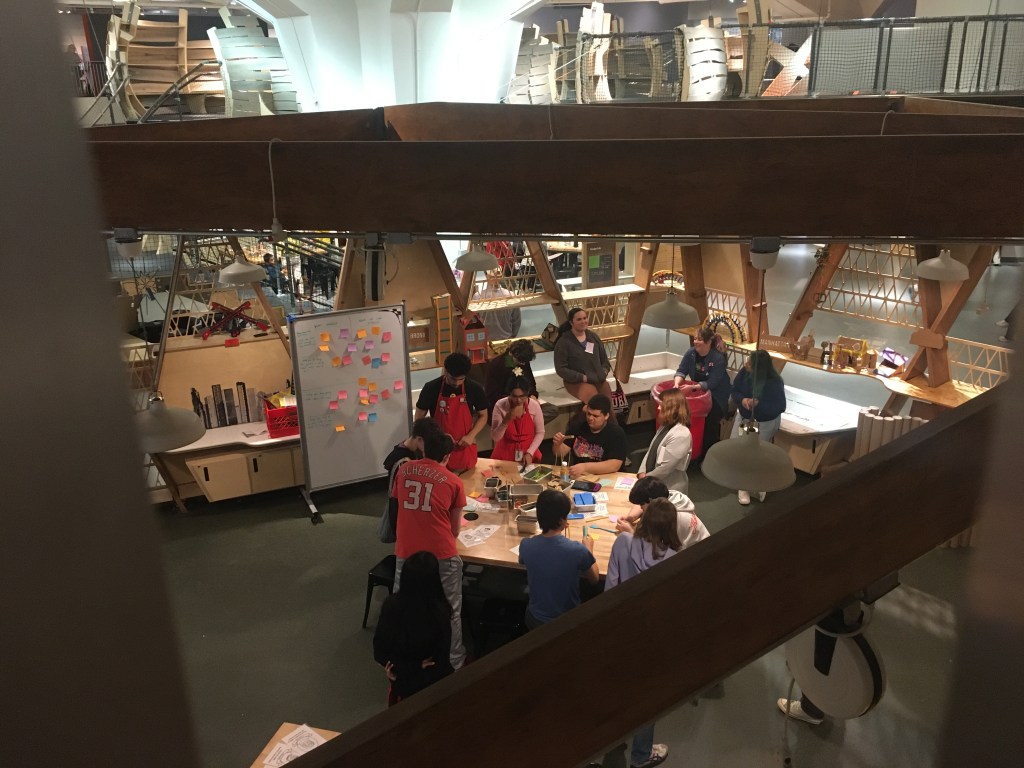
Teams broke up the design cycle, focusing on one step at a time. This made the process approachable for youth and manageable within short co-design sessions. In one meeting, teams might test an activity prototype and share their feedback, for example. In the next meeting, they might brainstorm possible improvements. Museum staff invited co-designers to share their ideas in whatever way they preferred—by writing or drawing, dictating ideas to a staff member, or talking to a partner.
The Resulting Activities
Co-design teams redesigned four activities:
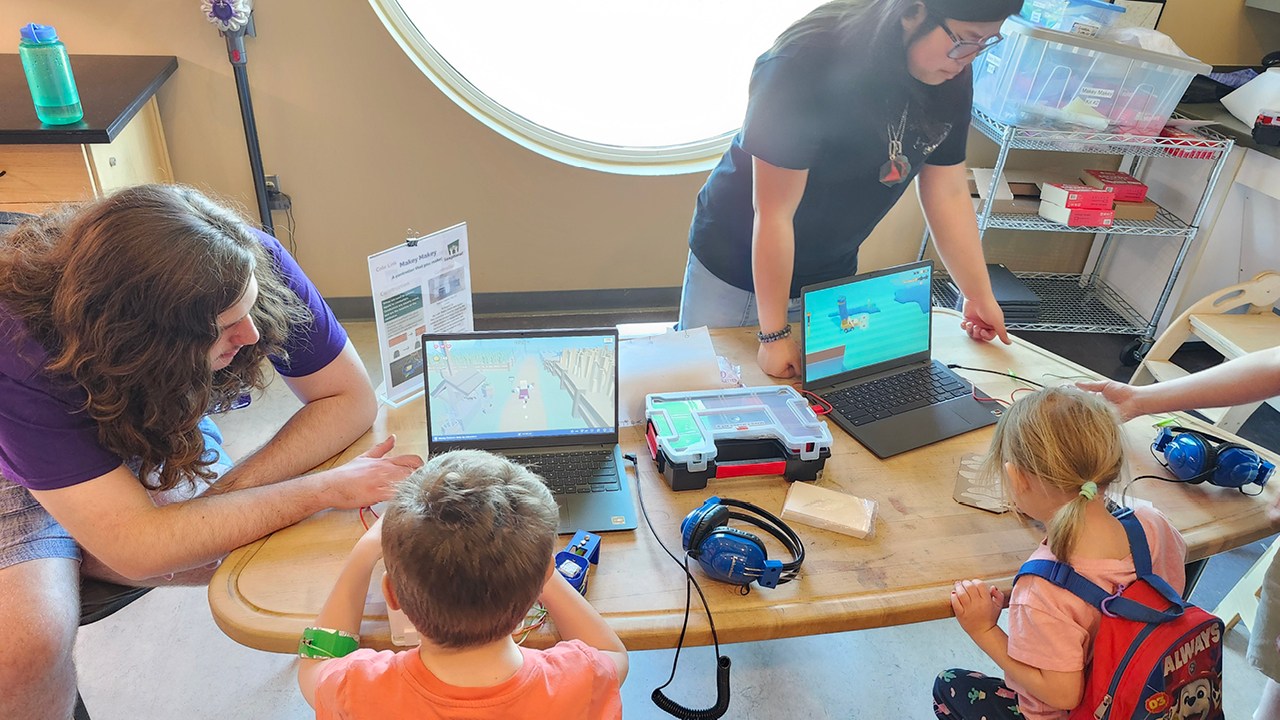
Makey Makey Video Game Controllers. In this activity, visitors use Makey Makeys (circuit boards that can use any conductive material as a computer interface) to design and build their own video game controllers. Co-designers created example controllers that visitors could test before deciding whether to make their own. Co-designers also facilitated this activity, providing individualized support and inviting visitors to test their controllers with two-player games. The team also added introductory circuit activities (like off-the-shelf circuit toys) to provide multiple entry points and ways of exploring circuits and conductive materials.
Balance Sculptures. Visitors use repurposed and familiar objects (like keys, wires, license plates, and scrap metal) to create a sculpture that can stay together using only gravity and balance. Co-designers created separate stations for gathering supplies and building, breaking up the activity into smaller steps and inviting exploration of the materials. They also created a large board with step-by-step instructions, an image of a simple sculpture, and suggested criteria for testing the design (such as trying to keep it standing for a certain amount of time).
Help Wanted. Visitors use a variety of familiar and repurposed materials to design an invention to help a fictional character solve a problem. To capture visitors’ interests and provide varying ways of approaching the activity, co-designers brainstormed both realistic characters (a chef whose kitchen is too hot or a student who needs to remember their assignments) and fantastical ones (a dragon with an itchy back or a mermaid who would like to meet new friends). The team also expanded the variety of available building materials to include more connectors (zip-ties, rubber bands, binder clips, and wires) and everyday objects (nuts and bolts, washers, chopsticks, plumbing hardware, kitchen utensils, wooden pegboard, and fabric cut in different shapes). The team also added a display area to invite visitors to leave their creations behind as inspiration for others.
Chain Reaction. Visitors create Rube Goldberg machines using ramps, balls, and everyday objects like sports equipment, VHS tapes, and electronic toys. To help visitors build or troubleshoot their designs, co-designers recommended short, visual signage describing key concepts (like potential energy), and tips for working with the materials (like how to keep pieces from moving while you build). They also brainstormed objects that could function in different ways (spinning, tilting, bouncing, or rolling), and the exhibits team found the objects they suggested at thrift stores or hardware stores and adjusted each item to make the pieces easier for visitors to connect together.
For each of these activities, researchers observed family groups with and without neurodivergent learners to test the hypothesis that centering autistic learners’ experiences would result in more accessible and engaging experiences for a broad audience of museum visitors. Researchers noted how families reacted to the adaptations the co-design teams made and whether these changes prompted or supported visitors in generating ideas, building, and/or testing and improving their designs. Families also completed surveys to rate how much they enjoyed the activities, whether they felt they had options that worked for them, and whether their group included a child with a learning difference like autism or ADHD.
Researchers found that UDL strategies supported and deepened visitors’ engagement, with no differences between groups with and without neurodivergent learners. The approaches were similarly beneficial for all.
Developing NUDL Guidelines
As teams developed the activities, museum staff, researchers, and evaluators met multiple times to compile co-designers’ recommendations and identify themes across the activities and sites. The project team also compared co-designers’ feedback with published UDL guidelines to create a framework that was grounded in UDL but tailored to museum environments and neurodiverse audiences. The final set of NUDL Guidelines includes four sections, reflecting the full arc of a visitor experience:
- Communicating goals and expectations: This section of the framework emphasizes helping visitors orient themselves and understand where and how to begin. Strategies include providing visitors with initial guidance through visuals and words, offering examples to show what’s possible, and introducing new tools or materials in low-pressure ways.
- Building autonomy: Co-design teams emphasized the importance of offering multiple ways of approaching an activity, providing a variety of materials, and encouraging learners to make choices (for example, by sorting materials into bins, providing different ways to get started, or suggesting multiple goals that learners can choose from).
- Sustaining engagement: Engaging activities often involve some challenge, and co-designers recommended helping learners persist by building on their interests, connecting to larger ideas (such as underlying STEM concepts or connections to everyday life), and breaking up complex tasks into smaller steps.
- Reflecting and transitioning: Wrapping up an activity and moving on to something else can be a challenge for many neurodivergent people. Prompting reflection, celebrating what learners do, and suggesting other activities to try next (either within the museum or at home) can ease these transitions.
Most importantly, the guidelines describe agency and belonging as a necessary foundation for every other aspect of museum experiences. For this to occur, museum staff need to work from an assumption that all learners will be different. Staff can embody this approach by making accommodations and options available to all visitors and actively encouraging visitors to adjust their learning experiences based on their preferences and needs. The NUDL Guidelines can be implemented in many different ways: through the physical design of the environment or materials, the goals or structure of an activity, facilitation by museum staff, and/or the structures for visitors to interact with and learn from one another.
The complete set of guidelines is available online as a free practitioner guidebook (see Resources on p. 30). The guidebook includes examples of what museums can change to create more neurodiversity-affirming experiences (even without extensive funding or time), tips for co-designing with neurodivergent youth, and printable tools that can guide reflective practice and iterative redesigns.
Museum experiences that integrate the NUDL Guidelines will give more visitors a chance to engage with concepts and practices, learn in ways that work for them, and leave with a sense of accomplishment and belonging. That is a win for everyone.
Resources
Neurodiversity and Universal Design for Learning: Practitioner Guidebook
CAST, Universal Design for Learning Guidelines, version 3.0, 2024
Judy Singer, NeuroDiversity: The Birth of an Idea, 2016
Susan Letourneau is Director of Informal Learning Research at the New York Hall of Science in Queens, New York, Wendy Martin is a Principal Research Scientist and Sam Tumolo is a Research Associate at Education Development Center (EDC).
The information in this article is based on work supported by the U.S. National Science Foundation under Grant No. 2313850. Any opinions, findings, conclusions or recommendations expressed in this material are those of the authors and do not necessarily reflect the views of the National Science Foundation.
Upcoming Events
-
-
Industry Showcase: Innovative Digital Solutions
Event Date: -
Getting Started in Local Advocacy
Event Date:Presented by: American Association for State and Local History (AASLH) -
Creative Museums Summit
Event Date:Presented by: MuseumNext